
About this book
Fogg bets his fortune he can circle the globe in eighty days. Verne's 1872 novel, French original, Hetzel edition, free to read online.
1V
IN WHICH PHILEAS FOGG ASTONISHES PASSEPARTOUT, HIS SERVANT
At seven twenty-five, Phileas Fogg, after having won about twenty guineas at whist, took leave of his honorable colleagues, and left the Reform-Club. At seven fifty, he opened the door of his house and returned home. Passepartout, who had conscientiously studied his program, was rather surprised on seeing Mr. Fogg, guilty of inexactness, appear at thisunusual hour.
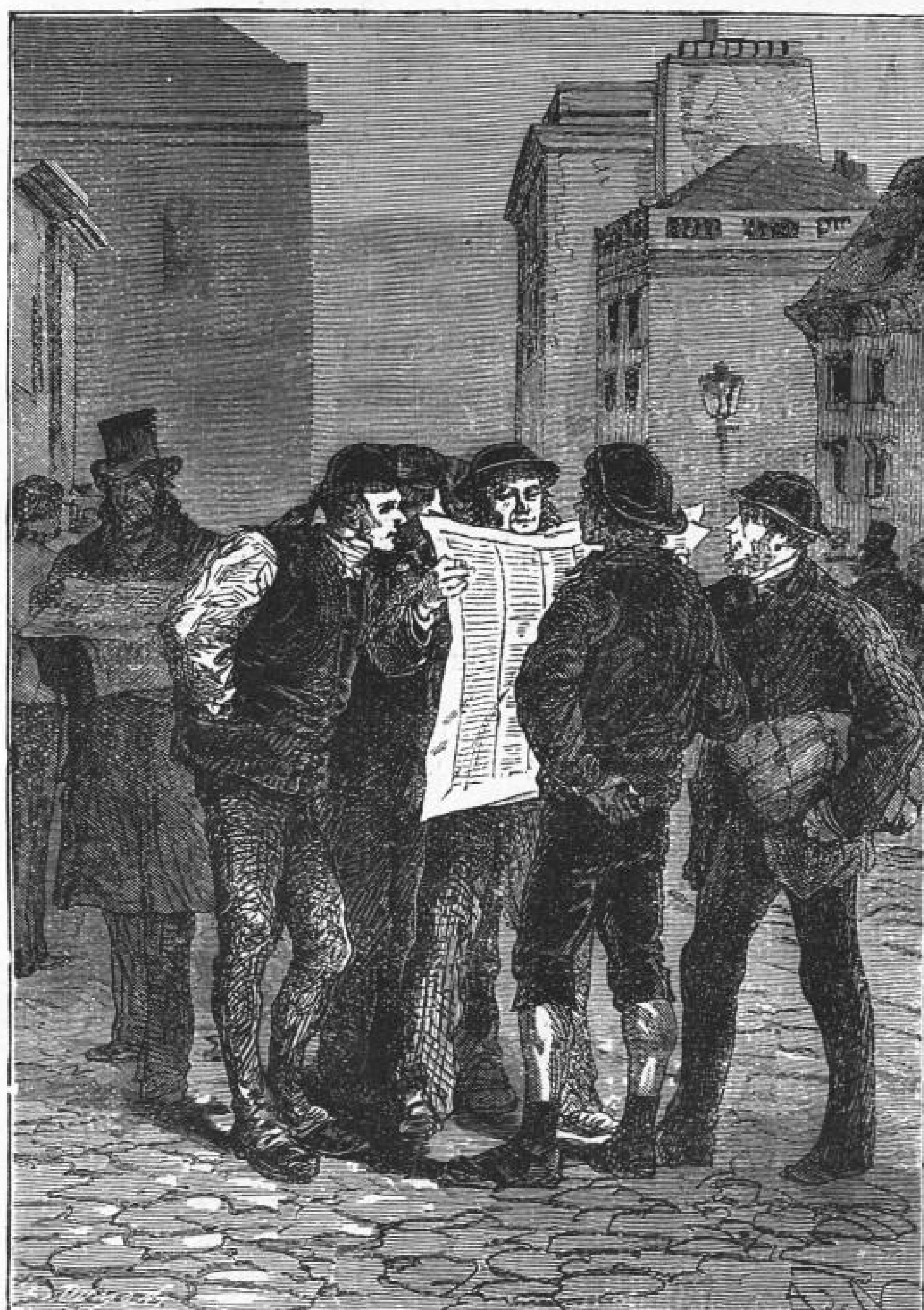
According to the notice, the tenant of Saville-row was not to return until precisely midnight.
Phileas Fogg had first gone up to his room, then he called:
"Passepartout."
Passepartout did not answer. This call could not be addressed to him. It was not the hour.
"Passepartout," resumed Mr. Fogg without raising his voice any further.
Passepartout appeared.
"It is the second time I have called you," said Mr. Fogg.
"But it is not midnight," replied Passepartout, watch in hand.
"I know it," resumed Phileas Fogg, "and I am not reproaching you. We are leaving in ten minutes for Dover and Calais."
A sort of grimace began to form on the round face of the Frenchman. It was evident that he had heard wrongly.
"Monsieur is going away?" he asked.
"Yes," replied Phileas Fogg. "We are going to make the tour of the world."
Passepartout, his eye opened immoderately wide, his eyelid and eyebrow raised, his arms slack, his body slumped, then presented all the symptoms of astonishment carried to the point of stupefaction.
"The tour of the world!" he murmured.
"In eighty days," replied Mr. Fogg. "Thus, we have not a moment to lose.
"But the trunks?..." said Passepartout, who was unconsciously shaking his head from right to left.
"No trunks. Only a night bag. In it, two woolen shirts, three pairs of stockings. As many for you. We will buy on the way. You will take down my mackintosh and my traveling blanket. Have good shoes. Besides, we will walk little or not at all. Go."
Passepartout would have liked to answer. He could not. He left Mr. Fogg's room, went up to his own, fell onto a chair, and, employing a rather vulgar phrase from his country:
"Ah well," said he to himself, "that one is a strong one!... I who wanted to remain quiet!..."
And, mechanically, he made his preparations for departure. The tour of the world in eighty days! Was he dealing with a madman? No... It was a joke? They were going to Dover, well. To Calais, so be it. After all, that could not notably upset the worthy fellow, who, for five years, had not trodden the soil of his homeland. Perhaps they would even go as far as Paris, and, upon my word, he would see the great capital again with pleasure. But, certainly, a gentleman so sparing of his steps would stop there... Yes, doubtless, but it was no less true that he was leaving, that he was moving about, this gentleman, so home-loving until then!
At eight o'clock, Passepartout had prepared the modest bag that contained his wardrobe and that of his master; then, his mind still troubled, he left his room, carefully closed the door, and rejoined Mr. Fogg.
Mr. Fogg was ready. Under his arm he carried the Bradshaw's Continental Railway Steam Transit and General Guide, which was to furnish him with all the information necessary for his journey. He took the bag from Passepartout's hands, opened it, and slipped into ita thick bundle of those fine banknotes that are current in every country.
"Have you forgotten nothing?" he asked.
"Nothing, sir."
"My mackintosh and my blanket?"
"Here they are."
"Good, take this bag."
Mr. Fogg handed the bag to Passepartout.
"And take good care of it," he added. "There are twenty thousand pounds in it (500,000 francs)."
The bag almost slipped from Passepartout's hands, as if the twenty thousand pounds had been in gold and weighed a considerable amount.
Master and servant then went downstairs, and the street door was locked with a double turn.
A cab stand was located at the end of Saville Row. Phileas Fogg and his servant got into a cab, which headed rapidly toward Charing Cross station, where one of the branches of the South-Eastern Railway terminates.
At eight twenty, the cab stopped before the gate of the station. Passepartout jumped to the ground. His master followed and paid the driver.
At that moment, a poor beggar woman, holding a child by the hand, barefoot in the mud, wearing a tattered hat from which hung a lamentable feather, a ragged shawl over her rags, approached Mr. Fogg and asked him for alms.
Mr. Fogg drew from his pocket the twenty guineas he had just won at whist, and, presenting them to the beggar woman:
"Here, my good woman," he said, "I am glad to have met you!" Then he passed on.
Passepartout felt something like a moisture around his eyes. His master had taken a step into his heart.
Mr. Fogg and he immediately entered the great hall of the station. There, Phileas Fogg gave Passepartout the order to take two first-class tickets for Paris. Then, turning around, he caught sight of his five colleagues from the Reform Club.
"Gentlemen, I am leaving," he said, "and the various visas affixed to a passport that I am taking with me for that purpose will allow you, upon my return, to check my itinerary."
— Oh! Mr. Fogg, replied Gauthier Ralph politely, that is unnecessary. We will trust to your honour as a gentleman!
— That is better so, said Mr. Fogg.
— You do not forget that you must be back?... observed Andrew Stuart.
— In eighty days, replied Mr. Fogg, on Saturday, December 21, 1872, at a quarter before nine in the evening. Good-bye, gentlemen."
At forty minutes past eight, Phileas Fogg and his servant took their places in the same compartment. At a quarter before nine a whistle sounded, and the train started.
The night was dark. A fine rain was falling. Phileas Fogg, leaning back in his corner, did not speak. Passepartout, still bewildered, mechanically pressed the bag of bank-notes to his breast.
But the train had not got beyond Sydenham when Passepartout uttered a veritable cry of despair!
"What is the matter?" asked Mr. Fogg.
— There is... that... in my haste... my confusion... I forgot...
— What?
— To turn off the gas-jet in my room!
— Well, my boy, replied Mr. Fogg coldly, it is burning at your expense!"