
About this book
Fogg bets his fortune he can circle the globe in eighty days. Verne's 1872 novel, French original, Hetzel edition, free to read online.
IN WHICH PHILEAS FOGG SIMPLY DOES HIS DUTY.
Three travelers, Passepartout included, had disappeared. Had they been killed in the struggle? Were they prisoners of the Sioux? It could not yet be known.
The wounded were quite numerous, but it was recognized that none had been mortally hit. One of the most seriously struck was Colonel Proctor, who had fought bravely and had been brought down by a bullet in the groin. He was transported to the station with other travelers whose condition required immediate care.
Mrs. Aouda was safe. Phileas Fogg, who had not spared himself, did not have a scratch. Fix was wounded in the arm, an insignificant wound. But Passepartout was missing, and tears flowed from the young woman's eyes.
Meanwhile all the travelers had left the train. The wheels of the cars were stained with blood. From the hubs and spokes hung shapeless shreds of flesh. As far as the eye could see over the white plain were long red trails. The last Indians were then disappearing to the south, toward Republican River.
Mr. Fogg, with his arms crossed, remained motionless. He had a grave decision to make. Mrs. Aouda, near him, looked at him without uttering a word... He
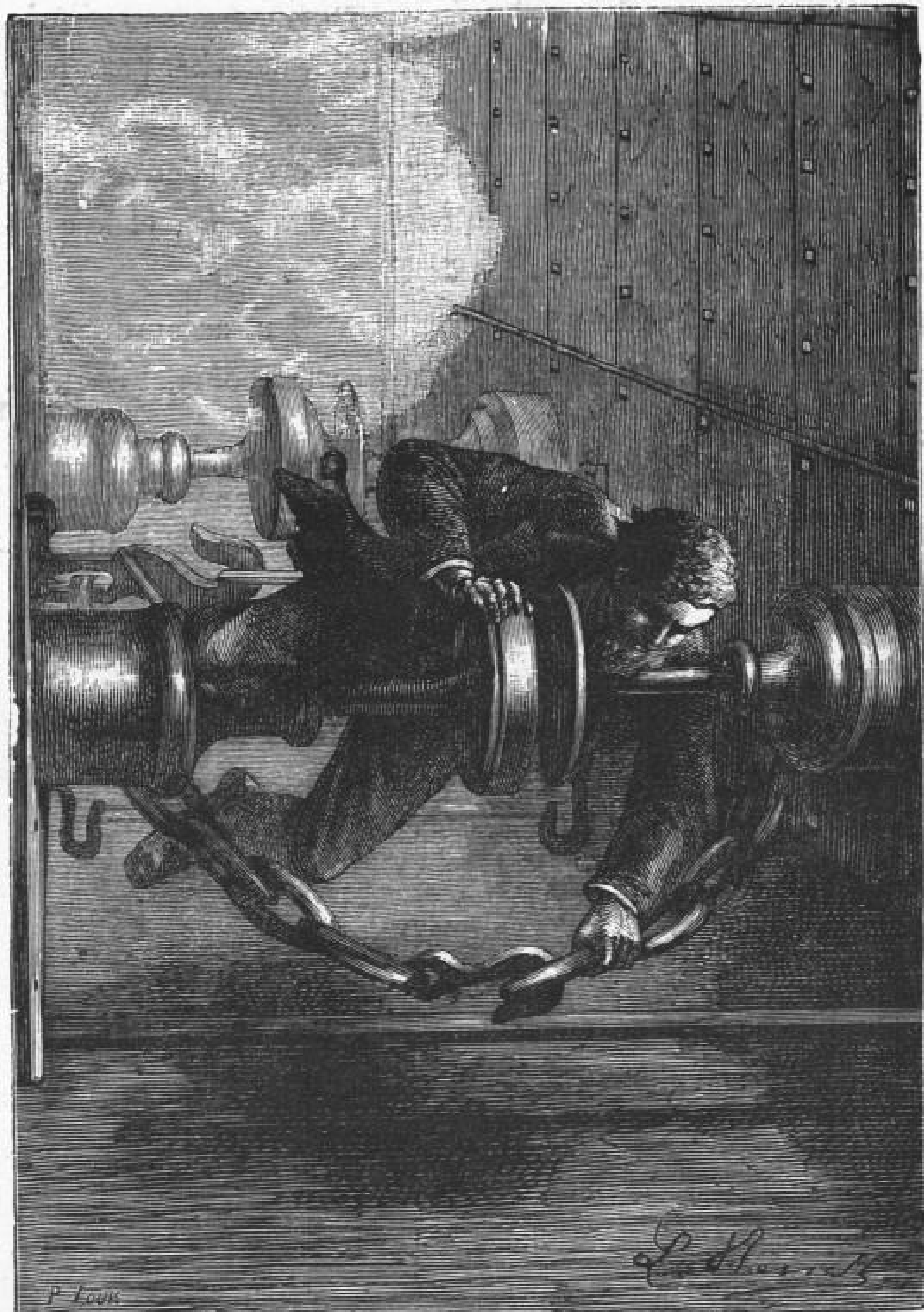
understood that look. If his servant was a prisoner, should he not risk everything to tear him from the Indians?...
"I will find him dead or alive," he said simply to Mrs. Aouda.
"Ah! sir... Mr. Fogg!" cried the young woman, seizing the hands of her companion and covering them with tears.
"Alive!" added Mr. Fogg, "if we do not lose a minute!"
By this resolution, Phileas Fogg was sacrificing himself entirely. He had just pronounced his ruin. A single day's delay would make him miss the steamer at New York. His bet was irrevocably lost. But before this thought: "It is my duty!" he had not hesitated.
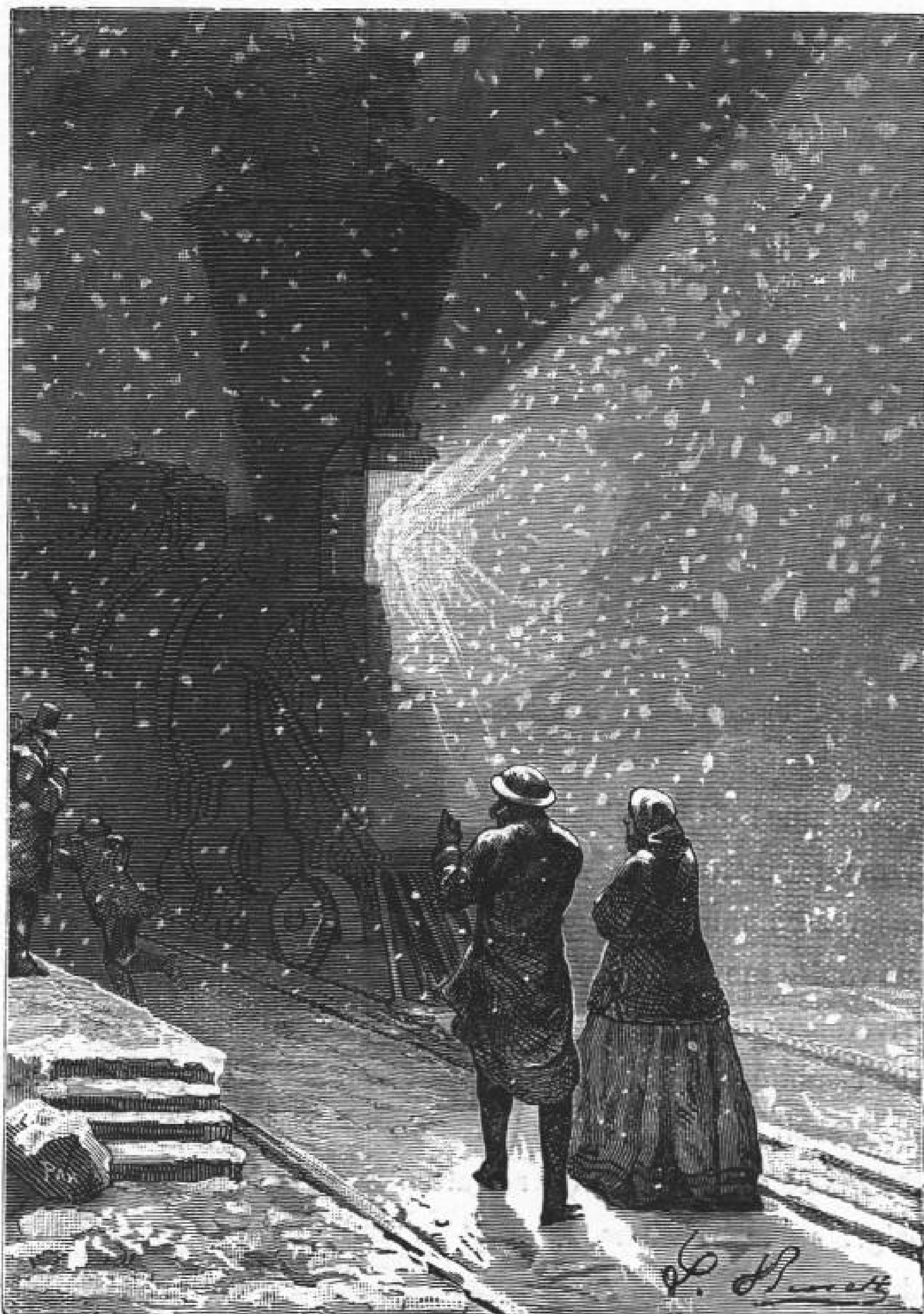
An enormous shadow, preceded by a tawny glow. (Page 178.)
The captain commanding Fort Kearney was there. His soldiers—about a hundred men—had gone on the defensive in case the Sioux should direct a direct attack against the station.
"Sir," said Mr. Fogg to the captain, "three travelers have disappeared."
"Dead?" asked the captain.
"Dead or prisoners," replied Phileas Fogg. "That is an uncertainty which must be resolved. Is it your intention to pursue the Sioux?"
"That is a serious matter, sir," said the captain. "These Indians can flee beyond the Arkansas! I cannot abandon the fort which is entrusted to me."
"Sir," resumed Phileas Fogg, "it is a question of the lives of three men."
"No doubt... but can I risk the lives of fifty to save three?"
"I do not know whether you can, sir, but you must."
"Sir," replied the captain, "no one here has to teach me what my duty is."
"So be it," said Phileas Fogg coldly. "I will go alone!"
"You, sir!" cried Fix, who had approached. "Go alone in pursuit of the Indians!"
"Do you then wish me to let perish this unfortunate man, to whom everything living here owes its life? I will go."
"Well, no, you will not go alone!" cried the captain, moved in spite of himself. "No! You are a brave heart!... Thirty volunteers!" he added, turning to his soldiers.
The whole company advanced in a body. The captain had only to choose among these brave men. Thirty soldiers were designated, and an old sergeant placed himself at their head.
"Thank you, captain!" said Mr. Fogg.
"Will you permit me to accompany you?" Fix asked the gentleman.
"You will do as you please, sir," Phileas Fogg replied. "But if you wish to do me a service, you will stay near Mrs. Aouda. In case misfortune should befall me..."
A sudden pallor spread over the police inspector's face. To separate himself from the man he had followed step by step with such persistence! To let him venture thus into the desert! Fix looked attentively at the gentleman, and, whatever he might feel, despite his prejudices, despite the struggle going on within him, he lowered his eyes before that calm and candid gaze.
"I will stay," he said.
A few moments later, Mr. Fogg had pressed the young woman's hand; then, after handing her his precious traveling bag, he set out with the sergeant and his small troop.
But before leaving, he had said to the soldiers:
"My friends, there is a thousand pounds for you if we save the prisoners!"
It was then a few minutes past noon.
Mrs. Aouda had withdrawn into a room in the station, and there, alone, she waited, thinking of Phileas Fogg, of that simple and great generosity, of that tranquil courage. Mr. Fogg had sacrificed his fortune, and now he was staking his life, all this without hesitation, out of duty, without speeches. Phileas Fogg was a hero in her eyes.
Inspector Fix, for his part, did not think so, and he could not contain his agitation. He paced feverishly along the station platform. For a moment subdued, he became himself again. Fogg gone, he understood the folly he had committed in letting him leave. What! This man whom he had just followed around the world, he had consented to separate himself from him! His nature regained the upper hand, he incriminated himself, he accused himself, he treated himself as if he had been the director of the metropolitan police, reprimanding an agent caught in the act of naivety.
"I have been inept!" he thought. "The other must have learned who I was! He has left, he will not return! Where to pick him up now? But how could I have let myself be so fascinated, I, Fix, I, who have his arrest warrant in my pocket! Decidedly I am nothing but a fool!"
Thus reasoned the police inspector, while the hours passed as slowly as he wished. He did not know what to do. Sometimes he had a mind to tell everything to Mrs. Aouda. But he understood how he would be received by the young woman. What course to take? He was tempted to set out across the long white plains in pursuit of this Fogg! It did not seem impossible to him to find him again. The steps of the detachment were still imprinted on the snow!... But soon, beneath a fresh layer, every trace was effaced.
Then discouragement took hold of Fix. He felt an insurmountable urge to abandon the game. And yet, precisely, this occasion to leave the station of Kearney and to pursue this journey, so fruitful in disappointments, was offered to him.
Indeed, toward two o'clock in the afternoon, while the snow was falling in large flakes, long whistles were heard coming from the east. An enormous shadow, preceded by a tawny glow, advanced slowly, considerably enlarged by the mists, which gave it a fantastic aspect.
However, no train from the east was yet expected. The aid called for by telegraph could not arrive so soon, and the train from Omaha to San Francisco was not due to pass until the next day. — They were soon enlightened.
This locomotive, which was moving at low steam, emitting great blasts of its whistle, was the one which, after having been detached from the train, had continued on its way with such frightful speed, carrying off the unconscious fireman and engineer. It had run along the rails for several miles; then the fire had died down for lack of fuel; the steam had slackened, and an hour later, gradually slowing its pace, the engine finally stopped twenty miles beyond the station of Kearney.
Neither the engineer nor the fireman had succumbed, and, after a rather prolonged faint, they had come to themselves.
The engine was then stopped. When he saw himself in the desert, the locomotive alone, having no more cars in its wake, the engineer understood what had happened. How the locomotive had been detached from the train, he could not guess, but it was not doubtful to him that the train, left behind, found itself in distress.
The engineer did not hesitate as to what he must do. To continue on the road toward Omaha was prudent; to return toward the train, which the Indians were perhaps still pillaging, was dangerous... No matter! Shovelfuls of coal and wood were thrust into the furnace of his boiler, the fire was rekindled, the pressure rose again, and, toward two o'clock in the afternoon, the engine was returning backward toward the station of Kearney. It was this engine that was whistling in the mist.
It was a great satisfaction for the travelers when they saw the locomotive take its place at the head of the train. They were going to be able to continue this journey so unfortunately interrupted.
At the arrival of the engine, Mrs. Aouda had left the station, and addressing the conductor:
"You are going to leave?" she asked him.
"This instant, madam."
"But these prisoners... our unfortunate companions..."
"I cannot interrupt the service," replied the conductor. "We are already three hours late."
"And when will the other train from San Francisco pass?"
"Tomorrow evening, madam."
"Tomorrow evening! But it will be too late. We must wait..."
"It is impossible," replied the conductor. "If you wish to leave, get into a car."
"I will not leave," replied the young woman.
Fix had heard this conversation. A few moments earlier, when he had lacked any means of locomotion, he had been determined to leave Kearney, and now that the train was there, ready to start, and he had only to take his place again in the car, an irresistible force held him to the ground. That station platform burned his feet, and he could not tear himself away from it. The struggle was beginning again within him. The anger of failure was stifling him. He wanted to fight to the end.
Meanwhile the travelers and a few of the wounded—among them Colonel Proctor, whose condition was serious—had taken their places in the cars. The humming of the overheated boiler could be heard, and steam escaped through the valves. The engineer sounded his whistle, the train started, and soon disappeared, mingling its white smoke with the whirlwind of snow.
Inspector Fix had remained behind.
Several hours passed. The weather was very bad, the cold very sharp. Fix, seated on a bench in the station, remained motionless. One might have thought he was asleep. Mrs. Aouda, despite the squall, left every moment the room that had been placed at her disposal. She came to the end of the platform, seeking to see through the snowstorm, wanting to pierce that mist which narrowed the horizon around her, listening for any sound that might be heard. But nothing. She would then go back in, chilled through, only to return a few moments later, and always in vain.
Evening came. The small detachment had not returned. Where was it at that moment? Had it been able to rejoin the Indians? Had there been a struggle, or were those soldiers, lost in the mist, wandering at random? The captain of Fort Kearney was very uneasy, although he did not wish to let any of his uneasiness show.
Night came, the snow fell less heavily, but the intensity of the cold increased. The most intrepid eye would not have contemplated without terror that obscure immensity. An absolute silence reigned over the plain. Neither the flight of a bird nor the passing of a wild beast disturbed its infinite calm.
Throughout that whole night, Mrs. Aouda, her mind full of sinister forebodings, her heart filled with anguish, wandered along the edge of the prairie. Her imagination carried her far away and showed her a thousand dangers. What she suffered during those long hours could not be expressed.
Fix still stood motionless in the same spot, but he, too, was not asleep. At a certain moment, a man had approached him and even spoken to him, but the officer had sent him away after answering his words with a negative sign.
The night passed thus. At dawn, the half-extinguished disk of the sun rose over a misty horizon. However, the range of vision could extend to a distance of two miles. It was toward the south that Phileas Fogg and the detachment had headed... The south was absolutely deserted. It was then seven o'clock in the morning.
The captain, extremely worried, did not know what course to take. Should he send a second detachment to the rescue of the first? Should he sacrifice new men with so little chance of saving those who had been sacrificed first? But his hesitation did not last, and with a gesture, summoning one of his lieutenants, he gave him the order to push a reconnaissance to the south—when shots rang out. Was it a signal? The soldiers rushed out of the fort, and at half a mile they caught sight of a small troop returning in good order.
;
Mr. Fogg walked at the head, and near him Passepartout and the two other travelers, torn from the hands of the Sioux.
There had been a fight ten miles south of Kearney. A few moments before the arrival of the detachment, Passepartout and his two companions were already struggling against their captors, and the Frenchman had knocked out three of them with his fists, when his master and the soldiers rushed to their rescue.
All, the rescuers and the rescued, were welcomed with cries of joy, and Phileas Fogg distributed to the soldiers the bonus he had promised them, while Passepartout kept repeating, not without some reason:
"Decidedly, I must admit that I cost my master dearly!"
Fix, without uttering a word, looked at Mr. Fogg, and it would have been difficult to analyze the impressions then battling within him. As for Mrs. Aouda, she had taken the gentleman's hand, and she clutched it in hers, unable to utter a word!
Meanwhile Passepartout, upon his arrival, had looked for the train in the station. He believed he would find it there, ready to speed off to Omaha, and he hoped that they could still make up for lost time.
"The train, the train!" he cried out.
"Gone," replied Fix.
"And the next train, when will it pass?" asked Phileas Fogg.
"This evening only."
"Ah!" replied the impassive gentleman simply.