
About this book
Fogg bets his fortune he can circle the globe in eighty days. Verne's 1872 novel, French original, Hetzel edition, free to read online.
XVII
IN WHICH MATTERS AND OTHER THINGS ARE DISCUSSED DURING THE PASSAGE FROM SINGAPORE TO HONG KONG.
From that day, Passepartout and the detective met frequently, but the agent kept himself in extreme reserve toward his companion, and he did not try to make him talk. Only once or twice did he glimpse
:
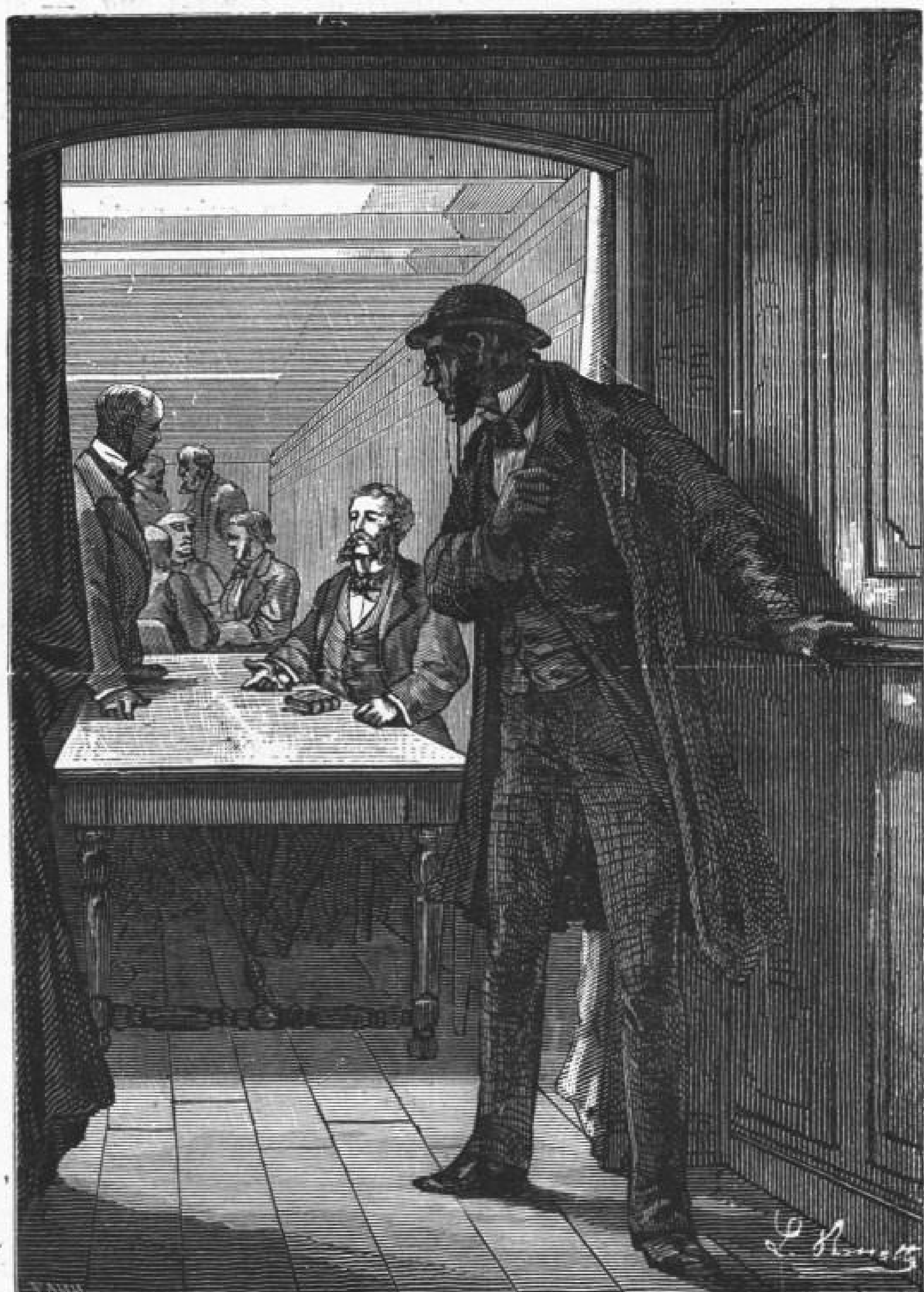
Mr. Fogg, who willingly stayed in the grand saloon of the Rangoon, either keeping Mrs. Aouda company or playing whist, according to his invariable habit.
As for Passepartout, he had begun very seriously to ponder the singular chance that had once again put Fix on his master's route. And indeed, one would have been surprised at less. This gentleman, very amiable, very obliging to be sure, whom one meets first at Suez, who embarks on the Mongolia, who disembarks at Bombay, where he says he must stay, whom one finds again on the Rangoon, making course for Hong Kong—in a word, following Mr. Fogg's itinerary step by step—that was worth reflecting upon. There was in it a coinci
dence at least bizarre. What was this Fix after? Passepartout was ready to wager his slippers—he had carefully kept them—that Fix would leave Hong Kong at the same time as they did, and probably on the same steamer.
Passepartout might have reflected for a century without ever guessing what mission the agent had been charged with. Never would he have imagined that Phileas Fogg was being "shadowed," in the manner of a thief, around the terrestrial globe. But as it is in human nature to give an explanation to everything, here is how Passepartout, suddenly enlightened, interpreted Fix's permanent presence, and truly, his interpretation was quite plausible. Indeed, according to him, Fix was and could only be an agent launched on Mr. Fogg's trail by his colleagues of the Reform-Club, in order to verify that this journey was being accomplished regularly around the world, according to the agreed itinerary.
"It is obvious! it is obvious!" repeated the honest fellow, quite proud of his perspicacity. "It is a spy that these gentlemen have set on our heels! That is not worthy! Mr. Fogg so upright, so honorable! To have him watched by an agent! Ah! gentlemen of the Reform-Club, that will cost you dear!"
Passepartout, delighted with his discovery, nevertheless resolved to say nothing of it to his master, fearing that the latter might be precisely wounded by this distrust shown him by his adversaries. But he firmly promised himself to tease Fix on occasion, in veiled words and without compromising himself.
On Wednesday, October 30, in the afternoon, the Rangoon entered the Strait of Malacca, which separates the peninsula of that name from the lands of Sumatra. Very steep, very picturesque mountainous islets hid the view of the great island from the passengers.
The next day, at four o'clock in the morning, the Rangoon, having gained half a day on its regulation passage, put in at Singapore, in order to renew its supply of coal.
Phileas Fogg entered this gain in the column of profits, and this time he went ashore, accompanying Mrs. Aouda, who had expressed the desire to walk about for a few hours.
Fix, to whom every action of Fogg appeared suspect, followed him without letting himself be seen. As for Passepartout, who laughed in petto at seeing Fix's maneuver, he went to make his usual purchases.
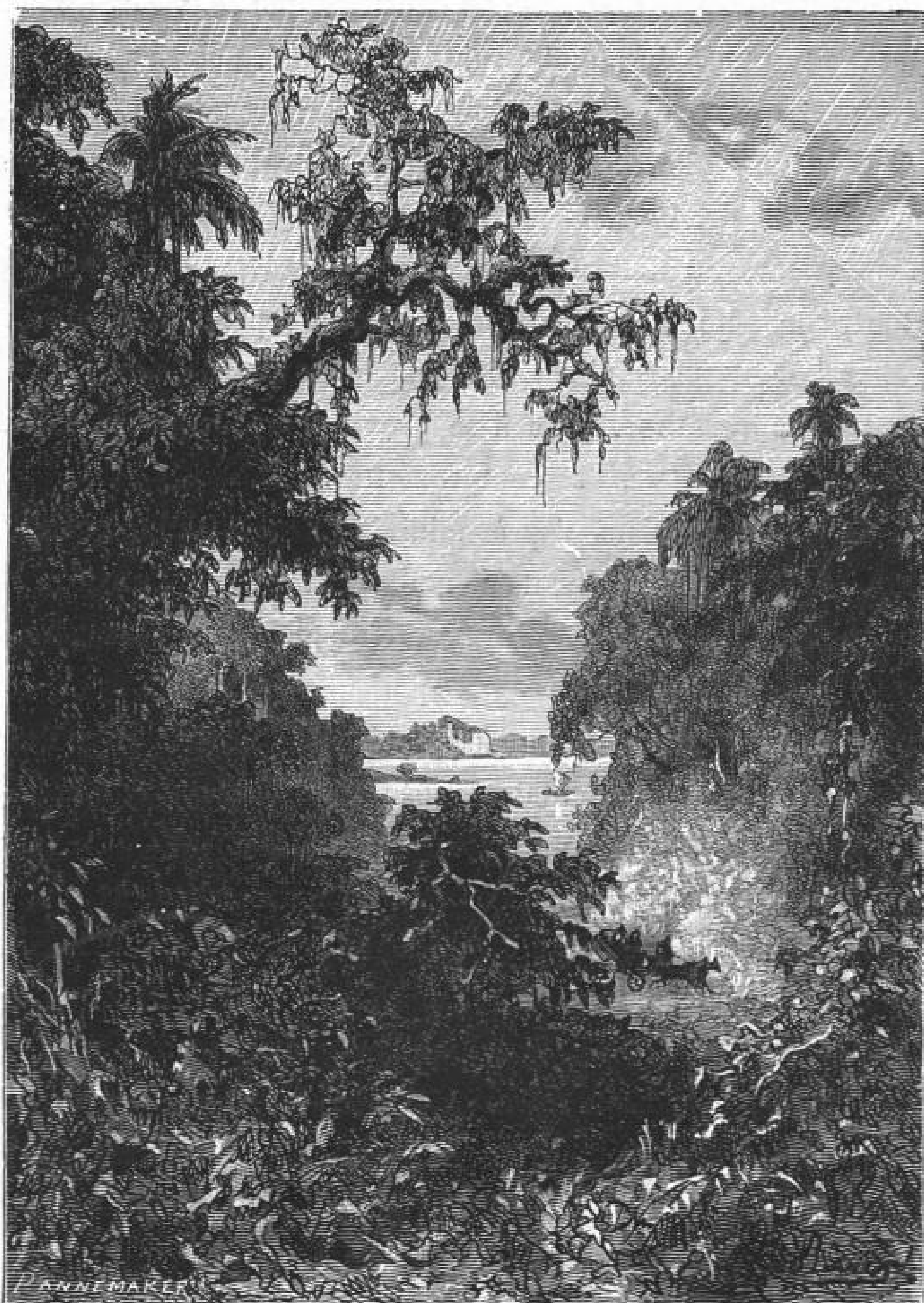
The island of Singapore is neither large nor imposing in aspect. Mountains, that is to say profiles, are lacking. However, it is charming in its leanness. It is a park cut through by fine roads. A pretty carriage, harnessed to those elegant horses that have been imported from New Holland, transported Mrs. Aouda and Phileas Fogg amid clumps of palms with brilliant foliage, and of clove trees whose nails are formed from the very bud of the half-opened flower. There, bushes of pepper plants replaced the thorny hedges of European countryside; sago trees, great ferns with their superb fronds, varied the aspect of this tropical region; nutmeg trees with varnished foliage saturated the air with a penetrating perfume. Monkeys, alert and grimacing bands, were not lacking in the woods, nor perhaps tigers in the jungles. To anyone who would be astonished to learn that on this island, relatively so small, these terrible carnivores had not been destroyed to the last one, it will be answered that they come from Malacca, crossing the strait by swimming.
After having traveled through the countryside for two hours, Mrs. Aouda and her companion—who looked a little without seeing—returned to the town, a vast agglomeration of heavy and crushed houses, surrounded by charming gardens where grow mangoes, pineapples, and all the best fruits in the world.
At ten o'clock, they returned to the steamer, after having been followed, without suspecting it, by the inspector, who had also had to go to the expense of a carriage.
Passepartout was waiting for them on the deck of the Rangoon. The brave fellow had bought a few dozen mangoes, as big as average apples, dark brown on the outside, bright red on the inside, and whose white flesh, melting between the lips, procures for true gourmets an unequaled pleasure. Passepartout was only too happy to offer them to Mrs. Aouda, who thanked him with much grace.
At eleven o'clock, the Rangoon, having her full load of coal, cast off her moorings, and a few hours later the passengers lost sight of those high mountains of Malacca, whose forests shelter the finest tigers on earth.
About thirteen hundred miles separate Singapore from the island of Hong Kong, a small English territory detached from the Chinese coast. Phileas Fogg had an interest in covering them in six days at most, in order to take at Hong Kong the ship that was to leave on November 6 for Yokohama, one of the principal ports of Japan.
The Rangoon was heavily loaded. Numerous passengers had embarked at Singapore—Indians, Ceylonese, Chinese, Malays, Portuguese—most of whom occupied the second-class places.
The weather, fairly fine until then, changed with the last quarter of the moon. There was a heavy sea. The wind sometimes blew as a strong breeze, but very fortunately from the southeast, which favored the steamer's progress. When it was manageable, the captain had the sails set. The Rangoon, rigged as a brig, often sailed with her two topsails and her forecourse, and her speed increased under the double action of steam and wind. It was thus that they coasted along, over a short and sometimes very tiring swell, the shores of Annam and Cochinchina.
But the fault lay rather with the Rangoon than with the sea, and it was to this steamer that the passengers, most of whom were seasick, had to attribute this fatigue.
Indeed, the vessels of the Peninsular Company, which run the service of the China seas, have a serious defect in construction. The ratio of their draft when loaded to their depth in hold has been badly calculated, and consequently they offer only a feeble resistance to the sea. Their closed volume, impervious to water, is insufficient. They are "drowned," to use the maritime expression, and in consequence of this disposition, only a few seas, thrown on board, are needed to alter their trim. These vessels are therefore very inferior—if not in engine and boiler apparatus, at least in construction—to the types of the French Messageries, such as the Impératrice and the Cambodge. Whereas, according to the calculations of engineers, the latter can take on a weight of water equal to their own weight before sinking, the boats of the Peninsular Company, the Golgonda, the Corea, and finally the Rangoon, could not take on a sixth of their weight without going to the bottom.
Therefore, in bad weather, great precautions had to be taken. Sometimes it was necessary to heave to under easy steam. It was a loss of time which did not appear to affect Phileas Fogg in any way, but with which Passepartout showed himself extremely irritated. He then blamed the captain, the engineer, the Company, and sent to the devil all those who meddle in transporting travelers. Perhaps also the thought of that gas burner which continued to burn at his expense in the house in Saville-row entered greatly into his impatience.
"But you must be in a great hurry to reach Hong Kong?" the detective asked him one day.
"Very much in a hurry!" replied Passepartout.
"You think Mr. Fogg is eager to take the Yokohama steamer?"
"An frightful eagerness."
"So you now believe in this singular journey around the world?"
"Absolutely. And you, Mr. Fix?"
"I? I don't believe it!"
"Joker!" replied Passepartout, winking.
This word left the agent thoughtful. This epithet worried him, without his quite knowing why. Had the Frenchman guessed it? He did not quite know what to think. But his quality as a detective, of which he alone had the secret, how could Passepartout have recognized it? And yet, in speaking to him thus, Passepartout had certainly had a hidden thought.
It even happened that the worthy fellow went further, another day, but that was stronger than he was. He could not hold his tongue.
"Come now, Mr. Fix," he asked his companion in a mischievous tone, "once we arrive at Hong Kong, shall we have the misfortune of leaving you there?
"
"Why," replied Fix, rather embarrassed, "I don't know!... Perhaps...
"Ah!" said Passepartout, "if you accompanied us, it would be a happiness for me! Come now! an agent of the Peninsular Company could not stop along the way! You were only going to Bombay, and here you are soon in China! America is not far, and from America to Europe it is only a step!"
Fix looked attentively at his interlocutor, who showed him the most amiable face in the world, and he decided to laugh with him. But the latter, who was in fine form, asked him if "that trade brought him in a great deal?"
"Yes and no," replied Fix without flinching. "There are good and bad deals. But you understand well that I do not travel at my own expense!"
"Oh! as for that, I am sure of it!" cried Passepartout, laughing more than ever.
The conversation over, Fix returned to his cabin and began to reflect. He was evidently found out. In one way or another, the Frenchman had recognized his quality as a detective. But had he warned his master? What role was he playing in all this? Was he an accomplice or not? Was the affair blown, and consequently ruined? The agent spent a few difficult hours there, sometimes believing all lost, sometimes hoping that Fogg was ignorant of the situation, finally not knowing what course to take.
However, calm was restored in his brain, and he resolved to act frankly with Passepartout. If he did not find himself in the conditions required to arrest Fogg at Hong Kong, and if Fogg was preparing to leave English territory definitively this time, he, Fix, would tell everything to Passepartout. Either the servant was the accomplice of his master—and the latter knew everything, and in that case the affair was definitively compromised—or the servant had nothing to do with the theft, and then his interest would be to abandon the thief.
Such was therefore the respective situation of these two men, and above them Phileas Fogg hovered in his majestic indifference. He was rationally accomplishing his orbit around the world, without worrying about the asteroids gravitating around him.
And yet, in the vicinity, there was—to use the expression of astronomers—a disturbing star which should have produced certain perturbations on the heart of this gentleman. But no! The charm of Mrs. Aouda did not act, to the great surprise of Passepartout, and the perturbations, if they existed, would have been more difficult to calculate than those of Uranus which led to the discovery of Neptune.
Yes! it was a daily astonishment for Passepartout, who read so much gratitude toward his master in the young woman's eyes! Decidedly Phileas Fogg had only as much heart as was needed to conduct himself heroically, but amorously, no! As for the preoccupations that the chances of this journey might arouse in him, there was no trace of them. But Passepartout, he lived in continual anguish. One day, leaning on the railing of the "engine-room," he was watching the powerful machine which sometimes ran away, when, in a violent pitching movement, the propeller raced madly out of the water. The steam then hissed through the valves, which provoked the anger of the worthy fellow.
"They are not loaded enough, these valves!" he cried. "We are not moving! There are those English for you! Ah! if it were an American ship, we might blow up perhaps. But we would go faster!"