
About this book
Fogg bets his fortune he can circle the globe in eighty days. Verne's 1872 novel, French original, Hetzel edition, free to read online.
XX
IN WHICH FIX ENTERS DIRECTLY INTO RELATIONS WITH PHILEAS FOGG.
During this scene, which was perhaps about to compromise his future so gravely, Mr. Fogg, accompanying Mrs. Aouda, was walking through the streets of the English town. Since Mrs. Aouda had accepted his offer to conduct her to Europe, he had had to think of all the details that so long a journey entails. That an Englishman like him should make the tour of the world with a bag in his hand was all very well; but a woman could not undertake such a crossing under those conditions. Hence the necessity of buying the clothes and objects needed for the journey. Mr. Fogg acquitted himself of his task with the calm that characterized him, and to all the excuses or objections of the young widow, confused by so much complaisance:
"It is in the interest of my journey, it is in my programme," he invariably replied.
The purchases made, Mr. Fogg and the young woman returned to the hotel and dined at the table d'hôte, which was sumptuously served. Then Mrs. Aouda, a little tired, went back up to her apartment, after having "in the English fashion" shaken hands with her imperturbable rescuer.
The honorable gentleman, for his part, absorbed himself throughout the evening in reading the Times and the Illustrated London News.
If he had been a man to be astonished at anything, it would have been at not seeing his servant appear at bedtime. But, knowing that the steamer from Yokohama was not to leave Hong Kong before the next morning, he did not concern himself otherwise. The next day, Passepartout did not come at Mr. Fogg's ring.
. . .
What the honorable gentleman thought upon learning that his servant had not returned to the hotel, no one could have said. Mr. Fogg contented himself with taking his bag, sent word to Mrs. Aouda, and sent for a palanquin.
It was then eight o'clock, and high tide, which the Carnatic was to take advantage of to leave the passes, was indicated for half past nine.
When the palanquin arrived at the door of the hotel, Mr. Fogg and Mrs. Aouda got into this comfortable vehicle, and the luggage followed behind on a wheelbarrow.
Half an hour later, the travelers were descending onto the embarkation quay, and there Mr. Fogg learned that the Carnatic had left the day before.
Mr. Fogg, who had counted on finding both the steamer and his servant, was reduced to doing without one and the other. But no mark of disappointment appeared on his face, and as Mrs. Aouda looked at him with uneasiness, he contented himself with replying:
"It is an incident, madam, nothing more."
At that moment, a personage who was observing him attentively approached him. It was Inspector Fix, who greeted him and said:
"Are you not, like me, sir, one of the passengers of the Rangoon, which arrived yesterday?"
"Yes, sir," coldly replied Mr. Fogg, "but I have not the honor..."
"Forgive me, but I thought I would find your servant here."
"Do you know where he is, sir?" asked the young woman eagerly.
"What!" replied Fix, feigning surprise, "is he not with you?"
"No," replied Mrs. Aouda. "Since yesterday, he has not reappeared. Could he have embarked without us on board the Carnatic?"
"Without you, madam?..." replied the agent. "But, excuse my question, you were counting then on leaving on that steamer?"
"Yes, sir."
"I too, madam, and you see me very disappointed. The Carnatic, having completed its repairs, left Hong Kong twelve hours earlier without warning anyone, and now we shall have to wait eight days for the next departure!"
In pronouncing these words: "eight days," Fix felt his heart leap with joy. Eight days! Fogg detained eight days in Hong Kong! There would be time to receive the arrest warrant. At last, fortune was declaring itself for the representative of the law.
Let one judge, then, of the stunning blow he received when he heard Phileas Fogg say in his calm voice:
"But there are other ships besides the Carnatic, it seems to me, in the port of Hong Kong."
And Mr. Fogg, offering his arm to Mrs. Aouda, directed his steps toward the docks in search of a ship about to sail.
Fix, dumbfounded, followed. One would have said that a thread attached him to this man.
However, fortune seemed truly to abandon the man whom it had served so well until then. Phileas Fogg, for three hours, traversed the port in every direction, decided, if need be, to charter a vessel to transport him to Yokohama; but he saw only ships loading or unloading, and which, consequently, could not set sail. Fix began to hope again.
Meanwhile Mr. Fogg did not lose his composure, and he was going to continue his search, even if he had to push on to Macao, when he was accosted by a sailor on the outer harbor.
"Your Honor is looking for a boat?" the sailor said to him, uncovering himself.
"You have a boat ready to leave?" asked Mr. Fogg.
"Yes, Your Honour, a pilot-boat, No. 43, the best in the fleet."
"Is she a good sailer?"
"Between eight and nine knots close-hauled. Do you wish to see her?"
"Yes."
"Your Honour will be satisfied. Is this a pleasure trip?"
"No. A voyage."
"A voyage?"
"Will you undertake to take me to Yokohama?"
At these words the sailor stood with his arms hanging down, his eyes wide open.
"Your Honour is joking?" said he.
"No! I have missed the start of the Carnatic, and I must be at Yokohama by the 14th at the latest, to catch the San Francisco steamer."
"I am sorry," replied the pilot, "but it is impossible."
"I offer you one hundred pounds (£2,500) a day, and a bonus of two hundred pounds if I arrive in time."
"Is this serious?" asked the pilot.
"Very serious," replied Mr. Fogg.
The pilot had withdrawn to one side. He looked at the sea, evidently torn between the desire to earn an enormous sum and the fear of venturing so far. Fix was in mortal agonies.
Meanwhile Mr. Fogg had turned back to Mrs. Aouda.
"You will not be afraid, madam?" he asked her.
“With you? No, Mr. Fogg,” replied the young woman.
The pilot had again stepped toward the gentleman and was turning his hat between his hands.
“Well, pilot?” said Mr. Fogg.
“Well, Your Honor,” replied the pilot, “I cannot risk my men, myself, or you either, in so long a passage on a boat of barely twenty tons, and at this time of year. Besides, we would not arrive in time, for it is sixteen hundred and fifty miles from Hong Kong to Yokohama.”
“Sixteen hundred only,” said Mr. Fogg.
“It is the same thing.”
Fix took a deep breath of air.
“But,” added the pilot, “there might perhaps be a way of arranging things differently.”
Fix stopped breathing.
“How?” asked Phileas Fogg.
“By going to Nagasaki, at the southern tip of Japan, eleven hundred miles, or only to Shanghai, eight hundred miles from Hong Kong. On that last passage, we would not go far from the Chinese coast, which would be a great advantage, especially since the currents there carry northward.”
“Pilot,” replied Phileas Fogg, “it is at Yokohama that I must catch the American mail steamer, not at Shanghai or Nagasaki.”
“Why not?” replied the pilot. “The San Francisco steamer does not leave from Yokohama. It calls at Yokohama and Nagasaki, but its port of departure is Shanghai.”
“Are you certain of what you are saying?”
“Certain.”
“And when does the steamer leave Shanghai?”
“On the 11th, at seven in the evening. We therefore have four days ahead of us. Four days is ninety-six hours, and with an average of eight miles an hour, if we are well served, if the wind holds from the southeast, if the sea is calm, we can cover the eight hundred miles that separate us from Shanghai.”
“And you could leave?...”
“In an hour. Just the time to buy provisions and get under way.”
“Agreed ... You are the master of the boat?”
“Yes, John Bunsby, master of the Tankadère.”
“Do you want a deposit?”
“If it does not displease Your Honor.”
“Here are two hundred pounds on account.... Sir,” added Phileas Fogg, turning to Fix, “if you wish to take advantage...”
“Sir,” Fix answered resolutely, “I was going to ask you for that favor.”
“Good. In half an hour we shall be on board.”
“But that poor boy...” said Mrs. Aouda, whom Passepartout’s disappearance greatly worried.
“I shall do for him all that I can do,” replied Phileas Fogg.
And while Fix, nervous, feverish, and furious, made his way to the pilot boat, the two others headed for the Hong Kong police offices. There Phileas Fogg gave Passepartout’s description and left a sufficient sum to bring him home. The same formality was completed at the French consular agent’s, and the palanquin, after stopping at the hotel, where the baggage was collected, brought the travelers back to the outer harbor.
Three o’clock was striking. Pilot boat No. 43, with its crew on board and its provisions loaded, was ready to get under way.
The Tankadère was a charming little twenty-ton schooner, very sharp in the bow, very free in her lines, very long in her waterlines. One would have called her a racing yacht. Her shining brasswork, her galvanized iron fittings, her deck as white as ivory, showed that Master John Bunsby knew how to keep her in good condition. Her two masts leaned slightly aft. She carried a brigantine, a mainsail, a fore-staysail, jibs, and topsails, and could set a spread of canvas for a following wind. She must have sailed wonderfully, and in fact she had already won several prizes in pilot-boat “matches.”
The crew of the Tankadère consisted of Master John Bunsby and four men. They were those hardy sailors who, in all weathers, venture out in search of ships and know those seas admirably. John Bunsby, a man of about forty-five, vigorous, tanned black by the sun, with a keen gaze, an energetic face, well balanced, thoroughly at home in his work, would have inspired confidence in the most fearful.
Phileas Fogg and Mrs. Aouda went on board. Fix was already there. Through the
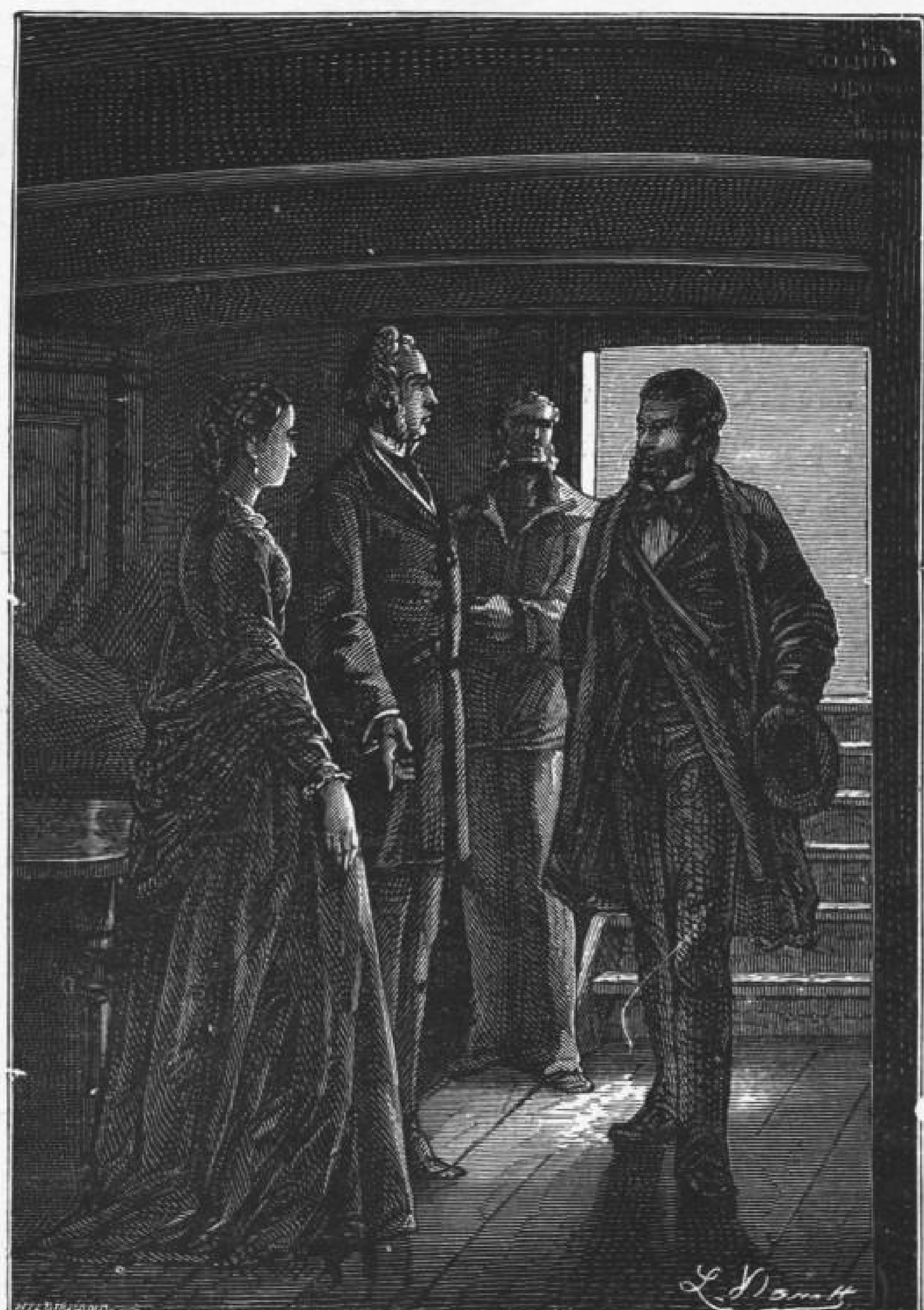
schooner’s after hatch, one went down into a square cabin whose walls curved inward in the shape of frames above a circular couch. In the middle, a table was lit by a swinging lamp. It was small, but clean.
“I regret not having anything better to offer you,” said Mr. Fogg to Fix, who bowed without answering.
The police inspector felt a sort of humiliation at thus taking advantage of Mr. Fogg’s obligingness.
“To be sure,” he thought, “he is a very polite scoundrel, but he is a scoundrel!”
At ten minutes past three, the sails were hoisted. The English flag fluttered at the schooner’s peak. The passengers were seated on deck.
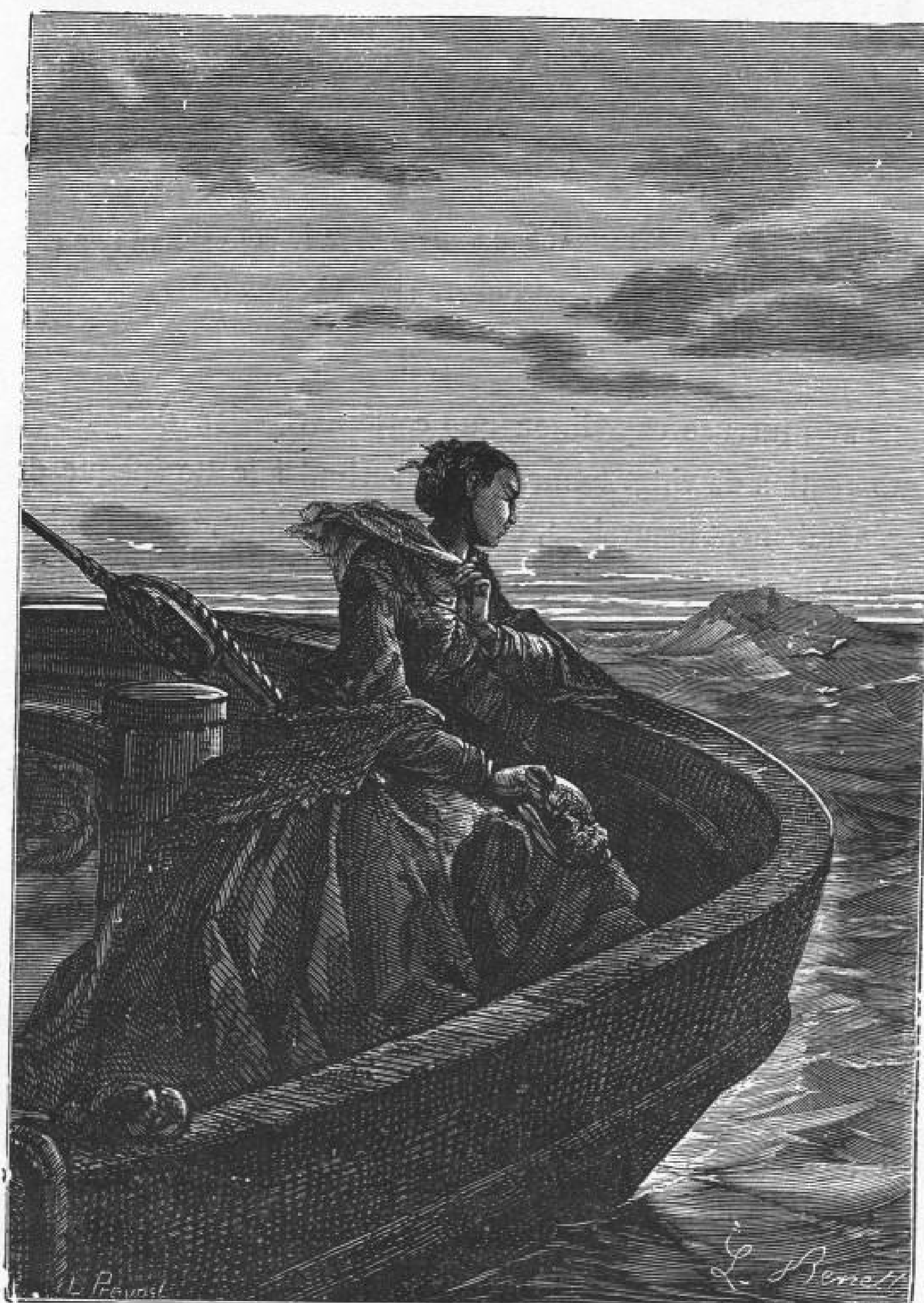
Mr. Fogg and Mrs. Aouda cast a last glance at the quay, to see whether Passepartout might appear.
Fix was not without apprehension, for chance might have led to that very place the unfortunate boy whom he had treated so shamefully, and then an explanation would have burst forth, from which the detective would not have come off to his advantage. But the Frenchman did not appear, and doubtless the stupefying narcotic still held him under its influence.
At last, Master John Bunsby stood out to sea, and the Tankadère, taking the wind under her brigantine, her mainsail, and her jibs, leaped bounding over the waves.