
About this book
Fogg bets his fortune he can circle the globe in eighty days. Verne's 1872 novel, French original, Hetzel edition, free to read online.
IN WHICH PHILEAS FOGG BUYS A MOUNT AT A FABULOUS PRICE.
The train had started at the regulation hour. It carried a certain number of travelers, a few officers, civil functionaries, and merchants in opium and indigo, whom their commerce called to the eastern part of the peninsula.
Passepartout occupied the same compartment as his master. A third traveler was seated in the opposite corner.
It was Brigadier General Sir Francis Cromarty, one of Mr. Fogg's partners during the crossing from Suez to Bombay, who was rejoining his troops stationed near Benares.
Sir Francis Cromarty, tall, blond, about fifty years of age, who had distinguished himself greatly during the last sepoy mutiny, would truly have deserved the qualification of native. From his youth he had lived in India and had made only rare appearances in his native country. He was an educated man, who would willingly have given information upon the customs, the history, the organization of the Indian country, had Phileas Fogg been a man to ask for it. But this gentleman asked nothing. He was not traveling, he was describing a circumference. He was a grave body, traversing an orbit around the terrestrial globe, following the laws of rational mechanics. At this moment he was going over in his mind the calculation of the hours spent since his departure from London, and he would have rubbed his hands, had it been in his nature to make a useless movement.
Sir Francis Cromarty had not failed to recognize the originality of his traveling companion, although he had studied him only cards in hand and between two rubbers. He was therefore justified in asking himself whether a human heart beat beneath this cold envelope, whether Phileas Fogg had a soul sensitive to the beauties of nature, to moral aspirations. For him, that was a question. Of all the originals the brigadier general had met, none was comparable to this product of the exact sciences.
Phileas Fogg had not concealed from Sir Francis Cromarty his project of traveling around the world, nor under what conditions he was carrying it out. The brigadier general saw in this wager only an eccentricity without useful purpose and necessarily lacking the transire benefaciendo which must guide every reasonable man. At the rate at which the bizarre gentleman was going, he would evidently pass through without "doing anything," neither for himself nor for others.
An hour after leaving Bombay, the train, crossing the viaducts, had traversed the island of Salcette and was running upon the continent. At the station of Callyan, it left on the right the branch which, by Kandallah and Pounah, descends toward the southeast of India, and it reached the station of Pauwell. At this point it entered the highly ramified mountains of the Western Ghauts, chains with a base of trap and basalt, whose highest summits are covered with thick woods.
From time to time, Sir Francis Cromarty and Phileas Fogg exchanged a few words, and, at this moment, the brigadier general, taking up a conversation that often dropped, said:
" A few years ago, Mr. Fogg, you would have experienced at this place a delay which would probably have compromised your itinerary.
"Why so, Sir Francis?"
"Because the railway stopped at the foot of these mountains, which had to be crossed in a palanquin or on ponies' backs to the station of Kandallah, situated on the opposite slope."
"That delay would not have in any way disturbed the economy of my programme," replied Mr. Fogg. "I have not failed to foresee the eventuality of certain obstacles."
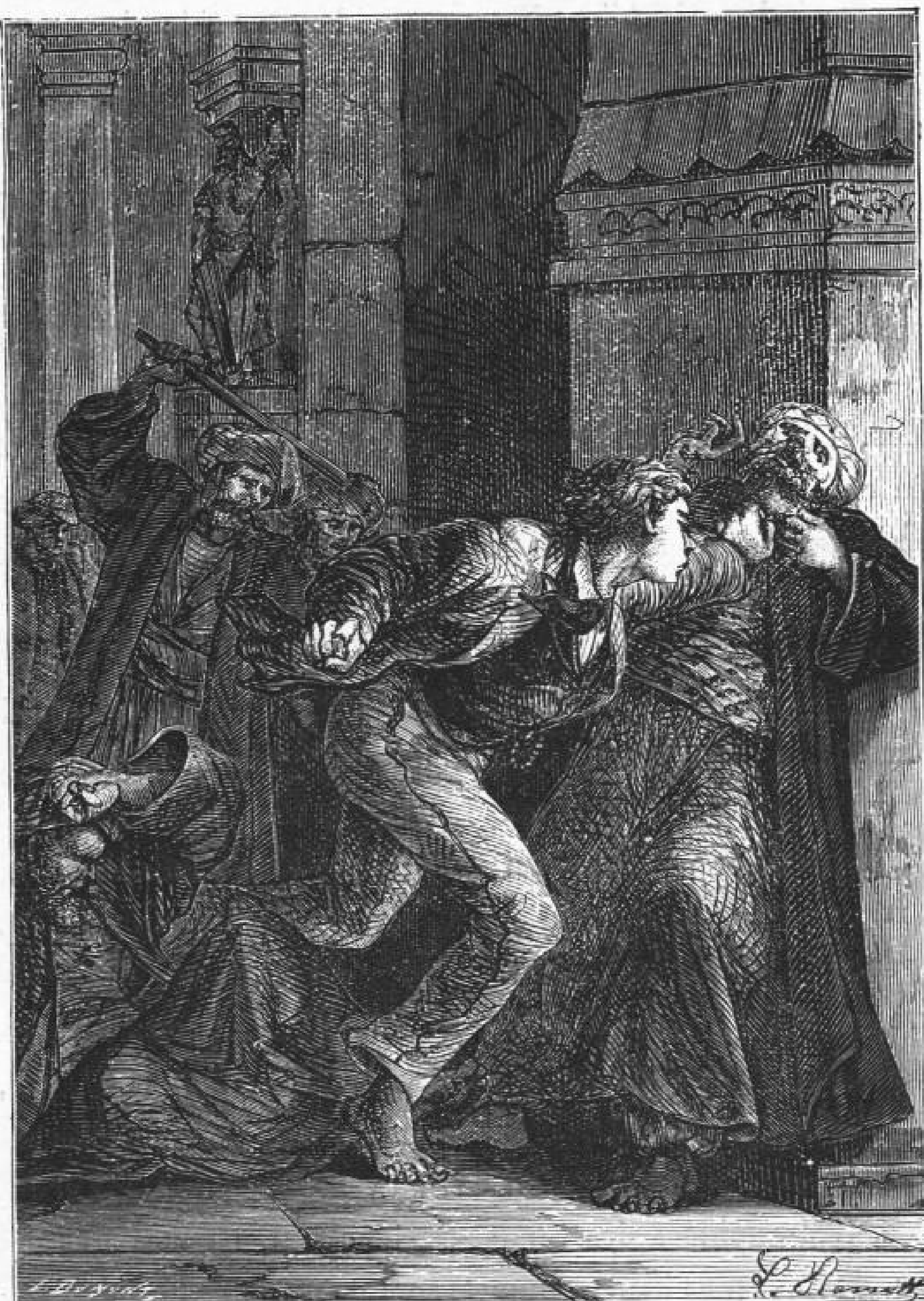
He knocked over two of his adversaries. (Page 45.)
"However, Mr. Fogg," resumed the brigadier general, "you risked having a very bad business on your hands with the adventure of that boy."
Passepartout, his feet tangled in his travelling blanket, was sleeping deeply and scarcely dreamed that anyone was talking about him.
"The English government is extremely severe, and with reason, for this kind of offence," resumed Sir Francis Cromarty. "It insists above all that the religious customs of the Incous be respected, and if your servant had been caught—"
"Well, if he had been caught, Sir Francis," replied Mr. Fogg, "he would have been condemned, he would have undergone his punishment, and then he would have returned quietly to Europe. I do not see in what way this affair could have delayed his master!"
And thereupon the conversation dropped. During the night the train crossed the Ghâts, passed through Nassik, and the next day, 21 October, it dashed across a relatively flat country, formed by the territory of Khandeish. The countryside, well cultivated, was dotted with villages, above which the minaret of the pagoda replaced the steeple of the European church. Numerous small streams, most of them tributaries or sub-tributaries of the Godavery, irrigated this fertile region.
Passepartout, having awakened, was looking about him and could not believe that he was crossing the land of the Hindoos in a train of the "Great Peninsular Railway." It seemed to him incredible. And yet nothing could be more real! The locomotive, driven by the arm of an English engineer and fired with English coal, was sending its smoke over the plantations of cotton, coffee, nutmeg, clove, and red pepper trees. The steam curled in spirals around the groups of palms, between which appeared picturesque bungalows, a few viharis, a sort of abandoned monasteries, and marvelous temples enriched by the inexhaustible ornamentation of Indian architecture. Then immense stretches of land unfolded as far as the eye could see, jungles in which were lacking neither serpents nor tigers, frightened by the neighing of the train, and finally forests, cleft by the line of the track, still haunted by elephants, which, with a pensive eye, watched the disheveled convoy pass by.
During that morning, beyond the station of Malligaum, the travelers crossed that fatal territory which was so often stained with blood by the sectaries of the goddess Kali. Not far off rose Ellora and its admirable pagodas, not far off the celebrated Aurungabad, the capital of the fierce Aureng-Zeb, now a mere chief town of one of the provinces detached from the kingdom of the Nizam. It was over this country that Feringhea, chief of the Thugs, king of the Stranglers, exercised his dominion. These assassins, united in an elusive association, strangled, in honor of the goddess of Death, victims of every age, without ever shedding blood, and there was a time when one could not dig into any spot of this soil without finding a corpse. The English government has been able to prevent these murders in a notable proportion, but the dreadful association still exists and still operates.
At half past twelve the train stopped at the station of Burhampour, and Passepartout was able to procure there at a golden price a pair of slippers adorned with false pearls, which he put on with a feeling of evident vanity.
The travelers lunched hastily and set off again for the station of Assurghur, after having for a moment skirted the bank of the Tapty, a little river which empties into the Gulf of Cambay, near Surat.
It is opportune to make known what thoughts were then occupying Passepartout's mind. Until his arrival at Bombay he had believed, and been able to believe, that things would stop there. But now, since he was speeding at full steam across India, a reversal had taken place in his mind. His natural disposition was returning at a gallop. He was recovering the fanciful ideas of his youth, he was taking his master's projects seriously, he believed in the reality of the wager, and consequently in this tour of the world and in this maximum of time which must not be exceeded. He was already even worrying about possible delays, about accidents which might occur along the way. He felt as though he had a stake in this wager, and trembled at the thought that he might have compromised it the day before by his unforgivable gaping. So, much less phlegmatic than Mr. Fogg, he was much more anxious. He counted and recounted the days elapsed, cursed the train's stops, accused it of slowness, and blamed Mr. Fogg in petto for not having promised a bonus to the engineer. He did not know, the worthy fellow, that what was possible on a steamer was no longer so on a railway, whose speed is regulated.
Toward evening they entered the passes of the Sutpour mountains, which separate the territory of Khandeish from that of Bundelkund.
The next day, October 22, in answer to a question from Sir Francis Cromarty, Passepartout, having consulted his watch, replied that it was three o'clock in the morning. And indeed, that famous watch, always set to the meridian of Greenwich, which was nearly seventy-seven degrees to the west, had to be slow, and was in fact four hours slow.
Sir Francis therefore corrected the time given by Passepartout, to whom he made the same observation that he had already received from Fix. He tried to make him understand that he ought to set it by each new meridian, and that, since he was constantly moving eastward, that is to say toward the sun, the days were shorter by four minutes for every degree traversed. It was useless. Whether or not the stubborn fellow understood the brigadier general's observation, he persisted in not advancing his watch, which he kept invariably at London time. An innocent mania, moreover, and one that could harm no one.
At eight o'clock in the morning, and fifteen miles ahead of the station of Rothal, the train stopped in the middle of a vast clearing, bordered by a few bungalows and workmen's huts. The train conductor passed along the line of cars, saying:
"Passengers get off here."
Phileas Fogg looked at Sir Francis Cromarty, who appeared to understand nothing of this halt in the middle of a forest of tamarinds and khajours.
Passepartout, no less surprised, rushed onto the track and returned almost at once, exclaiming:
"Sir, there is no more railway!"
"What do you mean?" asked Sir Francis Cromarty.
"I mean that the train does not go on!"
The brigadier immediately got down from the car. Phileas Fogg followed him without haste. Both addressed the conductor:"Where are we?" asked Sir Francis Cromarty.
"At the hamlet of Kholby," replied the conductor.
"We are stopping here?"
"Undoubtedly. The railway is not finished..."
"What! It is not finished?"
"No! There is still a stretch of about fifty miles to be laid between this point and Allahabad, where the track resumes."
"But the newspapers announced the complete opening of the railway!"
"What can you expect, my officer, the newspapers were mistaken."
"And you give tickets from Bombay to Calcutta!" resumed Sir Francis Cromarty, who was beginning to grow heated.
"Undoubtedly," replied the conductor, "but travelers well know that they must arrange to be transported from Kholby to Allahabad."
Sir Francis Cromarty was furious. Passepartout would gladly have knocked down the conductor, who could do nothing about it. He did not dare look at his master.
"Sir Francis," said Mr. Fogg simply, "we will, if you please, consider the means of reaching Allahabad."
"Mr. Fogg, is this not a delay absolutely prejudicial to your interests?"
"No, Sir Francis, that was foreseen."
"What! You knew that the track..."
"In no way, but I knew that some obstacle or other would arise sooner or later on my route. Now, nothing is compromised. I have two days in advance to sacrifice. There is a steamer leaving Calcutta for Hong Kong on the 25th at noon. We are only at the 22nd, and we shall arrive at Calcutta in time."
There was nothing to say to an answer made with such complete assurance.
It was only too true that the railway works stopped at this point. The newspapers are like certain watches which have a mania for running fast, and they had prematurely announced the completion of the line. Most of the travelers knew of this interruption of the track, and, on getting down from the train, they had seized the vehicles of all sorts possessed by the village: four-wheeled palkigharis, carts drawn by zebus, a sort of humped oxen, traveling cars resembling walking pagodas, palanquins, ponies, etc. So Mr. Fogg and Sir Francis Cromarty, after having searched throughout the village, returned without having found anything.
"I will go on foot," said Phileas Fogg.
Passepartout, who was just then rejoining his master, made a meaningful grimace as he considered his magnificent but inadequate slippers. Fortunately, he had been off exploring on his own, and, hesitating a little:
"Sir," he said, "I believe I have found a means of transport."
"What is it?"
"An elephant! An elephant belonging to an Indian who lives a hundred paces from here."
"Let us go and see the elephant," replied Mr. Fogg.
Five minutes later, Phileas Fogg, Sir Francis Cromarty, and Passepartout arrived near a hut adjoining an enclosure closed off by high palisades. In the hut was an Indian, and in the enclosure, an elephant. At their request, the Indian led Mr. Fogg and his two companions into the enclosure.
There they found themselves in the presence of a half-tamed animal, which its owner was raising not to make it a beast of burden but a fighting beast. To that end, he had begun to alter the animal's naturally gentle character so as to lead it gradually to that paroxysm of rage called "mutsh" in the Hindu language, and this by feeding it sugar and butter for three months. This treatment may seem unsuited to producing such a result, but it is nonetheless employed with success by breeders. Very fortunately for Mr. Fogg, the elephant in question had only just been put on this regimen, and the "mutsh" had not yet manifested itself.
Kiouni—such was the name of the beast—could, like all its fellows, provide a rapid march for a long time, and, lacking any other mount, Phileas Fogg resolved to employ it.
But elephants are expensive in India, where they are beginning to become rare. The males, who alone are suited to circus fights, are extremely sought after. These animals reproduce only rarely when they are reduced to a state of domestication, so that they can only be procured through hunting. They are therefore the object of extreme care, and when Mr. Fogg asked the Indian if he would rent him his elephant, the Indian refused outright.
Fogg insisted and offered an excessive price for the beast, ten pounds (250 fr.) an hour. Refused. Twenty pounds? Refused again. Forty pounds? Still refused. Passepartout bounded at each higher bid. But the Indian would not be tempted.
The sum was handsome, however. Assuming that the elephant took fifteen hours to reach Allahabad, that was six hundred pounds (15,000 fr.) that it would bring its owner.
Phileas Fogg, without becoming animated in any way, then proposed to the Indian to buy his beast and first offered him a thousand pounds (25,000 fr.) for it.
The Indian did not want to sell! Perhaps the rascal scented a magnificent deal.
Sir Francis Cromarty took Mr. Fogg aside and urged him to reflect before going further. Phileas Fogg replied to his companion that he was not in the habit of acting without reflection, that in the end it was a matter of a wager of twenty thousand pounds, that this elephant was necessary to him, and that, even if he had to pay twenty times its value, he would have that elephant.
Mr. Fogg returned to find the Indian, whose little eyes, lit by greed, clearly showed that for him it was only a question of price. Phileas Fogg offered successively twelve hundred pounds, then fifteen hundred, then eighteen hundred, and finally two thousand (50,000 fr.). Passepartout, ordinarily so red, was pale with emotion.
At two thousand pounds, the Indian yielded.
"By my babouches," cried Passepartout, "that puts elephant meat at a fine price!"
The deal concluded, it was now only a matter of finding a guide. This was easier. A young Parsi, with an intelligent face, offered his services. Mr. Fogg accepted and promised him a large remuneration, which could only double his intelligence.
The elephant was brought and equipped without delay. The Parsi knew perfectly the trade of "mahout" or cornac. He covered the elephant's back with a sort of housing and arranged, on each side of its flanks, two kinds of howdahs that were not very comfortable.
Phileas Fogg paid the Indian in bank-notes that were extracted from the famous bag. It really seemed as though they were being drawn from Passepartout's entrails. Then Mr. Fogg offered Sir Francis Cromarty to transport him to the Allahabad station. The brigadier general accepted. One more traveler was not going to tire the gigantic animal.
Provisions were bought at Kholby. Sir Francis Cromarty took his place in one of the howdahs, Phileas Fogg in the other. Passepartout straddled the housing between his master and the brigadier general. The Parsi perched on the elephant's neck, and at nine o'clock the animal, leaving the town, plunged by the shortest route into the thick forest of lataniers.