
About this book
Fogg bets his fortune he can circle the globe in eighty days. Verne's 1872 novel, French original, Hetzel edition, free to read online.
IN WHICH PHILEAS FOGG GOES DOWN THE WHOLE ADMIRABLE VALLEY OF THE GANGES WITHOUT EVEN THINKING OF SEEING IT.
The bold abduction had succeeded. An hour later, Passepartout was still laughing at his success. Sir Francis Cromarty had shaken the hand of the intrepid lad. His master had said to him: "Good," which, in the mouth of this gentleman, was equivalent to high approval. To which Passepartout had replied that all the honor of the affair belonged to his master. As for him, he had had only one "funny" idea, and he laughed as he thought that, for a few moments, he, Passepartout, former gymnast, ex-sergeant of firemen, had been the widower of a charming woman, an embalmed old rajah!
As for the young Indian woman, she had not been conscious of what had happened. Wrapped in the traveling blankets, she lay resting on one of the cacolets. Meanwhile the elephant, guided with extreme sureness by the Parsi, was running rapidly through the still dark forest. An hour after leaving the pagoda of Pillaji, it plunged across an immense plain. At seven o'clock, they halted. The young woman was still in a complete prostration. The guide made her drink a few swallows of water and brandy, but that stupefying influence which overwhelmed her was bound to last some time longer.
Sir Francis Cromarty, who knew the effects of the intoxication produced by inhaling the fumes of hemp, had no anxiety on her account.
But if the recovery of the young Indian woman was not in question in the brigadier general's mind, he was less reassured about the future. He did not hesitate to tell Phileas Fogg that if Mrs. Aouda remained in India, she would inevitably fall back into the hands of her executioners. These fanatics were present throughout the peninsula, and certainly, despite the English police, they would know how to take back their victim, even at Madras, Bombay, or Calcutta. And Sir Francis Cromarty cited, in support of this statement, a fact of the same nature that had recently occurred. In his opinion, the young woman would truly be safe only after leaving India.
Phileas Fogg replied that he would take these observations into account and would consider the matter.
Toward ten o'clock, the guide announced the station of Allahabad. There the interrupted line of the railway resumed, whose trains cover, in less than a day and a night, the distance separating Allahabad from Calcutta.
Phileas Fogg was therefore bound to arrive in time to catch a steamer that was not leaving until the next day only, October 25, at noon, for Hong Kong.
The young woman was placed in a room at the station. Passepartout was entrusted with going to buy various articles of dress for her—a gown, a shawl, furs, etc.—whatever he could find. His master opened an unlimited credit for him.
Passepartout set off at once and ran through the streets of the city. Allahabad is the city of God, one of the most venerated in India, because it is built at the confluence of two sacred rivers, the Ganges and the Jumna, whose waters attract pilgrims from the whole peninsula. It is moreover known that, according to the legends of the Ramayana, the Ganges takes its source in the sky, whence, thanks to Brahma, it descends to the earth.
While making his purchases, Passepartout soon saw the city, formerly defended by a magnificent fort that has become a state prison. No more commerce, no more industry in this city, once industrial and commercial. Passepartout, who sought in vain for a fancy-goods shop, as if he had been in Regent Street a few steps from Farmer and Co., found only at a secondhand dealer's, a peevish old Jew, the objects he needed: a gown of tartan fabric, a vast cloak, and a magnificent pelisse of otter skins, which he did not hesitate to pay seventy-five pounds (1,875 fr.). Then, quite triumphant, he returned to the station.
Mrs. Aouda was beginning to come back to herself. That influence to which the priests of Pillaji had subjected her was gradually dissipating, and her beautiful eyes were regaining all their Indian gentleness.
When the poet-king, Uçaf Uddaul, celebrates the charms of the queen of Ahmèhnagara, he expresses himself thus:
"Her glossy hair, regularly divided into two parts, framed the harmonious contours of her delicate white cheeks, bright with polish and freshness. Her ebony eyebrows had the shape and power of the bow of Kama, the god of love, and beneath her long silky lashes, in the black pupil of her large limpid eyes, there swam as in the sacred lakes of the Himalayas the purest reflections of celestial light. Fine, even, and white, her teeth shone between her smiling lips like drops of dew in the half-closed heart of a pomegranate flower. Her dainty ears with their symmetrical curves, her rosy hands, her small feet, rounded and tender as lotus buds, shone with the brilliance of the finest pearls of Ceylon, of the finest diamonds of Golconda. Her slender, supple waist, which a single hand suffices to encircle, set off the elegant arch of her rounded loins and the richness of her bosom, where blossoming youth displays its most perfect treasures, and, beneath the silky folds of her tunic, she seemed to have been modeled in pure silver by the divine hand of Vicvacarma, the eternal sculptor."
But, without all this poetic amplification, it is enough to say that Mrs. Aouda, the widow of the rajah of Bundelkund, was a charming woman in the whole European acceptation of the word. She spoke English with great purity, and the guide had not exaggerated in affirming that this young Parsi had been transformed by education.
Meanwhile the train was about to leave the station of Allahabad. The Parsi was waiting. Mr. Fogg paid him his wages at the agreed price, without exceeding it by a farthing. This somewhat astonished Passepartout, who knew all that his master owed to the guide's devotion. The Parsi had, in fact, voluntarily risked his life in the Pillaji affair, and if the Hindus learned of it later, he would hardly escape their vengeance.
There also remained the question of Kiouni. What would be done with an elephant bought so dear?
But Phileas Fogg had already come to a resolution on this point.
"Parsi," he said to the guide, "you have been helpful and devoted. I have paid for your service, but not for your devotion. Do you want this elephant? He is yours."
The guide's eyes gleamed.
"It is a fortune that Your Honor is giving me!" he exclaimed.
"Accept it, guide," replied Mr. Fogg, "and I shall still be your debtor."
"Good enough!" exclaimed Passepartout. "Take it, friend! Kiouni is a brave and courageous animal!"
And, going up to the beast, he offered it a few lumps of sugar, saying:
"Here, Kiouni, here, here!"
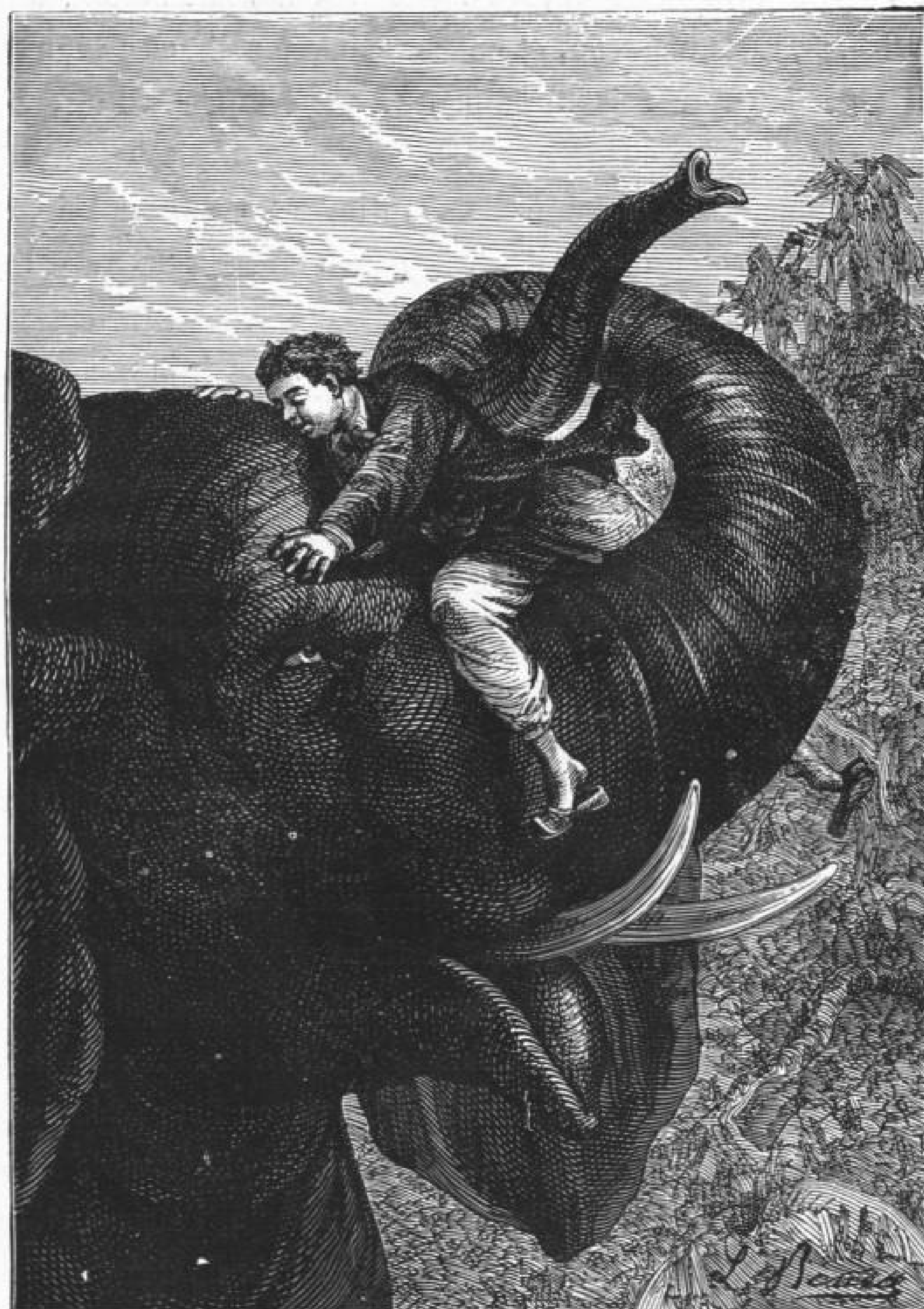
The elephant gave a few grunts of satisfaction. Then, seizing Passepartout by the waist and wrapping him in his trunk, he lifted him up to the height of his head. Passepartout, not in the least frightened, gave the animal a hearty caress, which gently set him back on the ground, and to the trunk-shake of honest Kiouni replied a vigorous handshake from the honest fellow.
A few moments later, Phileas Fogg, Sir Francis Cromarty and Passepartout, installed in a comfortable carriage of which Mrs. Aouda occupied the best place, were racing at full steam toward Benares.
At most eighty miles separate that city from Allahabad, and they were covered in two hours.
During the journey, the young woman came fully to herself; the soothing vapors of the hang dissipated.
What was her astonishment to find herself on the railway, in that compartment, covered with European clothes, amid travelers absolutely unknown to her!
At first, her companions lavished their care upon her and revived her with a few drops of liqueur; then the brigadier general told her his story. He dwelt upon the devotion of Phileas Fogg, who had not hesitated to risk his life to save her, and upon the outcome of the adventure, due to the audacious imagination of Passepartout.
Mr. Fogg let him speak without uttering a word. Passepartout, quite ashamed, kept repeating that "it was not worth the trouble!"
Mrs. Aouda thanked her saviors effusively, more by her tears than by her words. Her beautiful eyes, better than her lips, were the interpreters of her gratitude. Then, her thoughts carrying her back to the scenes of the sutty, her gaze seeing again that Indian land where so many dangers still awaited her, she was seized with a shudder of terror.
Phileas Fogg understood what was passing in Mrs. Aouda's mind, and, to reassure her, he offered—very coldly, moreover—to conduct her to Hong Kong, where she would remain until this affair should be hushed up.
Mrs. Aouda accepted the offer with gratitude. Precisely at Hong Kong resided one of her relatives, a Parsi like herself, and one of the principal merchants of that city, which is absolutely English, while occupying a point on the Chinese coast.
At half past twelve, the train stopped at the station of Benares. Brahmanic legends affirm that this city occupies the site of the ancient Casi, which was formerly suspended in space, between the zenith and the nadir, like the tomb of Mahomet. But, in this more realistic age, Benares, the Athens of India according to the orientalists, rested quite prosaically on the ground, and Passepartout could for a moment glimpse its brick houses, its wattle huts, which gave it an absolutely desolate aspect, without any local color.
It was there that Sir Francis Cromarty was to stop. The troops he was rejoining were camped a few miles north of the city. The brigadier general therefore took leave of Phileas Fogg, wishing him every possible success, and expressing the hope that he would recommence this journey in a less original but more profitable fashion. Mr. Fogg lightly pressed his companion's fingers. Mrs. Aouda'scompliments were more affectionate. Never would she forget what she owed to Sir Francis Cromarty. As for Passepartout, he was honored with a real handshake from the brigadier general. Quite moved, he wondered where and when he might well devote himself to him. Then they parted.
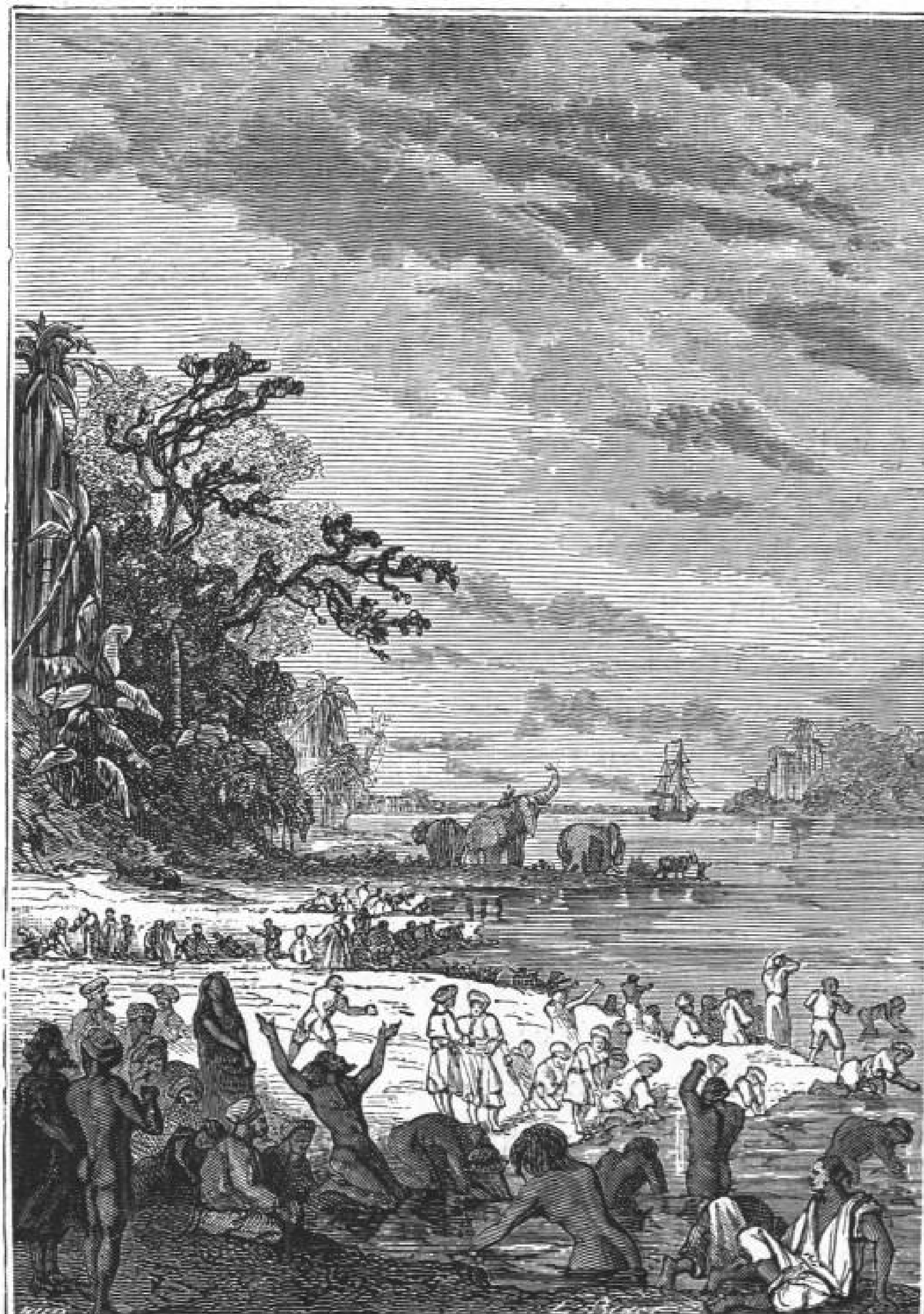
From Benares on, the railway partly followed the valley of the Ganges. Through the windows of the carriage, in rather clear weather, appeared the varied landscape of Behar, then mountains covered with verdure, fields of barley, maize and wheat, rios and ponds peopled with greenish alligators, well-kept villages, forests still verdant. Some elephants, some hump-backed zebus, came to bathe in the waters of the sacred river, and also, despite the advanced season and the already cold temperature, bands of Hindoos of both sexes, who piously performed their holy ablutions. These faithful, bitter enemies of Buddhism, are fervent sectaries of the Brahmanic religion, which is incarnate in these three persons: Vishnu, the solar divinity, Shiva, the divine personification of the forces of nature, and Brahma, the supreme master of the priests and legislators. But with what eye must Brahma, Shiva and Vishnu have regarded this India, now "Britanized," when some steam-boat passed by neighing and troubled the consecrated waters of the Ganges, frightening the gulls that flew over its surface, the turtles that swarmed on its banks, and the devotees stretched out along its shores!
All this panorama filed past like a flash, and often a cloud of white vapor hid its details. Scarcely could the travelers glimpse the fort of Chunar, twenty miles southeast of Benares, an ancient fortress of the rajahs of Behar, Ghazepore and its important factories of rose water, the tomb of Lord Cornwallis which rises on the left bank of the Ganges, the fortified town of Buxar, Patna, a great industrial and commercial city, where the principal opium market of India is held, Monghir, a city more than European, English like Manchester or Birmingham, renowned for its iron foundries, its factories of cutlery and edged weapons, and whose tall chimneys soiled with black smoke the sky of Brahma—a veritable blow of the fist in the land of dreams!
Then night came, and, amid the howlings of tigers, bears and wolves fleeing before the locomotive, the train passed at full speed, and nothing more was seen of the wonders of Bengal, nor Golconda, nor Gour in ruins, nor Mourshedabad, which was formerly a capital, nor Burdwan, nor Hougly, nor Chandernagor, that French point on Indian territory over which Passepartout would have been proud to see the flag of his country floating!
At last, at seven o'clock in the morning, Calcutta was reached. The steamer, on the point of departure for Hong Kong, was not to weigh anchor until noon. Phileas Fogg therefore had five hours before him.
According to his itinerary, this gentleman was to arrive in the capital of the Indies on October 25, twenty-three days after leaving London, and he arrived there on the appointed day. He was therefore neither late nor early. Unfortunately, the two days gained by him between London and Bombay had been lost, one knows how, in that crossing of the Indian peninsula—but it is to be supposed that Phileas Fogg did not regret them.