
About this book
Fogg bets his fortune he can circle the globe in eighty days. Verne's 1872 novel, French original, Hetzel edition, free to read online.
IN WHICH PASSEPARTOUT IS CONVINCED THAT HE HAS AT LAST FOUND HIS IDEAL
"Upon my word," said Passepartout to himself, somewhat bewildered at first, "I have known at Madame Tussaud's figures as much alive as my new master!"
It should be said here that Madame Tussaud's "figures" are waxworks, much visited in London, and the only thing really lacking in them is the power of speech.
During the few moments in which he had just glimpsed Phileas Fogg, Passepartout had rapidly but carefully examined his future master. He was a man who might be forty years old, of noble and handsome countenance, tall of stature, whom a slight stoutness did not disfigure, blond of hair and whiskers, with a smooth forehead showing no signs of wrinkles at the temples, a face rather pale than ruddy, magnificent teeth. He appeared to possess in the highest degree what physiognomists call "repose in action," a faculty common to all those who make more work than noise. Calm, phlegmatic, with a clear eye and motionless eyelid, he was the finished type of those cool-blooded Englishmen who are encountered rather frequently in the United Kingdom, and whose somewhat academic attitude Angelica Kauffmann has marvellously rendered with her brush. Seen in the various acts of his existence, this gentleman gave the idea of a being well balanced in all his parts, justly proportioned, as perfect as a chronometer by Leroy or Earnshaw. For in fact, Phileas Fogg was punctuality personified, which was clearly visible in "the expression of his feet and hands," for in man, as well as in animals, the limbs themselves are expressive organs of the passions.
Phileas Fogg was one of those mathematically exact people, who, never hurried and always ready, are economical of their steps and movements. He never took a stride too many, always going by the shortest way. He never lost a glance at the ceiling. He permitted himself no superfluous gesture. He had never been seen moved or disturbed. He was the least hurried man in the world, but he always arrived in time. However, it will be understood that he lived alone and, so to speak, outside all social relations. He knew that in life one must make allowance for friction, and since friction causes delay, he rubbed against no one.
As for Jean, called Passepartout, a true Parisian of Paris, during the five years he had lived in England and practiced the trade of valet in London, he had vainly sought a master to whom he could attach himself.
Passepartout was not one of those Frontins or Mascarilles who, with high shoulders, nose in the wind, assured gaze, and dry eye, are nothing but impudent rogues. No. Passepartout was a brave fellow, of amiable countenance, with somewhat prominent lips, always ready to taste or to caress, a gentle and helpful being, with one of those good round heads that one likes to see on the shoulders of a friend. He had blue eyes, a lively complexion, a face plump enough that he could himself see the apples of his cheeks, a broad chest, a strong frame, a vigorous musculature, and he possessed a Herculean strength that the exercises of his youth had admirably developed. His brown hair was a little unruly. If the sculptors of antiquity knew eighteen ways of arranging Minerva's hair, Passepartout knew only one for arranging his own: three strokes of the comb, and he was coiffed.
To say whether the expansive character of this fellow would agree with that of Phileas Fogg is what the most elementary prudence does not permit. Would Passepartout be that fundamentally exact servant that his master needed? One would only see by using him. After having had, as we know, a rather vagabond youth, he aspired to rest. Having heard the praises of English methodism and the proverbial coldness of gentlemen, he came to seek his fortune in England. But until then, fate had served him ill. He had been unable to take root anywhere. He had been through ten households. In all of them, they were whimsical, uneven, given to adventures or given to roaming the country—which could no longer suit Passepartout. His last master, the young Lord Longsferry, a member of Parliament, after having spent his nights in the oyster-rooms of Haymarket, too often returned home on the shoulders of policemen. Passepartout, wishing above all to be able to respect his master, risked a few respectful observations which were poorly received, and he broke with him. He learned, in the meantime, that Phileas Fogg, Esq., was looking for a servant. He made inquiries about this gentleman. A personage whose existence was so regular, who did not stay out overnight, who did not travel, who never absented himself, not even for a day, could only suit him. He presented himself and was accepted under the circumstances we know.
Passepartout—half past eleven having struck—therefore found himself alone in the house in Saville Row. At once he began inspecting it. He went through it from cellar to attic. This clean, orderly, severe, puritanical house, well organized for service, pleased him. It gave him the impression of a beautiful snail's shell, but a shell lighted and heated by gas, for carbureted hydrogen sufficed there for all the needs of light and heat. Passepartout found without difficulty, on the second floor, the room intended for him. It suited him. Electric bells and speaking tubes put it in communication with the apartments of the ground floor and the first floor. On the mantelpiece, an electric clock corresponded with the clock in Phileas Fogg's bedroom, and the two devices beat the same second at the same instant.
"That suits me, that suits me!" said Passepartout to himself.
He also noticed, in his room, a notice posted above the clock. It was the programme of the daily service. It included—from eight
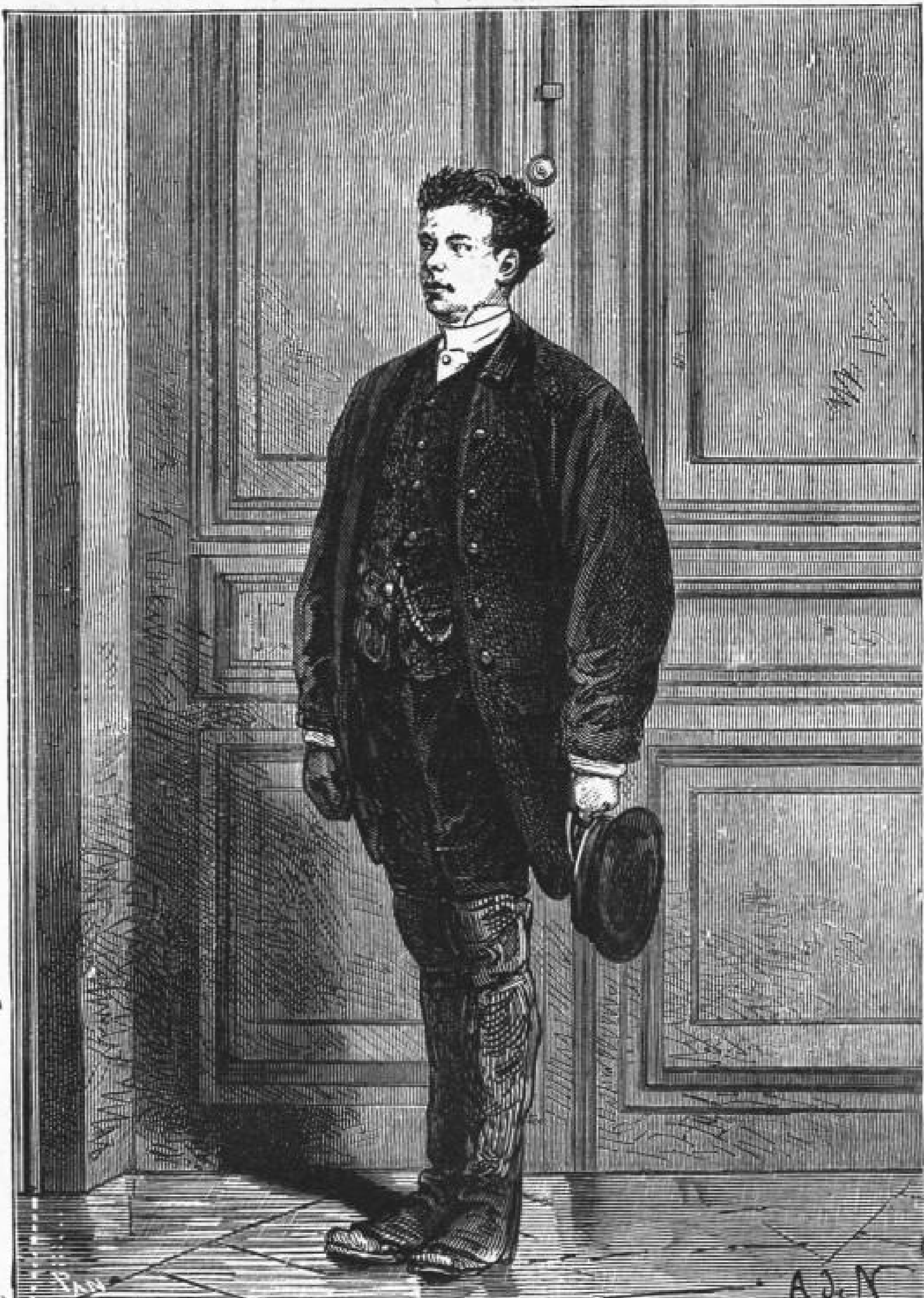
o'clock in the morning, the regulation hour at which Phileas Fogg rose, until half past eleven, the hour at which he left his house to go to lunch at the Reform Club—all the details of the service, the tea and toast at eight twenty-three, the water for shaving at nine thirty-seven, the hairdressing at twenty minutes to ten, etc. Then from half past eleven in the morning to midnight—the hour at which the methodical gentleman went to bed—everything was noted, foreseen, regularized. Passepartout took delight in pondering this programme and in engraving its various articles in his mind.
As for monsieur's wardrobe, it was very well stocked and marvellously arranged. Each pair of trousers, coat, or waistcoat bore an order number
reproduced in a register of entries and exits, indicating the date on which, according to the season, these garments were to be worn in turn. The same regulation applied to the shoes.
In short, in this house in Saville Row—which must have been the temple of disorder in the time of the illustrious but dissipated Sheridan—the furnishings were comfortable, betokening a fine ease. No library, no books, which would have been useless to Mr. Fogg, since the Reform Club placed two libraries at his disposal, one devoted to letters, the other to law and politics. In the bedroom, a safe of medium size, whose construction protected it as well from fire as from theft. No weapons in the house, no hunting or war implements. Everything there denoted the most peaceful habits.
After having examined this dwelling in detail, Passepartout rubbed his hands, his broad face beamed, and he joyfully repeated:
"That suits me! This is the very thing! We shall get along perfectly, Mr. Fogg and I! A home-loving and regular man! A veritable machine! Well, I am not sorry to serve a machine!"