
About this book
Fogg bets his fortune he can circle the globe in eighty days. Verne's 1872 novel, French original, Hetzel edition, free to read online.
IN WHICH PHILEAS FOGG SHOWS HIMSELF EQUAL TO THE SITUATION
An hour later, the steamer Henrietta passed the light-boat that marks the entrance to the Hudson, rounded the point of Sandy Hook, and put out to sea. During the day, it kept along Long Island, off Fire Island light, and ran rapidly eastward.
The next day, December 13, at noon, a man went up on the bridge to take his bearings. Surely, one must believe that this man was Captain Speedy! Not in the least. It was Phileas Fogg, esq.
As for Captain Speedy, he was quite simply locked up in his cabin, and uttering howls that denoted a rage, quite pardonable, carried to its paroxysm.
What had happened was very simple. Phileas Fogg wanted to go to Liverpool, the captain did not want to take him there. So Phileas Fogg had agreed to take passage for Bordeaux, and, in the thirty hours he had been on board, he had maneuvered so well with bank-notes that the crew, sailors and stokers—a somewhat shady crew, who were on rather bad terms with the captain—belonged to him. And that is why Phileas Fogg commanded in the place and stead of Captain Speedy, why the captain was locked in his cabin, and why finally the Henrietta was heading for Liverpool. Only, it was very clear, from seeing Mr. Fogg maneuver, that Mr. Fogg had been a sailor.
Now, how the adventure would end, would be known later. However, Mrs. Aouda did not fail to be uneasy, without saying anything about it. Fix, for his part, had been dumbfounded at first. As for Passepartout, he found the thing simply delightful.
"Between eleven and twelve knots," Captain Speedy had said, and indeed the Henrietta maintained that average speed.
If, then—how many "ifs" there still were!—if the sea did not become too rough, if the wind did not shift to the east, if no damage occurred to the vessel, no accident to the engine, the Henrietta, in the nine days counted from December 12 to the 21st, could cover the three thousand miles separating New York from Liverpool. It is true that once he arrived, the Henrietta affair overlapping with the Bank affair, this could carry the gentleman a little further than he would like.
During the first days, the navigation proceeded under excellent conditions. The sea was not too rough; the wind appeared fixed in the northeast; the sails were set, and, under her schooners, the Henrietta sailed like a true transatlantic liner.
Passepartout was delighted. His master's latest exploit, whose consequences he did not wish to see, filled him with enthusiasm. Never had the crew seen a more cheerful, more agile fellow. He made a thousand friends among the sailors and astonished them with his acrobatic tricks. He lavished the finest names and the most attractive drinks upon them. In his eyes, they maneuvered like gentlemen, and the stokers stoked like heroes. His good humor, highly contagious, permeated everyone. He had forgotten the past, the worries, the perils. He thought only of that goal, so near to being reached, and at times he boiled with impatience, as if he had been heated by the furnaces of the Henrietta. Often, too, the worthy fellow circled around Fix; he looked at him with an eye "that said a great deal!" but he did not speak to him, for no intimacy existed any longer between the two former friends.
Besides, Fix, it must be said, no longer understood any of it! The conquest of the Henrietta, the purchase of her crew, this Fogg maneuvering like a consummate sailor, that whole combination of things dazed him. He no longer knew what to think! But, after all, a gentleman who began by stealing fifty-five thousand pounds could well end by stealing a vessel. And Fix was naturally led to believe that the Henrietta, steered by Fogg, was not going to Liverpool at all, but to some point in the world where the thief, turned pirate, would quietly place himself in safety! This hypothesis, he had to admit, was utterly plausible, and the detective was beginning to regret very seriously having embarked on this affair.
As for Captain Speedy, he continued to howl in his cabin, and Passepartout, charged with providing for his food, did so only while taking the greatest precautions, vigorous as he was. Mr. Fogg, for his part, no longer even appeared to suspect that there was a captain on board.
On the 13th they passed over the tail of the Newfoundland Banks. These are bad waters. In winter especially, fogs are frequent there, and gales are formidable. Since the previous day the barometer, which had dropped sharply, had given warning of a coming change in the atmosphere. Indeed, during the night the temperature altered, the cold became sharper, and at the same time the wind shifted to the southeast.
It was a setback. Mr. Fogg, in order not to stray from his route, had to shorten sail and force the steam. Nevertheless, the ship's progress was slowed, given the state of the sea, whose long swells broke against her stem. She experienced very violent pitching motions, and this to the detriment of her speed. The breeze gradually turned to a hurricane, and one could already foresee the case in which the Henrietta would no longer be able to hold her head to the swell. Now, if she had to run before it, that meant the unknown with all its bad chances.
Passepartout's face darkened at the same time as the sky, and for two days the honest fellow suffered mortal terrors. But Phileas Fogg was a bold sailor, who knew how to face the sea, and he always held his course, even without reducing to half steam. The Henrietta, when she could not rise over the swell, passed through it, and her deck was swept clean, but she passed. Sometimes, too, the propeller emerged, beating the air with its frantic blades, when a mountain of water lifted her stern out of the waves, but the ship always went forward.
However, the wind did not freshen as much as one might have feared. It was not one of those hurricanes that pass with a speed of ninety miles an hour. It held at a strong gale, but unfortunately it blew obstinately from the southeast and did not allow any sail to be set. And yet, as will be seen, it would have been very useful to come to the aid of the steam!
On December 16, it was the seventy-fifth day elapsed since the departure from London. On the whole, the Henrietta was not yet alarmingly behind. Half the crossing was roughly done, and the worst waters had been passed. In summer, success would have been assured. In winter, one was at the mercy of the bad season. Passepartout did not commit himself. At bottom, he had hope, and, if the wind failed, at least he counted on the steam.
Now, that day, the engineer having come up on deck, met Mr. Fogg and had a rather lively conversation with him.
Without knowing why—by a presentiment, no doubt—Passepartout felt a vague uneasiness. He would have given one of his ears to hear with the other what was being said there. However, he managed to catch a few words, among them these, spoken by his master:
"You are certain of what you are saying?"
"Certain, sir," replied the engineer. "Do not forget that since our departure we have been stoking with all our furnaces lit, and if we had enough coal to go at half steam from New York to Bordeaux, we do not have enough to go at full steam from New York to Liverpool!"
"I will look into it," replied Mr. Fogg.
Passepartout had understood. He was seized with a mortal uneasiness.
The coal was going to run out!
"Ah! if my master gets out of this one," he said to himself, "decidedly he will be a famous man!"
And having met Fix, he could not help informing him of the situation.
"So," replied the agent through clenched teeth, "you believe we are going to Liverpool!"
"Of course!"
"Idiot!" replied the inspector, who went off shrugging his shoulders.
Passepartout was on the point of sharply taking up the epithet, whose true meaning he could not, moreover, understand; but he told himself that the unfortunate Fix must be very disappointed, very humiliated in his self-esteem, after having so clumsily followed a false trail around the world, and he passed sentence.
And now what course was Phileas Fogg going to take? That was difficult to imagine. However, it appears that the phlegmatic gentleman took one, for that very evening he summoned the engineer and said to him:
"Push the fires and hold the course until the fuel is completely exhausted."
A few moments later, the funnel of the Henrietta was vomiting torrents of smoke.
The ship therefore continued to move at full steam; but as he had announced, two days later, on the 18th, the engineer made known that the coal would give out during the day.
"Let no one allow the fires to die down," replied Mr. Fogg. "On the contrary. Let the valves be loaded."
That day, toward noon, after having taken the height and calculated the ship's position, Phileas Fogg summoned Passepartout and gave him the order to go and fetch Captain Speedy. It was as if the worthy fellow had been commanded to go and unchain a tiger, and he went down into the poop cabin, saying to himself:
"Positively, he will be enraged!"
Indeed, a few minutes later, amid shouts and oaths, a bombshell arrived on the poop deck. That bombshell was Captain Speedy. It was evident that it was going to explode.
"Where are we?" Such were the first words he pronounced amid the suffocations of anger, and certainly, had the worthy man been at all apoplectic, he would never have recovered from it.
"Where are we?" he repeated, his face congested.
"Seven hundred and seventy miles from Liverpool (300 leagues)," replied Mr. Fogg with imperturbable calm.
"Pirate!" cried Andrew Speedy.
"I have had you brought here, sir..."
"Sea robber!"
"... sir," resumed Phileas Fogg, "to beg you to sell me your ship."
"No! by all the devils, no!"
"The fact is, I am going to be obliged to burn it."
"Burn my ship!"
"Yes, at least in its upper works, for we lack fuel."
"Burn my ship!" cried Captain Speedy, who could no longer even pronounce the syllables. "A ship worth fifty thousand dollars (250,000 francs)!"
"Here are sixty thousand (300,000 francs)!" replied Phileas Fogg, offering the captain a bundle of bank-notes.
This produced a prodigious effect on Andrew Speedy. One is not an American without the sight of sixty thousand dollars causing one a certain emotion. The captain forgot in an instant his anger, his imprisonment, all his grievances against his passenger. His ship was twenty years old. This could become a golden affair!... The bombshell could no longer explode. Mr. Fogg had pulled out its fuse.
"And the iron hull will remain mine," he said in a singularly softened tone.
"The iron hull and the engine, sir. Is it agreed?"
"Agreed."
And Andrew Speedy, seizing the bundle of bank-notes, counted them and made them disappear into his pocket.
During this scene, Passepartout was white. As for Fix, he almost had a fit of apoplexy. Nearly twenty thousand pounds spent, and on top of that this Fogg who was abandoning to his seller the hull and the engine, that is to say almost the total value of the ship! It is true that the sum stolen from the bank amounted to fifty-five thousand pounds!
When Andrew Speedy had pocketed the money:
"Sir," Mr. Fogg said to him, "do not let all this astonish you. Know that I lose twenty thousand pounds if I am not arrived in London by December 21st, at eight forty-five in the evening. Now, I had missed the steamer from New York, and since you refused to take me to Liverpool..."
"And I did well, by the fifty thousand devils of hell," exclaimed Andrew Speedy, "since I gain at least forty thousand dollars by it!"
Then, more calmly:
"Do you know one thing," he added, "Captain?..."
"Fogg."
"Captain Fogg, well then, there is some Yankee in you."
And after having paid his passenger what he believed to be a compliment, he was going away, when Phileas Fogg said to him:
"Now this ship belongs to me?"
"Certainly, from the keel to the truck of the masts, for everything that is 'wood,' that is understood!"
"Good. Have the interior fittings demolished and stoke the fires with those remains."
One can judge what had to be consumed of this dry wood to maintain the steam at sufficient pressure. That day, the poop deck, the bulkheads, the cabins, the quarters, the orlop deck, all went into it.
The next day, December 19, the masting, the topmasts, the spars were burned. The masts were cut down, they were cut up with axe blows. The crew put an incredible zeal into it. Passepartout, chopping, cutting, sawing, did the work of ten men. It was a fury of demolition.
The following day, December 20, the bulwarks, the gunwales, the deadworks, the greater part of the deck, were devoured. The Henrietta was no longer anything but a vessel razed like a pontoon.
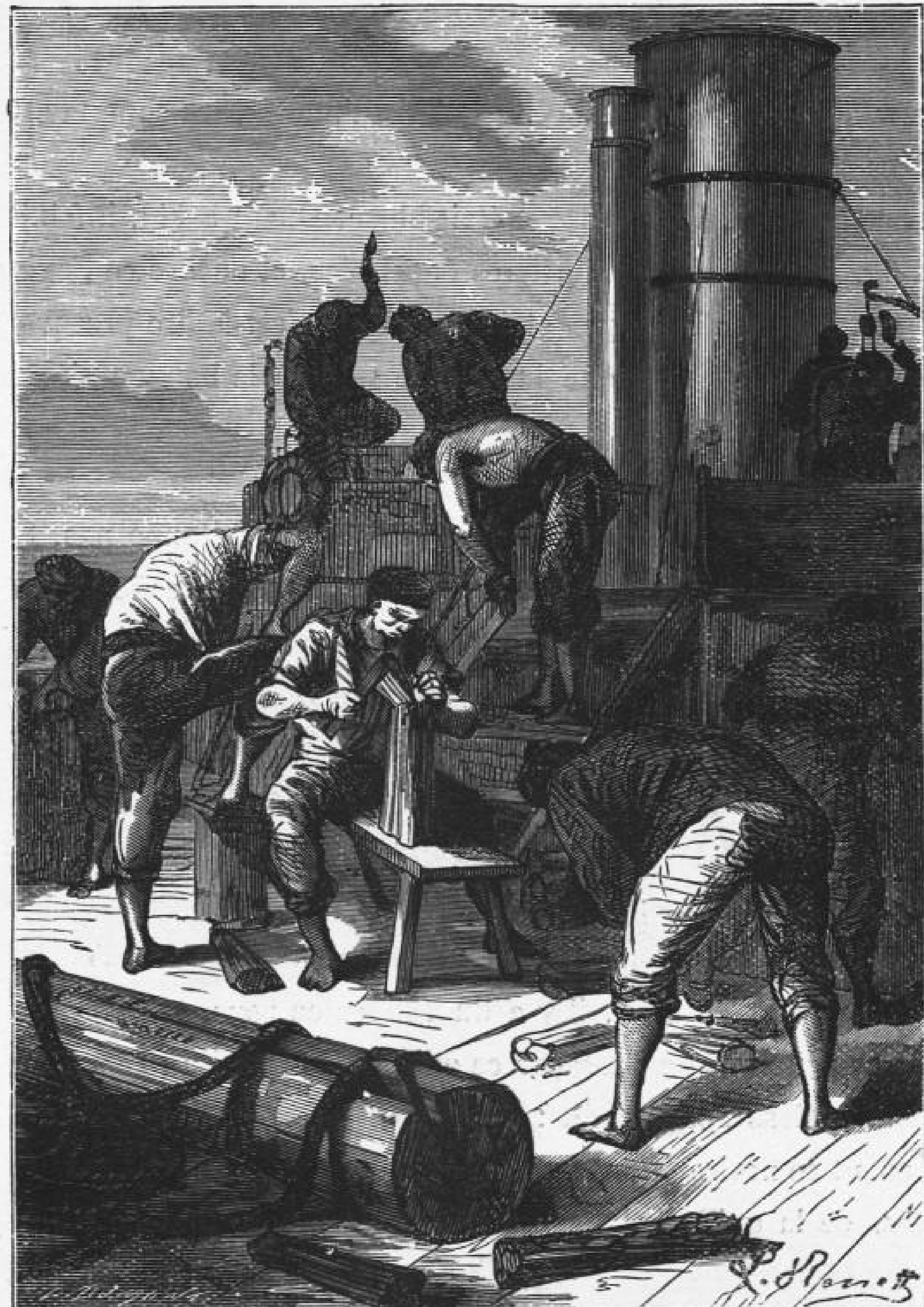
The crew displayed incredible zeal. (Page 199.)
But that day, the coast of Ireland and the Fastenet light had been sighted.
However, at ten o'clock in the evening, the ship was still only abreast of Queenstown. Phileas Fogg had only twenty-four hours left to reach London! And that was exactly the time the Henrietta needed to reach Liverpool—even at full steam. And steam was finally going to run out on the audacious gentleman!
"Sir," Captain Speedy then said to him, having ended up taking an interest in his plans, "I truly pity you. Everything is against you! We are still only off Queenstown.
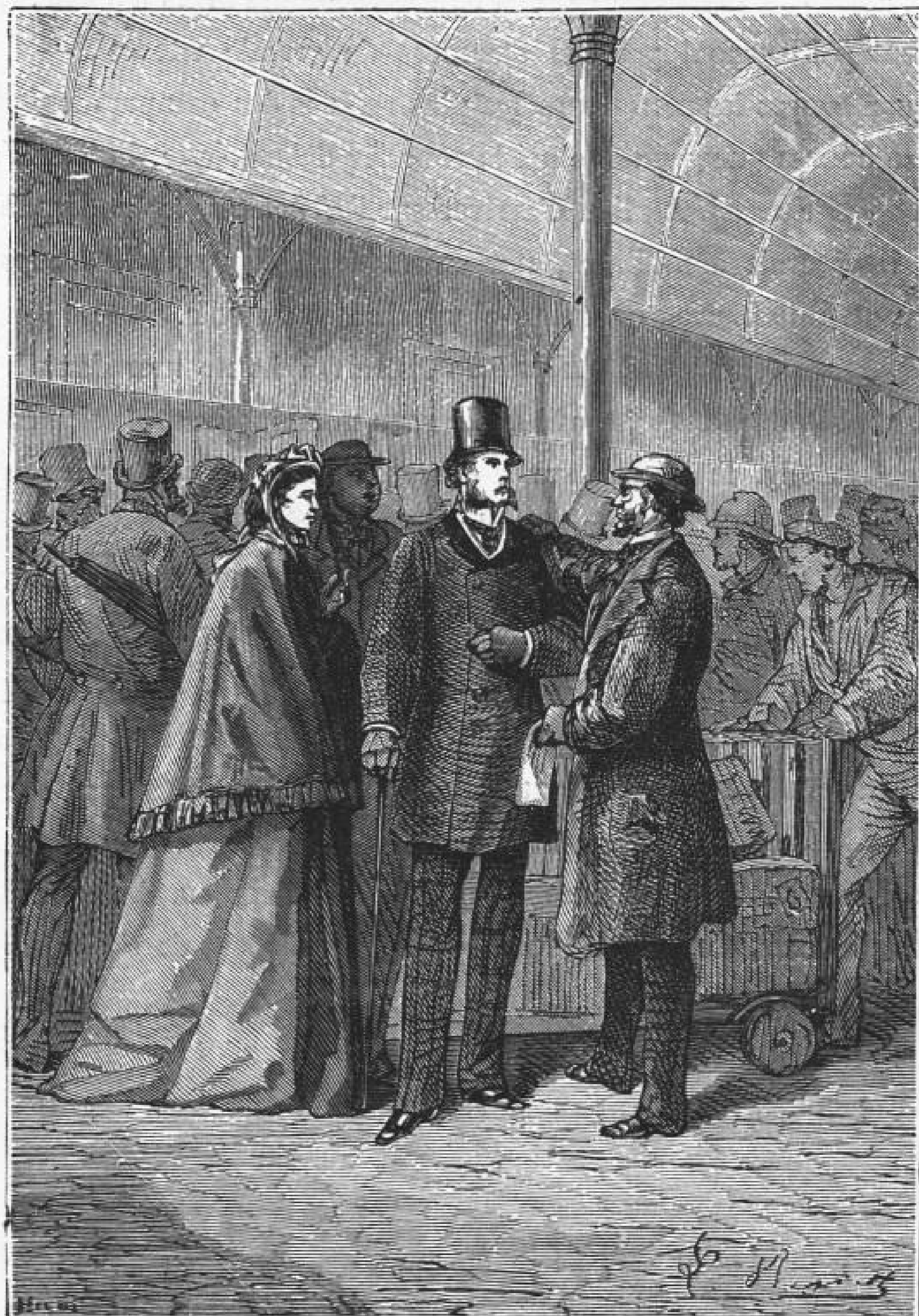
In the name of the Queen, I arrest you! (Page 202.)
— Ah!" said Mr. Fogg, "that is Queenstown, that town whose lights we can see?
— Yes.
— Can we enter the port?
— Not before three hours. Only at high tide.
— Let us wait!" Phileas Fogg answered calmly, without letting it show on his face that, by a supreme inspiration, he was about to attempt to defeat adverse chance once again!
Indeed, Queenstown is a port on the coast of Ireland where transatlantic liners coming from the United States drop off their mailbags in passing. Theseletters are carried to Dublin by express trains always ready to depart. From Dublin they reach Liverpool by high-speed steamers—thus arriving twelve hours ahead of the fastest vessels of the maritime companies.
Those twelve hours that the American mail thus gained, Phileas Fogg intended to gain as well. Instead of arriving at Liverpool the following evening on the Henrietta, he would be there at noon, and consequently would have time to be in London before eight forty-five in the evening.
Around one o'clock in the morning, the Henrietta entered the port of Queenstown at high tide, and Phileas Fogg, after receiving a vigorous handshake from Captain Speedy, left him on the stripped hull of his ship, which was still worth half of what he had sold it for!
The passengers disembarked at once. Fix, at that moment, felt a fierce urge to arrest the said Fogg. He did not do so, however! Why? What struggle was taking place within him? Had he reconsidered his view of Mr. Fogg? Did he finally understand that he had been mistaken? Yet Fix did not abandon Mr. Fogg. With him, with Mrs. Aouda, with Passepartout, who no longer had time to breathe, he boarded the train from Queenstown at one thirty in the morning, arrived in Dublin at daybreak, and immediately embarked on one of those steamers—true steel spindles, all in .