
About this book
Fogg bets his fortune he can circle the globe in eighty days. Verne's 1872 novel, French original, Hetzel edition, free to read online.
IN WHICH WE TAKE THE EXPRESS TRAIN OF THE PACIFIC RAILROAD.
"Ocean to Ocean,"—so say the Americans,—and these three words should be the general designation of the "grand trunk," which crosses the United States of America in their greatest length. But, in reality, the "Pacific rail-road" is divided into two distinct parts: the "Central Pacific" between San Francisco and Ogden, and the "Union Pacific" between Ogden and Omaha. There five distinct lines connect, which put Omaha into frequent communication with New York.
New York and San Francisco are therefore presently connected by an uninterrupted ribbon of metal measuring no less than three thousand seven hundred and eighty-six miles. Between Omaha and the Pacific, the railway crosses a region still frequented by Indians and wild beasts—a vast expanse of territory that the Mormons began to colonize around 1845, after they had been driven out of Illinois.
Formerly, under the most favorable circumstances, it took six months to travel from New York to San Francisco. Now, it takes seven days.
It was in 1862 that, despite the opposition of the Southern delegates, who wanted a more southerly line, the route of the railroad was fixed between the forty-first and forty-second parallels. President Lincoln, of such lamentedmemory, himself established, in the State of Nebraska, at the city of Omaha, the terminus of the new network. The works were begun at once and pursued with that American activity which is neither paper-ridden nor bureaucratic. The speed of the labor was in no way to impair the proper construction of the railway. Across the prairie, they advanced at the rate of a mile and a half per day. A locomotive, running on the rails laid the day before, brought the rails for the next day, and ran over them as fast as they were laid.
The Pacific Railroad throws out several branches along its course, in the States of Iowa, Kansas, Colorado, and Oregon. Leaving Omaha, it follows the left bank of the Platte River to the mouth of the north branch, follows the south branch, crosses the Laramie grounds and the Wahsatch Mountains, skirts Salt Lake, arrives at Lake-Salt-City, the capital of the Mormons, penetrates into the valley of the Tuilla, skirts the American desert, the Cedar and Humboldt mountains, the Humboldt River, the Sierra Nevada, and descends by Sacramento to the Pacific, without this route exceeding a gradient of one hundred and twelve feet per mile, even in crossing the Rocky Mountains.
Such was this long artery that the trains traversed in seven days, and which was to permit the honorable Phileas Fogg—he hoped so, at least—to take, on the 11th, at New York, the steamer for Liverpool.
The car occupied by Phileas Fogg was a sort of long omnibus resting on two sets of wheels, each formed of four, whose mobility allows it to take curves of small radius. Inside, no compartments: two rows of seats, arranged on each side, perpendicular to the axis, and between which a passage was reserved leading to the washrooms and others with which each car is provided. Along the entire length of the train, the cars communicated with one another by gangways, and travelers could circulate from one end of the convoy to the other, which placed at their disposal parlor cars, observation cars, dining cars, and cafe cars. Only theater cars were lacking. But there will be one someday.
On the gangways circulated incessantly book and newspaper peddlers, hawking their wares, and vendors of liquors, comestibles, and cigars, who did not lack for customers.
The travelers had departed from the Oakland station at six o'clock in the evening. It was already night—a cold, dark night, with an overcast sky whose clouds threatened to dissolve into snow. The train did not move with great speed. Taking stops into account, it covered no morethan twenty miles an hour, a speed which was nevertheless to allow it to cross the United States within the regulation time.
There was little conversation in the car. Besides, sleep would soon overtake the travelers. Passepartout found himself seated beside the police inspector, but he did not speak to him. Since the latest events, their relations had cooled noticeably. No more sympathy, no more intimacy. Fix had changed nothing in his manner, but Passepartout, on the contrary, kept himself extremely reserved, ready at the slightest suspicion to strangle his former friend.
An hour after the train's departure, snow fell—fine snow, which fortunately could not delay the convoy's progress. Through the windows nothing was visible anymore but an immense white sheet, over which, unfurling its volutes, the steam of the locomotive appeared grayish.
At eight o'clock, a steward entered the car and announced to the travelers that bedtime had struck. This car was a sleeping-car, which in a few minutes was transformed into a dormitory. The backs of the benches folded down, carefully packed berths unrolled by an ingenious system, cabins were improvised in a few moments, and each traveler soon had at his disposal a comfortable bed, which thick curtains defended against any indiscreet gaze. The sheets were white, the pillows soft. There was nothing left but to lie down and sleep—which each did, as if he had found himself in the comfortable cabin of a steamer—while the train sped at full steam across the State of California.
In this portion of the territory extending between San Francisco and Sacramento, the ground is little broken. This part of the railway, under the name of the "Central Pacific road," first took Sacramento as its point of departure, and advanced eastward to meet the one starting from Omaha. From San Francisco to the capital of California, the line ran directly northeast, skirting American River, which empties into the bay of San Pablo. The one hundred and twenty miles between these two important cities were covered in six hours, and toward midnight, while they were sleeping their first sleep, the travelers passed through Sacramento. They therefore saw nothing of this considerable city, seat of the legislature of the State of California—neither its beautiful quays, nor its wide streets, nor its splendid hotels, nor its squares, nor its temples.
Leaving Sacramento, the train, after passing the stations of Junction, Rocklin, Auburn, and Colfax, entered the massif of the Sierra Nevada. It was seven o'clock in the morning when the station of Cisco was passed. An hour later, the dormitory had become an ordinary car again, and the travelerscould glimpse through the windows the picturesque views of this mountainous country. The route of the train obeyed the caprices of the Sierra, here clinging to the mountainsides, there suspended above precipices, avoiding sharp angles by bold curves, plunging into narrow gorges that one would have thought had no outlet. The locomotive, sparkling like a chasseur, with its great headlamp casting tawny gleams, its silver bell, its cowcatcher extending like a spur, mingled its whistles and its bellowings with those of the torrents and cascades, and twisted its smoke into the black branches of the firs.
Few or no tunnels, nor bridges along the route. The railroad skirted the flanks of the mountains, not seeking in a straight line the shortest path from one point to another, and not doing violence to nature.
Toward nine o'clock, by the valley of Carson, the train entered the State of Nevada, still following a northeasterly direction. At noon, it left Reno, where the travelers had twenty minutes to lunch.
From this point, the railway, skirting Humboldt River, rose for a few miles toward the north, following its course. Then it bent eastward, and was not to leave the watercourse until it had reached the Humboldt Ranges, which give it birth, almost at the eastern extremity of the State of Nevada.
After lunch, Mr. Fogg, Mrs. Aouda, and their companions resumed their places in the car. Phileas Fogg, the young woman, Fix, and Passepartout, comfortably seated, watched the varied landscape passing before their eyes—vast prairies, mountains profiling themselves on the horizon, creeks rolling their foaming waters. Sometimes, a great herd of bison, massing in the distance, appeared like a moving dike. These innumerable armies of ruminants often present an insurmountable obstacle to the passage of trains. Thousands of these animals have been seen filing past for several hours, in close ranks, across the railroad. The locomotive is then forced to stop and wait until the track is clear again.
This was indeed what happened on this occasion. Toward three o'clock in the evening, a herd of ten to twelve thousand head barred the railroad. The engine, after moderating its speed, tried to engage its cowcatcher in the flank of the immense column, but it had to stop before the impenetrable mass.
One could see these ruminants—these buffaloes, as the Americans improperly call them—walking along at their tranquil pace, occasionally uttering formidable bellowings. They were larger than European
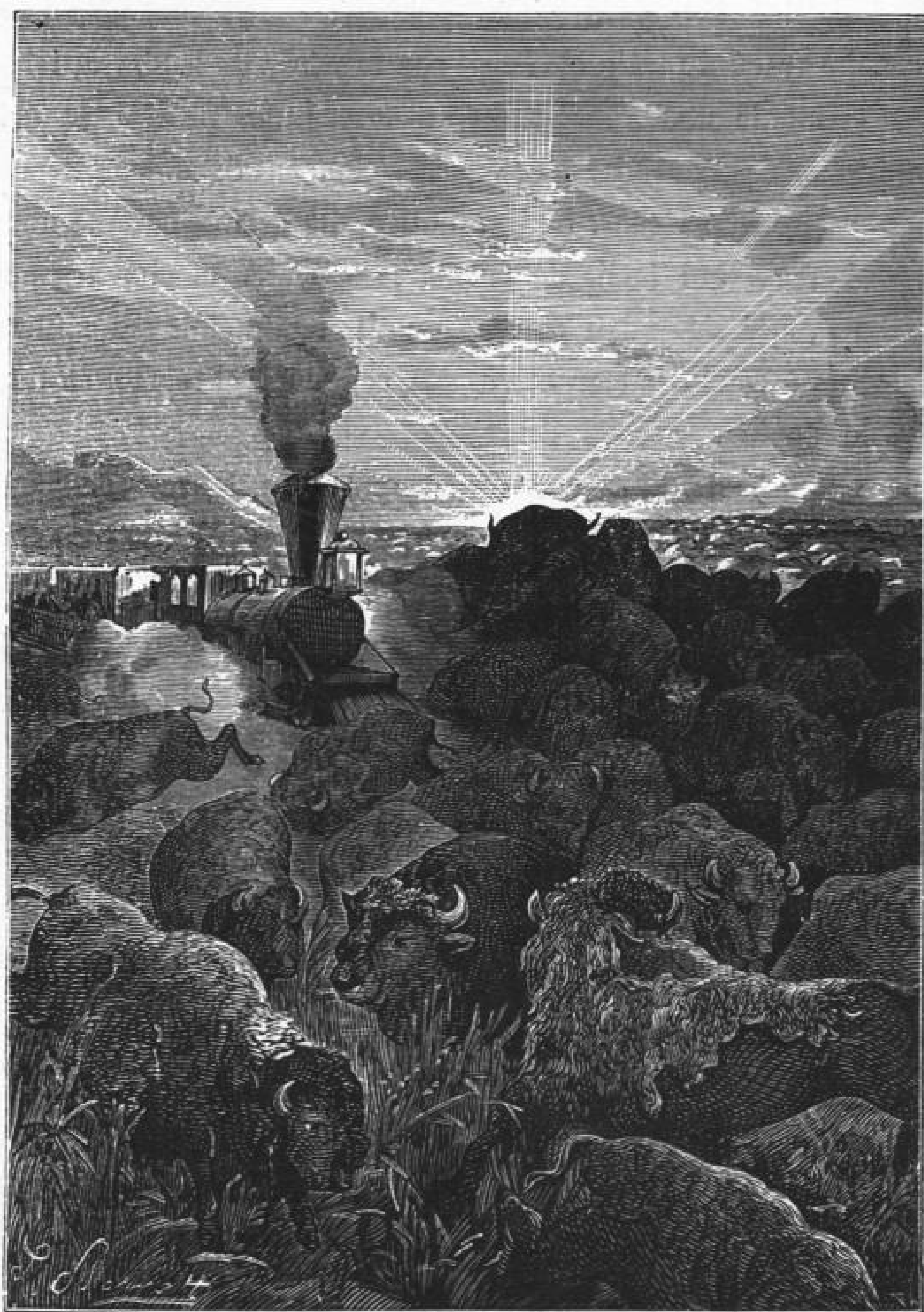
bulls, with short legs and tails, a prominent withers forming a muscular hump, horns spread apart at the base, and their head, neck, and shoulders covered with a mane of long hair. There was no point in thinking of stopping this migration. Once the bison have adopted a direction, nothing could either halt or alter their course. It is a torrent of living flesh that no dam could contain.
The travelers, scattered along the footbridges, watched this curious spectacle. But the one who must have been in the greatest hurry of all, Phileas Fogg, had remained in his place and was philosophically waiting for it to please the buffaloes to let him pass. Passepartout was furious at the delay caused by this agglomeration
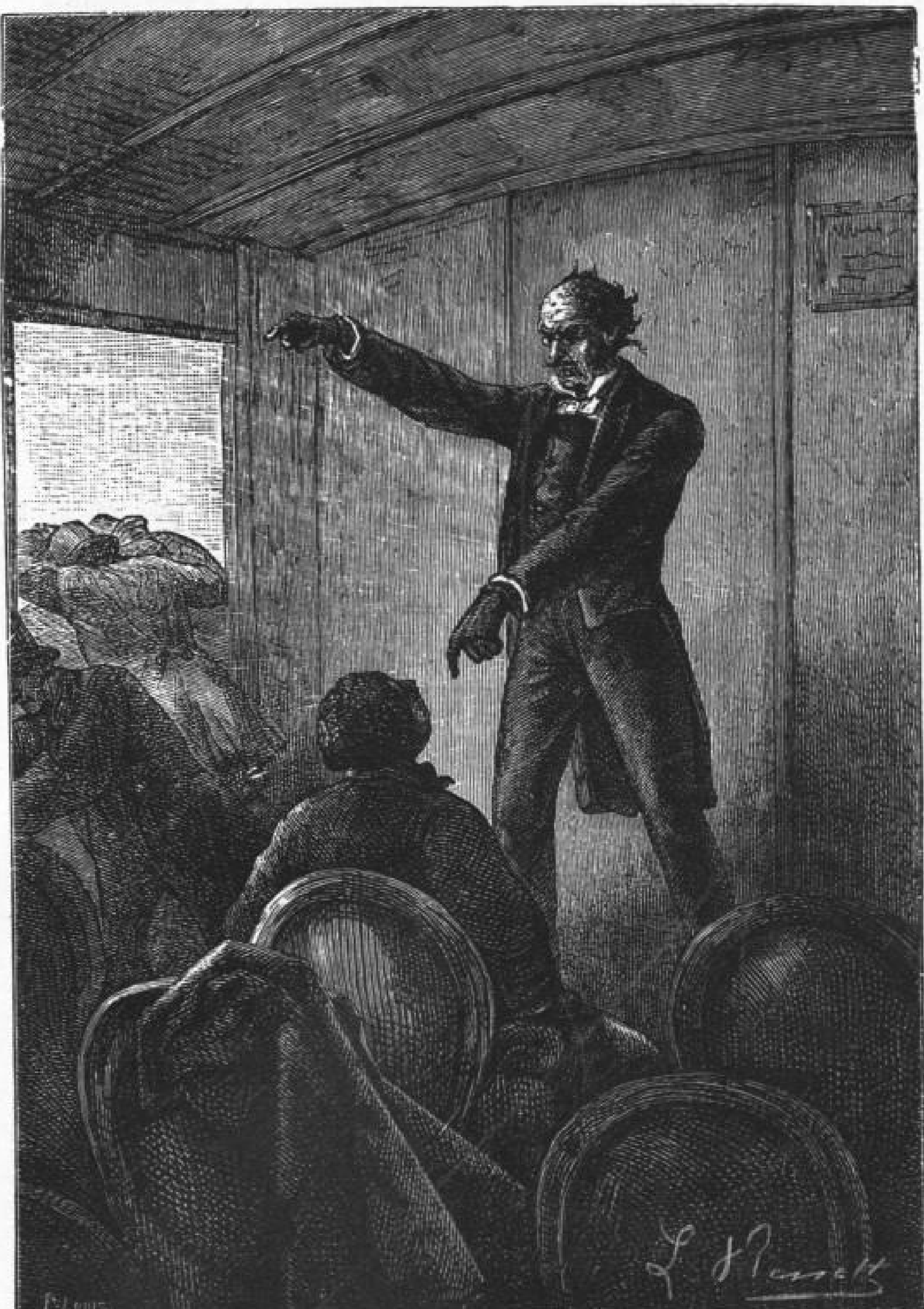
of animals. He would have liked to discharge his arsenal of revolver shots against them.
"What a country!" he exclaimed. "Simple oxen that stop trains, and that go along there, processionally, no more hurried than if they weren't obstructing traffic! By Jove! I should very much like to know if Mr. Fogg had foreseen this contretemps in his program! And that engineer who doesn't dare launch his engine through this cumbersome cattle!"
The mechanic had not attempted to overturn the obstacle, and he had acted prudently. He would doubtless have crushed the first buffaloes attacked by the locomotive's pilot; but, however powerful it might be, the machine would soon have been stopped, a derailment would inevitably have occurred, and the train would have remained in distress.
The best course, therefore, was to wait patiently, and afterward to make up for lost time by increasing the train's speed. The procession of the bison lasted three full hours, and the track did not become clear again until nightfall. At that moment, the last ranks of the herd were crossing the rails, while the first were disappearing below the southern horizon.
It was therefore eight o'clock when the train passed through the defiles of the Humboldt Ranges, and nine-thirty when it entered the territory of Utah, the region of the Great Salt Lake, the curious country of the Mormons.