
About this book
Fogg bets his fortune he can circle the globe in eighty days. Verne's 1872 novel, French original, Hetzel edition, free to read online.
IN WHICH THE RED SEA AND THE INDIAN OCEAN PROVE FAVORABLE TO THE DESIGNS
OF PHILEAS FOGG.
The distance between Suez and Aden is exactly thirteen hundred and ten miles, and the Company's regulations allow its packets a period of one hundred and thirty-eight hours to cover it. The Mongolia, whose fires were being actively stoked, sailed in such a way as to outstrip the scheduled arrival.
Most of the passengers embarked at Brindisi had almost all India as their destination. Some were going to Bombay, others to Calcutta, but via Bombay, for since a railway crosses the whole width of the Indian peninsula, it is no longer necessary to double the tip of Ceylon.
Among these passengers of the Mongolia were various civil officials and officers of every rank. Of these, some belonged to the British army proper, others commanded the native sepoy troops, all richly salaried, even now that the government has replaced the rights and charges of the old East India Company: second lieutenants at 7,000 francs, brigadiers at 60,000, generals at 100,000.1
Life was therefore good aboard the Mongolia, in that society of officials, mingled with a few young Englishmen who, with a million in their pockets, were going to establish trading posts far away. The "purser," the Company's trusted man, the captain's equal aboard, did things sumptuously. At the morning breakfast, the two o'clock lunch, the five-thirty dinner, the eight o'clock supper, the tables groaned under platters of fresh meat and side dishes supplied by the packet's butcher shop and pantries. The lady passengers—there were a few—changed their dress twice a day. There was music, there was even dancing, when the sea permitted.
But the Red Sea is very capricious and too often rough, like all these narrow and long gulfs. When the wind blew from either the Asian coast or the African coast, the Mongolia, a long screw-propelled spindle, caught broadside, rolled frightfully. The ladies then disappeared; the pianos fell silent; songs and dances ceased at once. And yet, despite the squall, despite the swell, the packet, driven by its powerful engine, ran without delay toward the Strait of Bab-el-Mandeb.
What was Phileas Fogg doing during this time? One might believe that, always uneasy and anxious, he was worrying about changes of wind harmful to the ship's progress, about the disordered movements of the swell that risked causing an accident to the engine, in short about all possible damages which, by forcing the Mongolia to put in at some port, would have compromised his journey?
Not at all, or at least, if this gentleman thought of these eventualities, he let nothing show. He was still the impassive man, the imperturbable member of the Reform-Club, whom no incident or accident could surprise. He appeared no more moved than the ship's chronometers. He was rarely seen on deck. He cared little about observing this Red Sea, so rich in memories, this theater of the first historical scenes of humanity. He did not come to recognize the curious cities scattered along its shores, whose picturesque silhouettes sometimes stood out on the horizon. He did not even dream of the dangers of this Arabian gulf, of which the ancient historians Strabo, Arrian, Artemidorus, and Edrisi always spoke with dread, and on which navigators never ventured in former times without consecrating their voyage by propitiatory sacrifices.
What then was this original doing, imprisoned in the Mongolia? First he ate his four meals a day, without either rolling or pitching ever being able to disrupt so marvelously organized a machine. Then he played whist.
Yes! he had found partners as mad about it as himself: a tax collector going to his post at Goa, a minister, the Reverend Decimus Smith, returning to Bombay, and a brigadier general of the English army, rejoining his corps at Benares. These three passengers had for whist the same passion as Mr. Fogg; and they played for whole hours, no less silently than he.
As for Passepartout, seasickness had no hold on him. He occupied a cabin forward and ate, he too, conscientiously. It must be said that, decidedly, this voyage, made under these conditions, no longer displeased him. He was resigning himself to it. Well fed, well lodged, he was seeing the country, and besides he assured himself that all this whimsy would end at Bombay.
The day after the departure from Suez, October 29, it was not without a certain pleasure that he met on deck the obliging personage he had addressed upon landing in Egypt.
"I am not mistaken," he said, approaching him with his most amiable smile. "It is indeed you, sir, who so obligingly served me as guide at Suez?
—Indeed," replied the detective, "I recognize you! You are the servant of that original Englishman...
—Precisely, sir...?
—Fix.
— Mr. Fix, replied Passepartout. Delighted to meet you again on board. And where are you going, then?
— Why, just as you are, to Bombay.
— That's all for the best! Have you made this voyage before?
— Several times, replied Fix. I am an agent of the Peninsular Company.
— Then you know India?
— Well... yes..., replied Fix, who did not want to commit himself too far.
— And is that India curious?
— Very curious! Mosques, minarets, temples, fakirs, pagodas, tigers, snakes, bayaderes! But I hope you will have time to visit the country?
— I hope so, Mr. Fix. You understand well that it is not permitted to a man in his right mind to spend his life jumping from a steamer onto a railway and from a railway onto a steamer, under the pretext of making the tour of the world in eighty days! No. All this gymnastics will cease at Bombay, have no doubt of it.
— And is he well, Mr. Fogg? asked Fix in the most natural tone.
— Very well, Mr. Fix. I am too, for that matter. I eat like an ogre who had been fasting. It is the sea air.
— And your master, I never see him on deck.
— Never. He is not curious.
— Do you know, Mr. Passepartout, that this pretended voyage in eighty days might well conceal some secret mission... a diplomatic mission, for example!
— Upon my word, Mr. Fix, I know nothing about it, I confess to you, and, at bottom, I would not give half a crown to know. »
From this meeting onward, Passepartout and Fix often talked together. The police inspector was anxious to become intimate with the servant of Mr. Fogg. That might be of use to him on occasion. He therefore often offered him, in the bar-room of the Mongolia, a few glasses of whisky or pale ale, which the good fellow accepted without ceremony and even returned, so as not to be outdone,—finding, moreover, this Fix a very honest gentleman.
However, the steamer was advancing rapidly. On the 13th, Mocha was sighted, appearing within its belt of ruined walls, above which stood out a few verdant date palms. In the distance, in the mountains, vast fields of coffee trees spread out. Passepartout was delighted to contemplate this famous city, and he even found that with its circular walls and a dismantled fort that curved like a handle, it resembled an enormous half-cup.
During the following night, the Mongolia passed through the Strait of Bab-el-Mandeb, whose Arabic name means the Gate of Tears, and the next day, the 14th, it made a stop at Steamer Point, northwest of the harbor of Aden. It was there that it was to replenish its fuel.
A grave and important matter, this feeding of the furnaces of steamships at such distances from the centers of production. For the Peninsular Company alone, it is an annual expense that figures at eight hundred thousand pounds (20 million francs). It has indeed been necessary to establish depots in several ports, and in these distant seas, coal costs eighty francs a ton.
The Mongolia still had sixteen hundred and fifty miles to go before reaching Bombay, and it was to remain four hours at Steamer Point in order to fill its bunkers.
But this delay could in no way harm Phileas Fogg's program. It was foreseen. Moreover, the Mongolia, instead of arriving at Aden only on the morning of October 15, entered it on the evening of the 14th. That was a gain of fifteen hours.
Mr. Fogg and his servant went ashore. The gentleman wanted to have his passport visaed. Fix followed him without being noticed. The visa formality accomplished, Phileas Fogg returned on board to resume his interrupted game.
Passepartout, for his part, strolled, according to his custom, amid that population of Somalis, Banians, Parsis, Jews, Arabs, and Europeans composing the twenty-five thousand inhabitants of Aden. He admired the fortifications that make this city the Gibraltar of the Indian Sea, and magnificent cisterns on which English engineers were still working, two thousand years after the engineers of King Solomon.
"Very curious, very curious!" Passepartout said to himself as he returned on board. "I see that it is not useless to travel if one wishes to see something new."
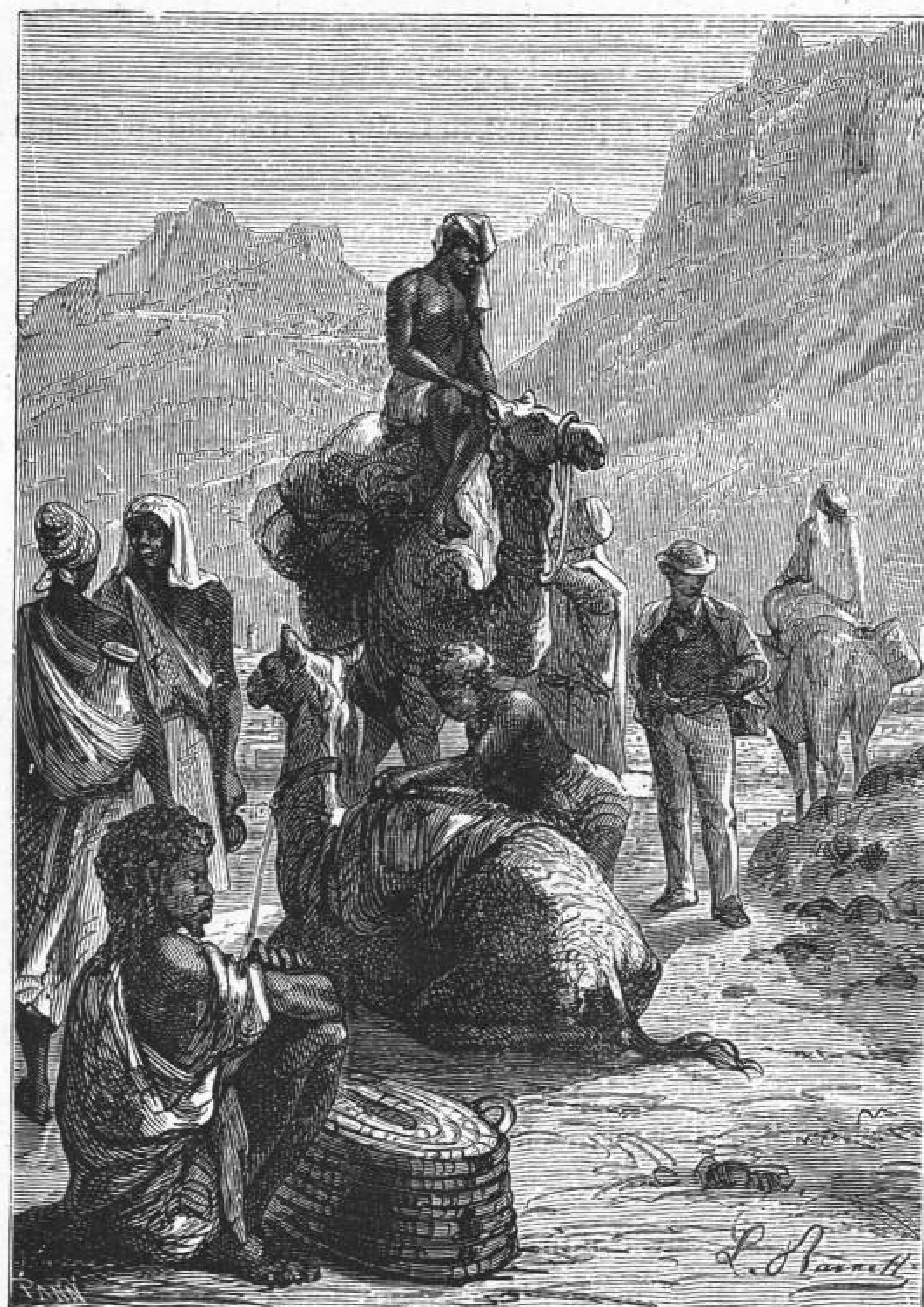
At six o'clock in the evening, the Mongolia beat the waters of the harbor of Aden with the blades of its propeller and soon raced across the Indian Sea. It was allowed one hundred and sixty-eight hours to accomplish the crossing between Aden and Bombay. Moreover, this Indian Sea was favorable to it. The wind held in the northwest. The sails came to the aid of steam.
The ship, better supported, rolled less. The lady passengers, in fresh toilettes, reappeared on deck. Songs and dances began again.
The voyage was therefore accomplished under the best conditions. Passepartout was enchanted with the amiable companion that chance had procured for him in the person of Fix.
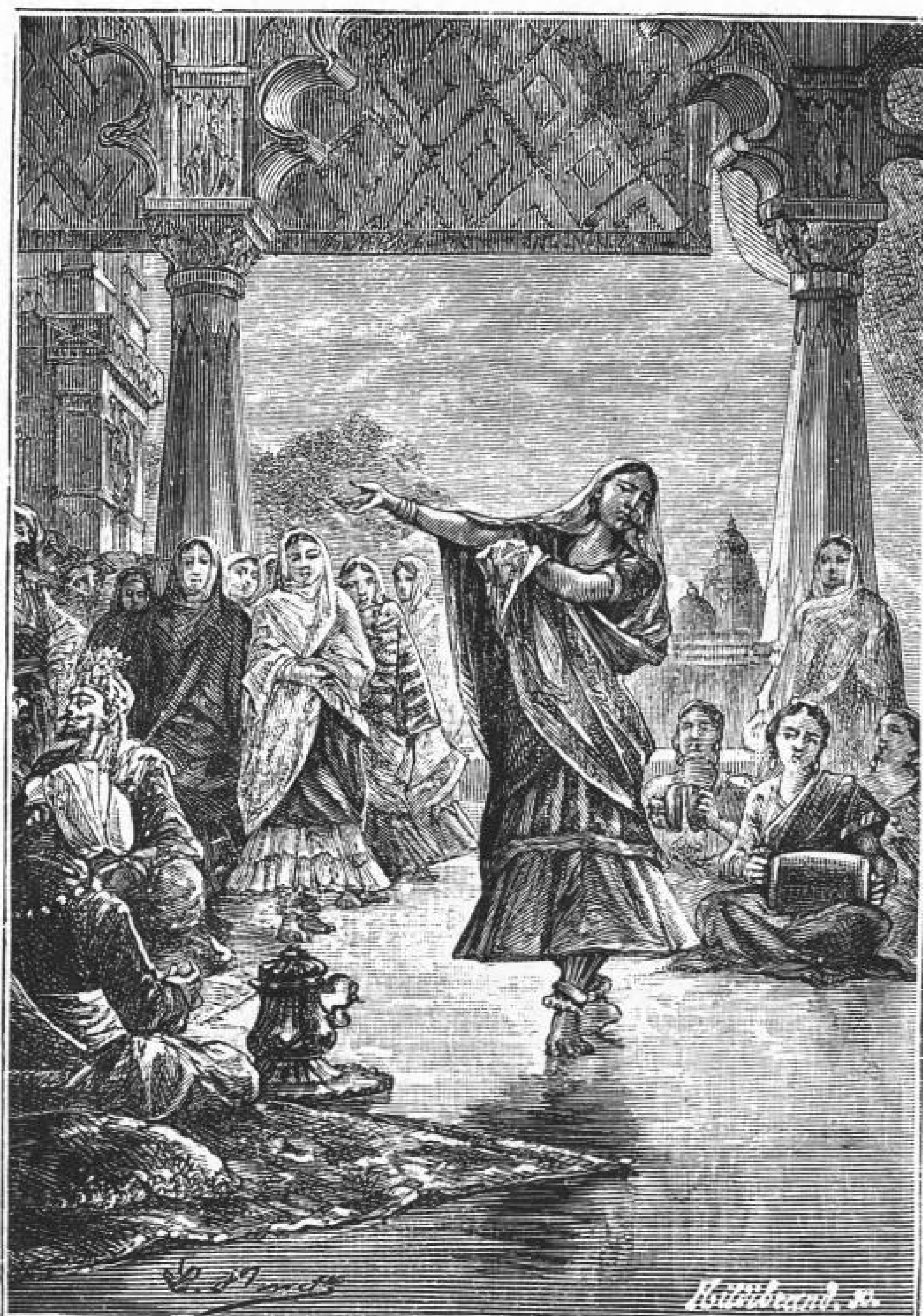
The bayaderes at Bombay. (Page 45.)
On Sunday, October 20, toward noon, the Indian coast was sighted. Two hours later, the pilot came aboard the Mongolia. On the horizon, a background of hills was outlined harmoniously against the backdrop of the sky. Soon, the rows of palm trees that cover the city stood out vividly. The steamer entered that harbor formed by the islands of Salcette, Colaba, Elephanta, and Butcher, and at four thirty it drew alongside the quays of Bombay.
Phileas Fogg was then finishing the thirty-third rubber of the day, and he and his partner, thanks to an audacious maneuver, having won the thirteen tricks, ended this fine crossing with an admirable slam.
The Mongolia was not due to arrive at Bombay until October 22. Yet it arrived there on the 20th. That was therefore, since its departure from London, a gain of two days, which Phileas Fogg methodically inscribed on his itinerary in the profits column.