
About this book
Fogg bets his fortune he can circle the globe in eighty days. Verne's 1872 novel, French original, Hetzel edition, free to read online.
XIX
IN WHICH PASSEPARTOUT TAKES TOO LIVELY AN INTEREST IN HIS MASTER, AND WHAT FOLLOWS FROM IT.
Hong Kong is only a small island, whose possession was assured to England by the Treaty of Nanking, after the war of 1842. In a few years, the colonizing genius of Great Britain had founded an important city there and created a port, the port of Victoria. This island is situated at the mouth of the Canton River, and only sixty miles separate it from the Portuguese city of Macao, built on the other bank. Hong Kong was necessarily bound to defeat Macao in a commercial struggle, and now the greater part of Chinese transit is carried on through the English city. Docks, hospitals, wharves, warehouses, a Gothic cathedral, a "government-house," macadamized streets, everything would lead one to believe that one of the commercial cities of the counties of Kent or Surrey, having crossed the terrestrial sphere, has come out again at this point of China, almost at its antipodes.
Passepartout, his hands in his pockets, therefore made his way toward the port of Victoria, looking at the palanquins, the sail-carts still in favor in the Celestial Empire, and all that crowd of Chinese, Japanese, and Europeans pressing through the streets. With little difference, it was still Bombay, Calcutta, or Singapore that the worthy fellow found again along his route. There is thus, as it were, a trail of English cities all around the world.
Passepartout arrived at Victoria Port. There, at the mouth of the Canton River, was a swarming of ships of all nations—English, French, American, Dutch, warships and merchant vessels, Japanese or Chinese boats, junks, sampans, tankas, and even flower boats, which formed so many floating flowerbeds on the water. While strolling about, Passepartout noticed a certain number of natives dressed in yellow, all very advanced in age. Having entered a Chinese barber's shop to be shaved "in the Chinese style," he learned from the local Figaro, who spoke fairly good English, that these old men were all at least eighty years old, and that at that age they had the privilege of wearing the yellow color, which is the imperial color. Passepartout found this very funny, without quite knowing why.
His beard done, he made his way to the Carnatic's boarding quay, and there he caught sight of Fix pacing back and forth, which did not surprise him at all. But the police inspector showed on his face the marks of a keen disappointment.
"Good! said Passepartout to himself, things are going badly for the gentlemen of the Reform-Club!"
And he approached Fix with his cheerful smile, without wishing to notice his companion's vexed air.
Now, the agent had good reasons to curse the infernal luck that pursued him. No warrant! It was obvious that the warrant was chasing after him, and could only reach him if he stayed a few days in this city. Yet, Hong Kong being the last English soil on the route, Mr. Fogg was going to escape him definitively if he could not manage to hold him there.
"Well then, Mr. Fix, are you decided to come with us all the way to America? asked Passepartout.
"Yes, answered Fix through clenched teeth.
"Come on then! cried Passepartout, letting out a resounding burst of laughter! I knew well that you would not be able to separate yourself from us. Come and book your place, come!"
And both entered the maritime transport office and booked cabins for four people. But the employee pointed out to them that, the repairs to the Carnatic being finished, the steamer would leave that very evening at eight o'clock, and not the following morning, as had been announced.
"Very well!" replied Passepartout, "that will suit my master. I will go and warn him."
At that moment, Fix made an extreme decision. He resolved to tell Passepartout everything. It was perhaps the only means he had of detaining Phileas Fogg for a few days at Hong Kong.
On leaving the office, Fix offered his companion some refreshment in a tavern. Passepartout had time. He accepted Fix's invitation.
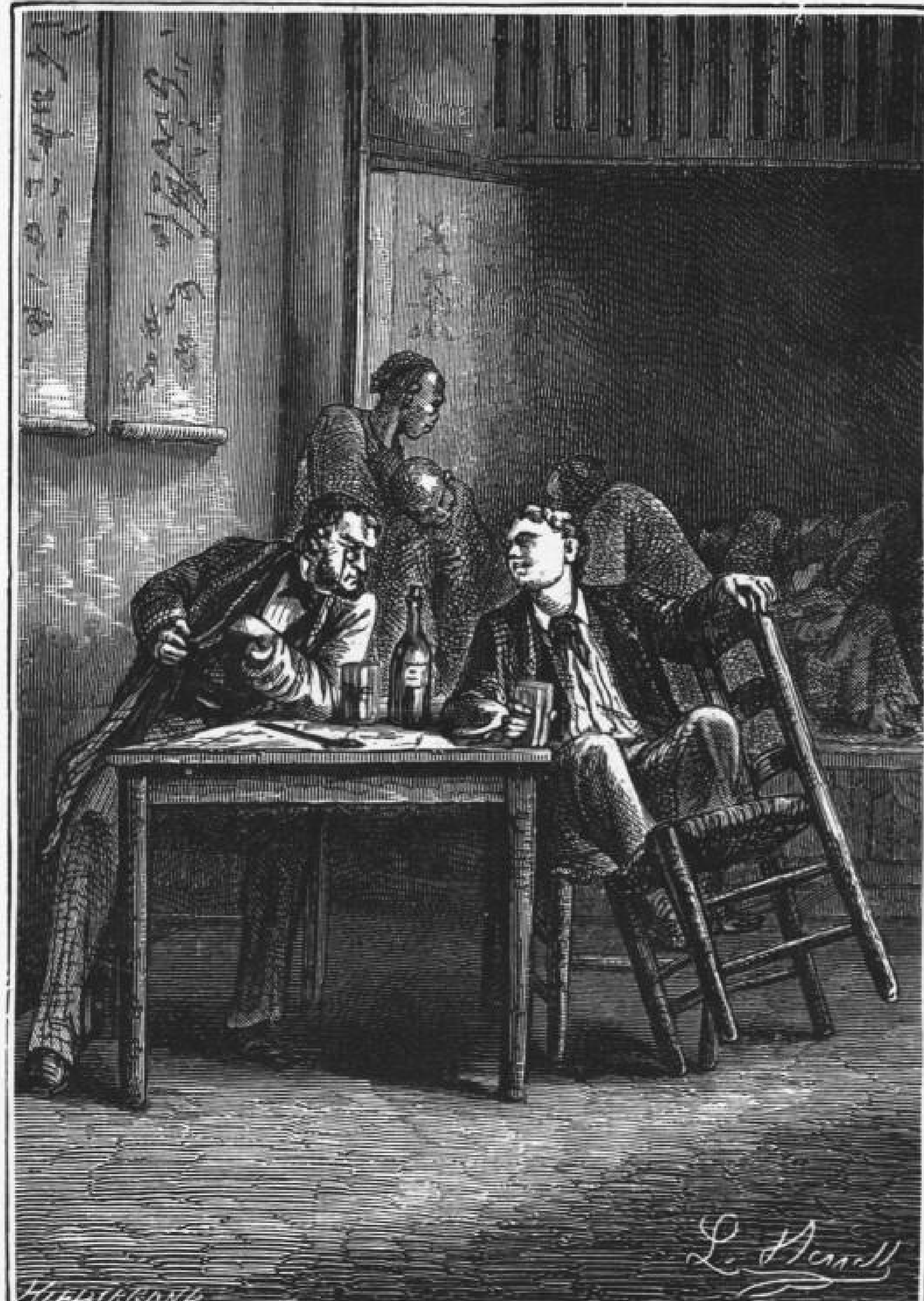
A tavern opened onto the quay. It had an inviting appearance. Both entered. It was a vast, well-decorated room, at the back of which stretched a camp bed furnished with cushions. On this bed were ranged a certain number of sleepers.
Some thirty customers occupied small tables of woven rattan in the large room. Some were emptying pints of English beer, ale or porter, others, mugs of alcoholic liquors, gin or brandy. Moreover, most were smoking long pipes of red clay, stuffed with little pellets of opium mixed with rose essence. Then, from time to time, some overwrought smoker would slip under the table, and the establishment's waiters, taking him by the feet and by the head, would carry him to the camp bed near a fellow creature. Some twenty of these drunkards were thus ranged side by side, in the last degree of stupefaction.
Fix and Passepartout understood that they had entered an opium den haunted by those wretches, dazed, emaciated, idiotic, to whom mercantile England annually sells for two hundred and sixty million francs of that fatal drug called opium! Sad millions those, levied upon one of the most fatal vices of human nature.
The Chinese government has indeed tried to remedy such an abuse by severe laws, but in vain. From the wealthy class, to which the use of opium was at first formally reserved, this use descended to the lower classes, and the ravages could no longer be stopped. Opium is smoked everywhere and always in the Middle Kingdom. Men and women give themselves over to this deplorable passion, and when they are accustomed to this inhalation, they can no longer do without it, unless they experience horrible contractions of the stomach. A great smoker can smoke up to eight pipes a day, but he dies within five years.
Now, it was into one of the numerous opium dens of this kind, which swarm even in Hong Kong, that Fix and Passepartout had entered with the intention of refreshing themselves. Passepartout had no money, but he willingly accepted the "politeness" of his companion, intending to return it in time and place.
Two bottles of port were requested, to which the Frenchman did ample honor, while Fix, more reserved, observed his companion with extreme attention. They chatted about this and that, and especially about the excellent idea Fix had had of taking passage on the Carnatic. And apropos of this steamer, whose departure had been advanced by a few hours, Passepartout, the bottles being empty, rose in order to go and warn his master.
Fix held him back.
"One moment," he said.
"What do you want, Mr. Fix?"
"I have serious things to speak to you about."
"Serious things!" cried Passepartout, draining the few drops of wine left at the bottom of his glass. "Well, we will speak of them tomorrow. I don't have time today."
"Stay," replied Fix. "It is about your master!"
At this word, Passepartout looked attentively at his interlocutor.
The expression on Fix's face seemed singular to him. He sat down again.
"What is it, then, that you have to say to me?" he asked.
Fix pressed his hand on his companion's arm, and, lowering his voice:
"You have guessed who I was?" he asked him.
"By Jove!" said Passepartout, smiling.
"Then I am going to confess everything to you..."
"Now that I know everything, my good fellow! Ah! that's not very clever! Well, go on anyway. But first, let me tell you that these gentlemen have gone to expense quite uselessly!"
"Uselessly!" said Fix. "You speak at your ease! One can well see that you don't know the importance of the sum!"
"But yes, I know it," replied Passepartout. "Twenty thousand pounds!"
"Fifty-five thousand!" replied Fix, pressing the Frenchman's hand.
"What!" cried Passepartout, "Mr. Fogg would have dared!... Fifty-five thousand pounds!... Well! all the more reason not to lose a single instant," he added, rising again.
"Fifty-five thousand pounds!" repeated Fix, who forced Passepartout to sit down again, after having had a flask of brandy brought, "and if I succeed, I earn a bonus of two thousand pounds. Do you want five hundred (12,500 fr.) on condition that you help me?"
"Help you?" cried Passepartout, whose eyes were opened wide.
"Yes, help me to detain the said Fogg for a few days at Hong Kong!"
"Hey! what are you saying there?" said Passepartout. "How, not content with having my master followed, with suspecting his loyalty, these gentlemen want still to raise obstacles for him! I am ashamed for them!"
"Here now! what do you mean?" asked Fix.
"I mean that it is pure indelicacy. As good as stripping Mr. Fogg, and taking his money from his pocket!"
"Eh! that is indeed what we intend to arrive at!"
"But that is a trap!" cried Passepartout, who was then becoming animated under the influence of the brandy that Fix was serving him, and which he was drinking without noticing it, "a veritable trap! Gentlemen! colleagues!"
Fix was beginning to no longer understand.
"Colleagues!" cried Passepartout, "members of the Reform Club! Know, Mr. Fix, that my master is an honest man, and that, when he has made a wager, it is loyally that he intends to win it."
"But who do you think I am, then?" asked Fix, fixing his gaze on Passepartout.
"By Jove! an agent of the members of the Reform Club, who has a mission to check my master's itinerary, which is singularly humiliating! Also, although for some time already I had guessed your quality, I took good care not to reveal it to Mr. Fogg!"
"He knows nothing?... " asked Fix quickly.
"Nothing," replied Passepartout, emptying his glass once again.
The police inspector passed his hand over his forehead. He hesitated before speaking again. What should he do? Passepartout's error seemed sincere, but it made his plan more difficult. It was evident that this boy
was speaking with absolute good faith, and that he was not his master's accomplice—which Fix might have feared.
"Well," he said to himself, "since he is not his accomplice, he will help me."
The detective had once again made up his mind. Besides, he no longer had time to wait. At any cost, Fogg had to be stopped in Hong Kong.
"Listen," said Fix in a curt voice, "listen to me carefully. I am not what you think I am—that is to say, an agent of the members of the Reform Club..."
"Bah!" said Passepartout, looking at him with a mocking air.
"I am a police inspector, charged with a mission by the metropolitan administration...
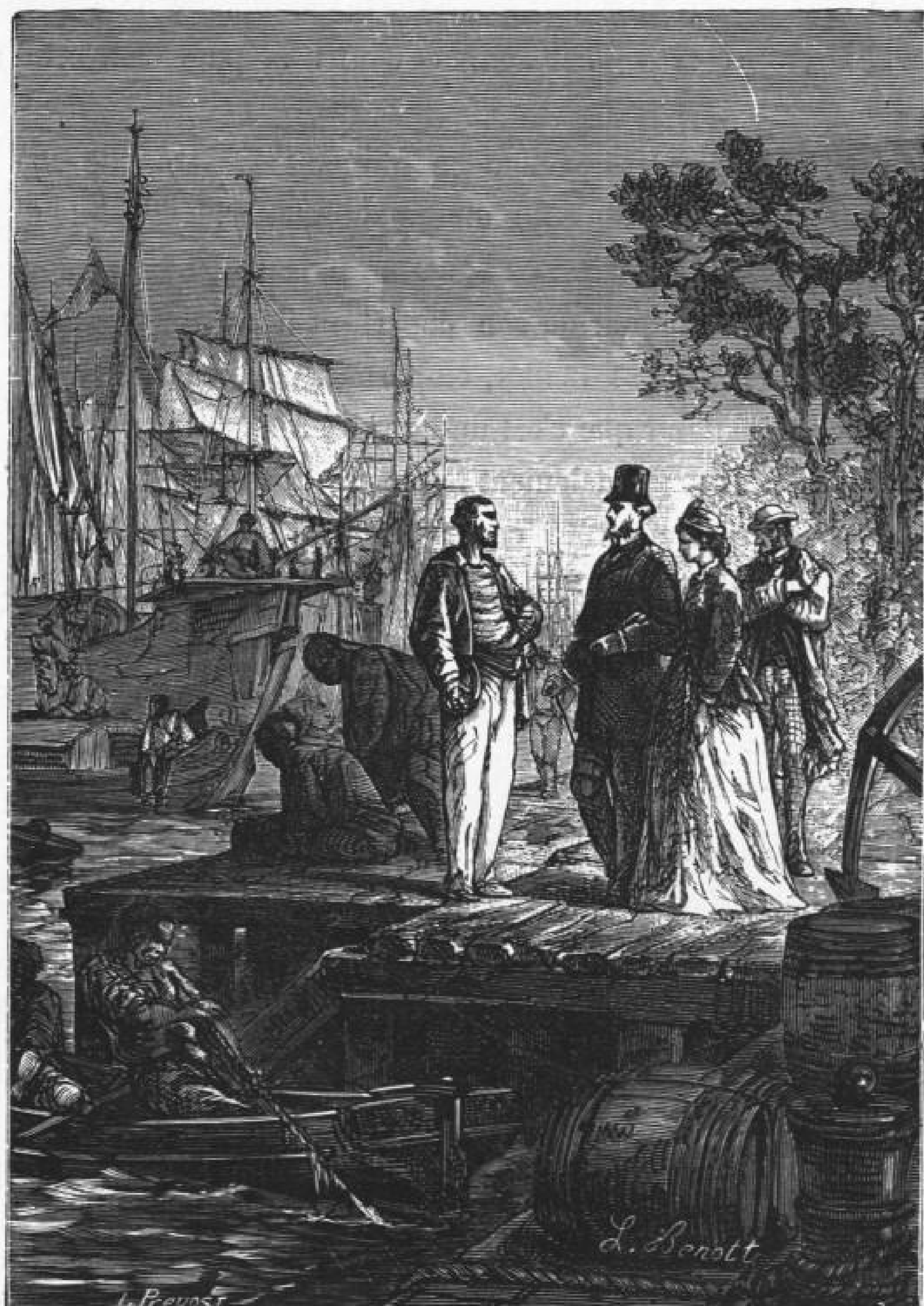
Is Your Honor looking for a boat? (Page 100).
"You... a police inspector!..."
"Yes, and I can prove it," resumed Fix. "Here is my commission."
And the agent, pulling a paper from his wallet, showed his companion a commission signed by the director of the central police. Passepartout, stunned, stared at Fix without being able to articulate a word.
"The wager of Mr. Fogg," continued Fix, "is nothing but a pretext of which you and his colleagues at the Reform Club are dupes, for he had an interest in securing your unconscious complicity."
"But why?..." exclaimed Passepartout.
"Listen. On September 28th last, a theft of fifty-five thousand pounds was committed at the Bank of England by an individual whose description could be noted. Now, here is that description, and it is feature for feature that of Mr. Fogg."
,
"Come now!" exclaimed Passepartout, striking the table with his robust fist. "My master is the most honest man in the world!"
"What do you know about it?" replied Fix. "You do not even know him! You entered his service on the day of his departure, and he left precipitately under an absurd pretext, without trunks, carrying a large sum in banknotes! And you dare to maintain that he is an honest man!"
"Yes! yes!" the poor fellow repeated mechanically.
"Do you then wish to be arrested as his accomplice?"
Passepartout had taken his head in both hands. He was no longer recognizable. He did not dare look at the police inspector. Phileas Fogg a thief—he, the savior of Aouda, the generous and brave man! And yet how many presumptions had been raised against him! Passepartout tried to push away the suspicions that were slipping into his mind. He did not want to believe in his master's guilt.
"Finally, what do you want of me?" he said to the police agent, restraining himself by a supreme effort.
"Here it is," replied Fix. "I have followed Mr. Fogg all the way here, but I have not yet received the arrest warrant, which I have requested from London. So you must help me detain him in Hong Kong..."
"Me! That I should..."
"And I will share with you the reward of two thousand pounds promised by the Bank of England!"
"Never!" replied Passepartout, who tried to rise and fell back, feeling his reason and his strength failing him at once.
"Mr. Fix," he stammered, "even if everything you have told me were true... even if my master were the thief you are looking for... which I deny... I have been... I am in his service... I have seen him good and generous... Betray him... never... no, not for all the gold in the world... I come from a village where people don't eat that kind of bread!..."
"You refuse?"
"I refuse."
"Let's pretend I said nothing," replied Fix, "and let's drink."
"Yes, let's drink!"
Passepartout felt himself more and more overcome by drunkenness. Fix, understanding that he must at all costs separate him from his master, wanted to finish him off. On the table were several pipes charged with opium. Fix slipped one into Passepartout's hand, who took it, raised it to his lips, lit it, breathed a few puffs, and fell back, his head heavy under the influence of the narcotic.
"At last," said Fix, seeing Passepartout unconscious, "Mr. Fogg will not be warned in time of the Carnatic's departure, and if he leaves, at least he will leave without this cursed Frenchman!"
Then he went out, after paying the bill.