
About this book
Fogg bets his fortune he can circle the globe in eighty days. Verne's 1872 novel, French original, Hetzel edition, free to read online.
DURING WHICH THE CROSSING OF THE PACIFIC OCEAN IS ACCOMPLISHED.
What had happened in sight of Shanghai is easily understood. The signals made by the Tankadère had been seen from the Yokohama steamer. The captain, seeing a flag at half-mast, had headed toward the little schooner. A few moments later, Phileas Fogg, settling his passage at the agreed price, placed five hundred and fifty pounds (14,750 francs) in the pocket of the skipper John Bunsby. Then the honorable gentleman, Mrs. Aouda, and Fix had gone aboard the steamer, which had immediately set course for Nagasaki and Yokohama.
Having arrived the same morning, November 14, at the regulation hour, Phileas Fogg, leaving Fix to attend to his business, had gone aboard the Carnatic, and there he learned, to the great joy of Mrs. Aouda—and perhaps to his own, but at least he let nothing of it show—that the Frenchman Passepartout had indeed arrived the day before at Yokohama.
Phileas Fogg, who was to set out again that very evening for San Francisco, immediately began searching for his servant. He applied, but in vain, to the French and English consular agents, and, after having scoured the streets of Yokohama to no purpose, he was despairing of finding Passepartout again, when chance, or perhaps a sort of presentiment, made him enter the shed of the honorable Batulcar. He certainly would not have recognized his servant under that eccentric herald's outfit; but the latter, in his upside-down position, caught sight of his master in the gallery. He could not restrain a movement of his nose. Hence the loss of balance, and what followed.
This is what Passepartout learned from Mrs. Aouda's own lips, who then told him how that crossing from Hong Kong to Yokohama had been made, in the company of a certain Mr. Fix, on the schooner the Tankadère.
At the name of Fix, Passepartout did not blink. He thought that the moment had not come to tell his master what had passed between the police inspector and himself. So, in the story that Passepartout told of his adventures, he accused and excused himself only for having been surprised by opium intoxication in a smoking-house in Yokohama.
:
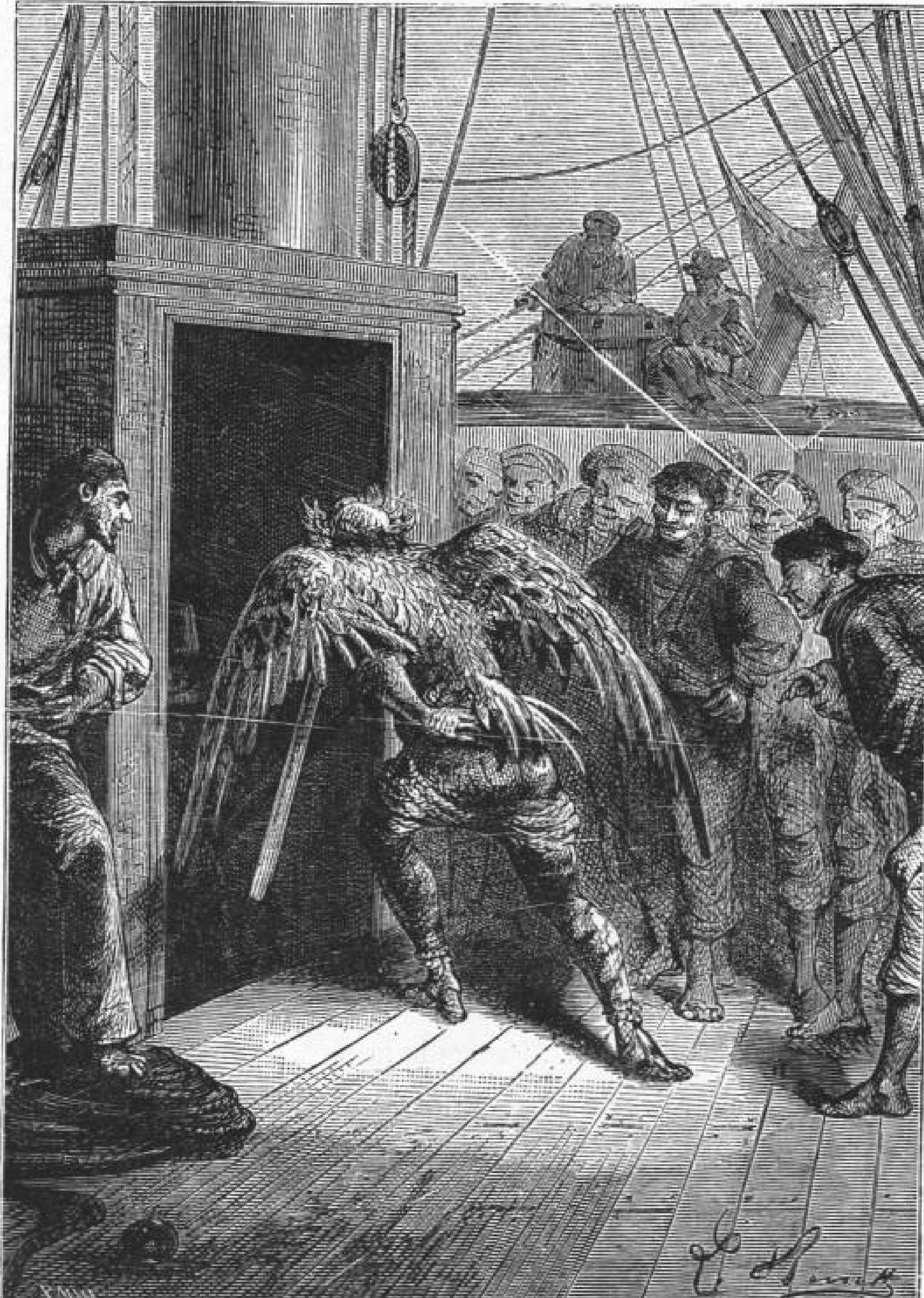
Mr. Fogg listened coldly to this account, without replying; then he opened to his servant a sufficient credit so that the latter could procure more suitable clothes on board. And indeed, not an hour had passed before the honest fellow, having cut off his nose and trimmed his wings, had nothing left about him that recalled the follower of the god Tingou.
The steamer making the crossing from Yokohama to San Francisco belonged to the "Pacific Mail Steam" Company, and was named the General-Grant. It was a vast paddle steamer, gauging two thousand five hundred tons, well appointed and endowed with great speed. An enormous beam rose and lowered successively above the deck; at one of its ends was articulated the rod of a...
piston, and at the other that of a connecting rod, which, transforming rectilinear motion into circular motion, applied itself directly to the wheel shaft. The General-Grant was rigged as a three-masted schooner, and possessed a large sail area, which powerfully aided the steam. At a speed of twelve miles an hour, the steamer should not take more than twenty-one days to cross the Pacific. Phileas Fogg was therefore entitled to believe that, having arrived on December 2 at San Francisco, he would be on the 11th at New York and on the 20th at London—thus gaining by a few hours on that fatal date of December 21.
The passengers were rather numerous aboard the steamer, English, many Americans, a veritable emigration of coolies for America, and a certain number of officers of the Indian army, who were using their leave to make the tour of the world.
During this crossing no nautical incident occurred. The steamer, supported on its broad wheels, aided by its strong sail area, rolled little. The Pacific Ocean quite justified its name. Mr. Fogg was as calm, as little communicative as usual. His young companion felt herself more and more attached to this man by bonds other than those of gratitude. This silent nature, so generous after all, impressed her more than she believed, and it was almost without her knowledge that she gave herself up to feelings whose influence the enigmatic Fogg did not seem in any way to feel.
Moreover, Mrs. Aouda took a prodigious interest in the gentleman's projects. She worried about the setbacks that could compromise the success of the journey. Often she talked with Passepartout, who was not incapable of reading between the lines in Mrs. Aouda's heart. This brave fellow now had, with regard to his master, the faith of a charcoal-burner; he never tired of praising the honesty, the generosity, the devotion of Phileas Fogg; then he reassured Mrs. Aouda about the outcome of the journey, repeating that the most difficult part was done, that they had come out of those fantastic countries of China and Japan, that they were returning to civilized lands, and finally that a train from San Francisco to New York and a transatlantic liner from New York to London would doubtless suffice to complete this impossible tour of the world within the agreed time.
Nine days after leaving Yokohama, Phileas Fogg had traveled exactly halfway around the globe.
Indeed, on November 23, the General Grant was passing the one hundred and eightieth meridian, the one on which, in the southern hemisphere, the antipodes of London are located. Of the eighty days placed at his disposal, Mr. Fogg, it is true, had used fifty-two, and he had only twenty-eight left to spend. But it must be noted that if the gentleman found himself only halfway along "by the difference of the meridians," he had in reality accomplished more than two thirds of the total journey. What forced detours, indeed, from London to Aden, from Aden to Bombay, from Calcutta to Singapore, from Singapore to Yokohama! Following the fiftieth parallel in a circular route, which is that of London, the distance would have been only about twelve thousand miles, whereas Phileas Fogg was forced, by the caprices of the means of locomotion, to cover twenty-six thousand of them, of which he had covered about seventeen thousand five hundred by that date of November 23. But now the route was straight, and Fix was no longer there to pile up obstacles along it!
It also happened that, on this November 23, Passepartout experienced great joy. It will be remembered that the stubborn fellow had insisted on keeping London time by his famous family watch, regarding as false all the times of the countries he passed through. Now, on that day, although he had never advanced or set it back, his watch was found to agree with the chronometers on board.
If Passepartout triumphed, that is readily understandable. He would have very much liked to know what Fix might have said, had he been present.
"That rogue who used to tell me a pack of stories about the meridians, about the sun, about the moon!" Passepartout kept repeating. "Well, I never! If you listened to those people, you'd make a fine piece of clockwork! I was quite sure that one day or another the sun would make up its mind to set itself by my watch!..."
Passepartout was unaware of this: that if the dial of his watch had been divided into twenty-four hours like Italian clocks, he would have had no reason to triumph, for the hands of his instrument, when it was nine o'clock in the morning on board, would have indicated nine o'clock in the evening, that is to say the twenty-first hour since midnight—a difference precisely equal to that which exists between London and the one hundred and eightieth meridian.
But if Fix had been capable of explaining this purely physical effect, Passepartout, doubtless, would have been incapable, if not of understanding it, at least of admitting it. And in any case, if, by some impossibility, the police inspector had suddenly appeared on board at that moment, it is probable that Passepartout, rightly resentful, would have treated with him a totally different subject and in a completely different manner.
Now, where was Fix at that moment?...
Fix was precisely on board the General-Grant.
Indeed, on arriving at Yokohama, the agent, abandoning Mr. Fogg whom he counted on finding again during the day, had immediately gone to the English consul. There, he had at last found the warrant, which, chasing after him since Bombay, was already forty days old—a warrant which had been dispatched to him from Hong-Kong by that same Carnatic on board which they believed him to be. Let one judge of the detective's disappointment! The warrant had become useless! The said Fogg had left the English possessions! An act of extradition was now necessary to arrest him!
"So be it!" said Fix to himself, after the first moment of anger. "My warrant is no longer good here, it will be good in England. That rogue has every appearance of returning to his native land, believing he has thrown the police off the scent. Very well. I will follow him there. As for the money, God grant that some of it remains! But in travels, in bonuses, in lawsuits, in fines, in elephant, in expenses of every sort, my man has already left more than five thousand pounds along his route. After all, the Bank is rich!"
:
His mind made up, he immediately embarked on the General-Grant. He was on board when Mr. Fogg and Mrs. Aouda arrived there. To his extreme surprise, he recognized Passepartout under his herald's costume. He hid himself at once in his cabin, in order to avoid an explanation which could compromise everything—and, thanks to the number of passengers, he counted on not being noticed by his enemy, when that very day precisely he found himself face to face with him on the fore part of the ship.
Passepartout sprang at Fix's throat, without any other explanation, and, to the great delight of certain Americans who immediately bet on him, he administered to the unfortunate inspector a superb volley, which demonstrated the high superiority of French boxing over English boxing.
When Passepartout had finished, he found himself calmer and as if relieved. Fix got up, in rather bad condition, and, looking at his adversary, he said to him coldly:
"Is it finished?
— Yes, for the moment.
— Then come and speak to me.
— That I...
— In the interest of your master."
Passepartout, as if subjugated by this coolness, followed the police inspector, and both sat down at the fore part of the steamer.
"You have beaten me," said Fix. "Fine. Now listen to me. Until now I have been the adversary of Mr. Fogg, but now I am in his game.
— At last!" cried Passepartout, "you believe him an honest man?
— No," replied Fix coldly, "I believe him a rogue... Hush! don't move and let me speak. As long as Mr. Fogg was on the English possessions, I had an interest in detaining him while awaiting a warrant of arrest. I did everything for that. I set the priests of Bombay against him, I made you drunk at Hong-Kong, I separated you from your master, I made him miss the steamer at Yokohama..."
Passepartout listened, his fists clenched.
"Now," resumed Fix, "Mr. Fogg seems to be returning to England? So be it, I will follow him. But, from now on, I will put as much care and zeal into clearing the obstacles from his route as I have put until now into accumulating them. You see, my game has changed, and it has changed because my interest wills it. I add that your interest is the same as mine, for it is only in England that you will know whether you are in the service of a criminal or of an honest man!" Passepartout had listened to Fix very attentively, and he was convinced that Fix was speaking with complete good faith.
"Are we friends?" asked Fix.
"Friends, no," replied Passepartout. "Allies, yes, and subject to inventory, for at the slightest appearance of treason, I will wring your neck.
— Agreed," said the police inspector quietly.
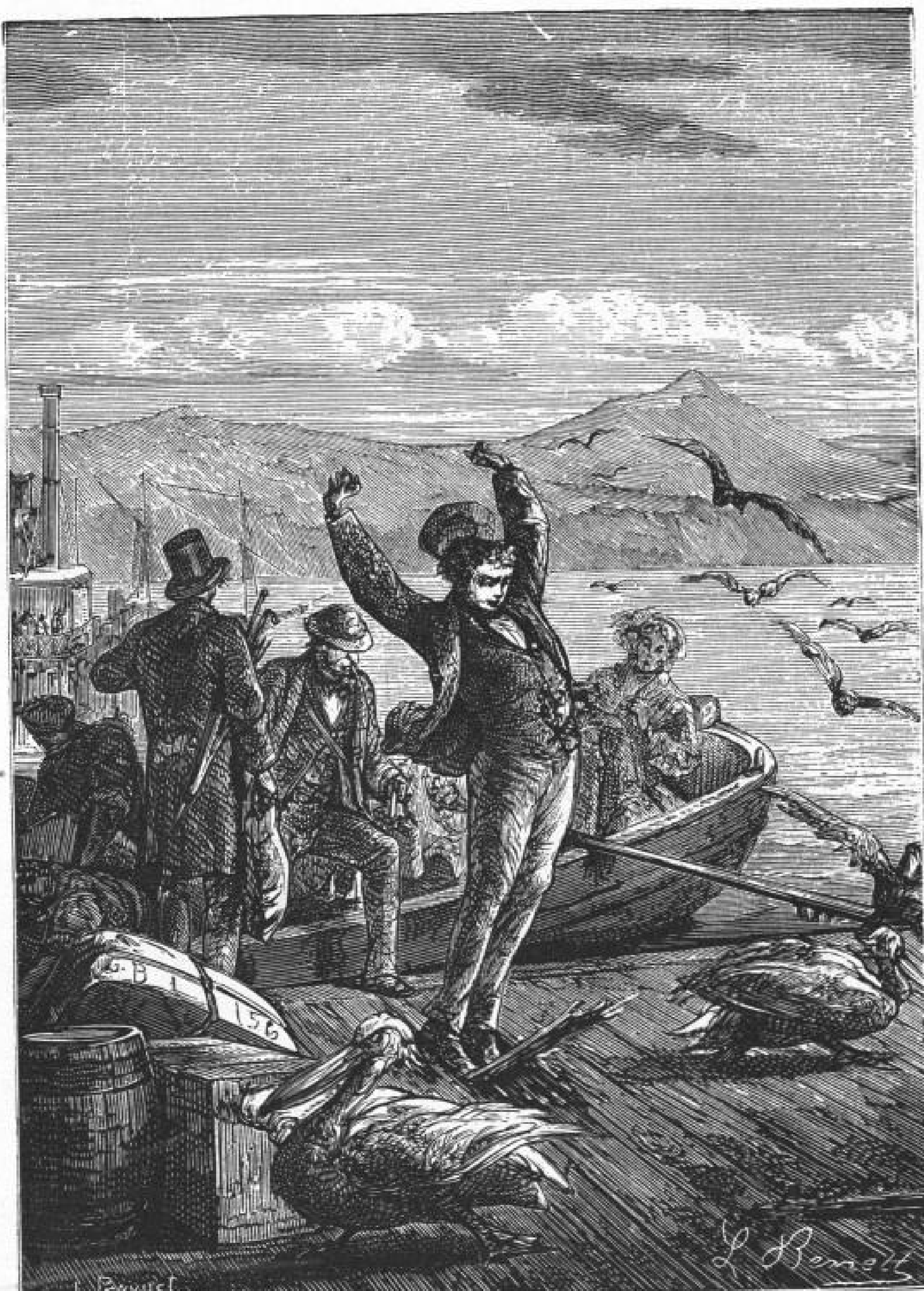
Eleven days later, on the 3rd of December, the General-Grant entered the bay of the Golden Gate and arrived at San Francisco.
Mr. Fogg had as yet neither gained nor lost a single day.