
About this book
Fogg bets his fortune he can circle the globe in eighty days. Verne's 1872 novel, French original, Hetzel edition, free to read online.
IN WHICH PASSEPARTOUT DOES NOT HAVE HIS MASTER'S ORDER REPEATED TWICE.
The next day, the inhabitants of Saville-row would have been much surprised if they had been told that Mr. Fogg had returned home. Doors and windows, everything was closed. No change had occurred outside.
Indeed, after leaving the station, Phileas Fogg had given Passepartout the order to buy some provisions, and he had gone back into his house.
This gentleman had received with his usual impassiveness the blow that struck him. Ruined! and through the fault of that clumsy police inspector! After having walked with a sure step during that long journey, after having overturned a thousand obstacles, braved a thousand dangers, having still found time to do some good alonghis route, to fail in port before a brutal fact, which he could not foresee, and against which he was unarmed: that was terrible! Of the considerable sum he had taken with him at departure, there remained only an insignificant remnant. His fortune now consisted only of the twenty thousand pounds deposited with Baring brothers, and these twenty thousand pounds, he owed them to his colleagues of the Reform-Club. After so many expenses made, this wager won would doubtless not have enriched him, and it is probable that he had not sought to enrich himself—being one of those men who bet for honor—but this wager lost ruined him totally. Moreover, the gentleman's course was decided. He knew what remained for him to do.
A room in the house in Saville-row had been reserved for Mrs. Aouda. The young woman was in despair. From certain words spoken by Mr. Fogg, she had understood that he was meditating some fatal project.
It is known, indeed, to what deplorable extremes these monomaniacal Englishmen sometimes carry themselves under the pressure of a fixed idea. So Passepartout, without appearing to, was watching his master.
But, first of all, the honest fellow had gone up to his room and had turned off the burner that had been burning for eighty days. He had found in the letter box a note from the Gas Company, and he thought that it was more than time to stop these expenses for which he was responsible.
The night passed. Mr. Fogg had gone to bed, but had he slept? As for Mrs. Aouda, she could not take a single moment of rest. Passepartout, for his part, had watched like a dog at his master's door.
The next day, Mr. Fogg summoned him and recommended, in very brief terms, that he attend to Mrs. Aouda's lunch. For himself, he would content himself with a cup of tea and a piece of toast. Mrs. Aouda would kindly excuse him for lunch and dinner, for all his time was devoted to putting his affairs in order. He would not come down. Only in the evening would he ask Mrs. Aouda's permission to speak with her for a few moments.
Passepartout, having been informed of the day's program, had only to conform to it. He looked at his master, still impassive, and he could not bring himself to leave his room. His heart was heavy, his conscience tormented with remorse, for he accused himself more than ever of this irreparable disaster. Yes: if he had warned Mr. Fogg, if he had revealed to him the projects of Agent Fix, Mr. Fogg certainly would not have dragged Agent Fix to Liverpool, and then...
Passepartout could bear it no longer.
"My master! Mr. Fogg!" he cried, "curse me. It is through my fault that—"
"I accuse no one," replied Phileas Fogg in the calmest tone. "Go."
Passepartout left the room and came to find the young woman, to whom he made known his master's intentions.
"Madame," he added, "I can do nothing by myself, nothing! I have no influence over my master's mind. You, perhaps—"
"What influence would I have," replied Mrs. Aouda. "Mr. Fogg submits to none! Has he ever understood that my gratitude toward him was ready to overflow! Has he ever read into my heart!... My friend, you must not leave him, not for a single instant. You say that he has manifested the intention of speaking to me this evening?"
"Yes, madame. It undoubtedly concerns safeguarding your situation in England."
"Let us wait," replied the young woman, who remained deep in thought.
Thus, during that Sunday, the house in Saville-row was as if it had been uninhabited, and, for the first time since he had lived in that house, Phileas Fogg did not go to his club when eleven-thirty sounded from the Parliament tower.
And why would this gentleman have presented himself at the Reform-Club? His colleagues no longer expected him there. Since, the previous evening, on that fatal date of Saturday, December 21, at eight forty-five, Phileas Fogg had not appeared in the drawing room of the Reform-Club, his wager was lost. It was not even necessary that he go to his banker to collect that sum of twenty thousand pounds. His adversaries had in their hands a check signed by him, and a simple transfer made at Baring brothers would suffice for the twenty thousand pounds to be credited to them.
Mr. Fogg therefore had no need to go out, and he did not go out. He remained in his room and put his affairs in order. Passepartout did not cease to go up and down the staircase of the house in Saville-row. The hours did not move for this poor fellow. He listened at the door of his master's room, and, in doing so, he did not think he was committing the slightest indiscretion! He looked through the keyhole, and he imagined he had that right! Passepartout dreaded some catastrophe at every moment. Sometimes he thought of Fix, but a reversal had taken place in his mind. He no longer bore a grudge against the police inspector. Fix had been mistaken like everyone else with regard to Phileas Fogg, and, in shadowing him, in arresting him, he had only done his duty, whereas he himself... This thought overwhelmed him, and he considered himself the last of wretches.
When, at last, Passepartout found himself too unhappy at being alone, he knocked
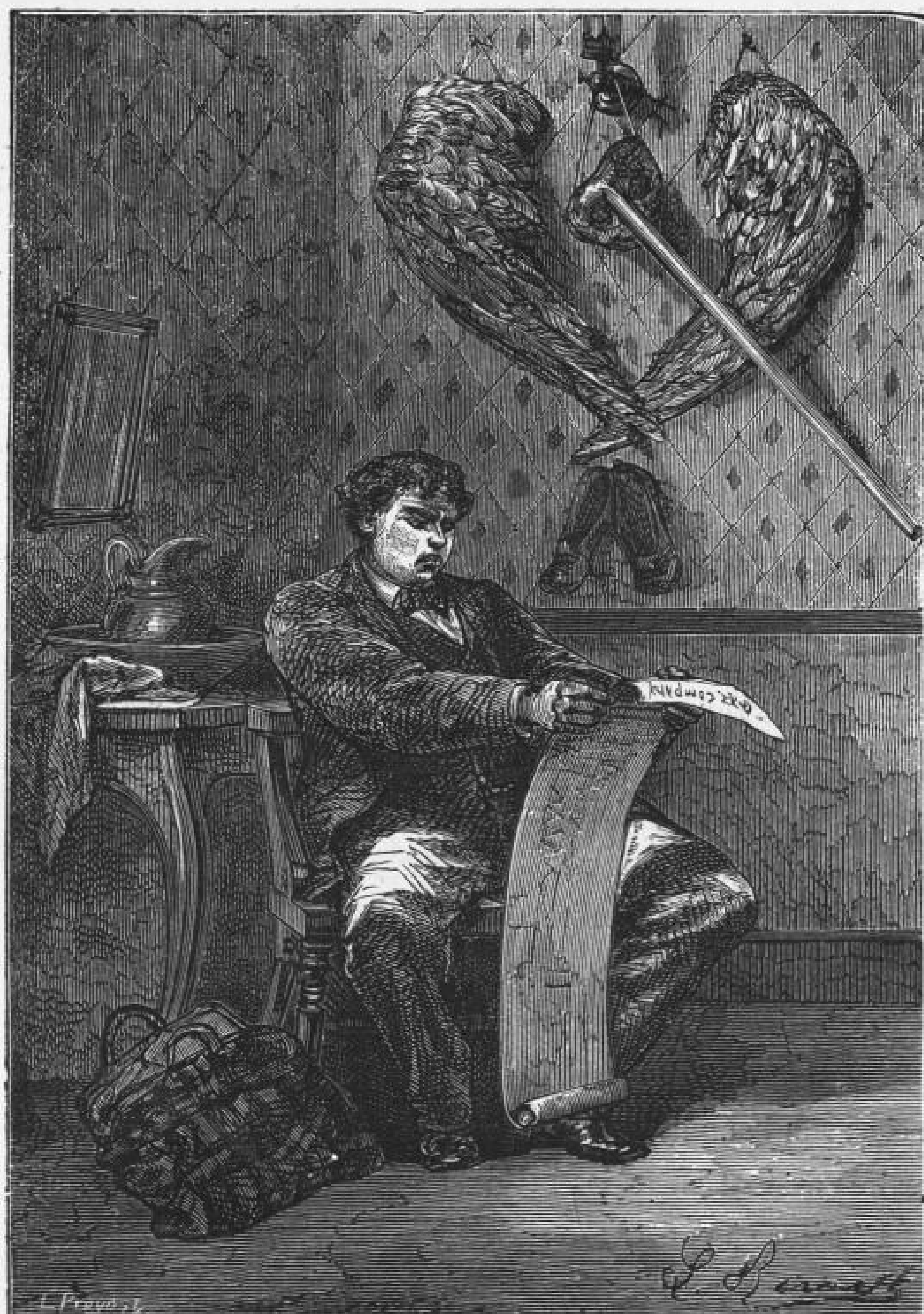
at Mrs. Aouda's door, entered her room, sat down in a corner without saying a word, and looked at the young woman, still deep in thought.
Toward seven-thirty in the evening, Mr. Fogg asked whether Mrs. Aouda could receive him, and a few moments later, the young woman and he were alone in that room.
Phileas Fogg took a chair and sat down near the fireplace, facing Mrs. Aouda. His face reflected no emotion. The Fogg of the return was exactly the Fogg of the departure. Same calm, same impassiveness.
He remained without speaking for five minutes. Then, raising his eyes to Mrs. Aouda: "Madame," he said, "will you forgive me for having brought you to England?"
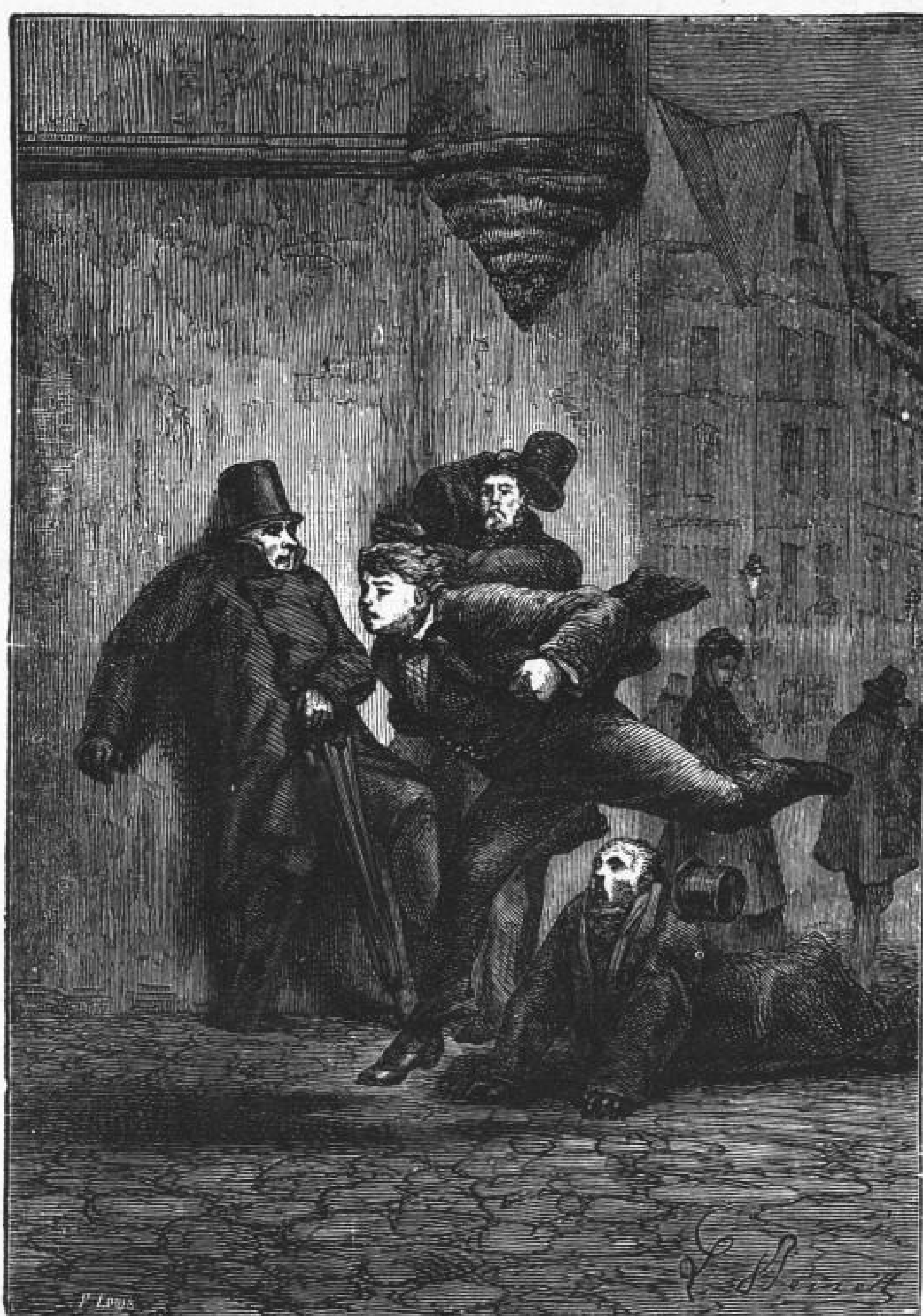
"I, Mr. Fogg!..." replied Mrs. Aouda, compressing the beatings of her heart.
"Please allow me to finish," resumed Mr. Fogg. "When I conceived the thought of drawing you away from that country, which had become so dangerous for you, I was rich, and I counted on placing a part of my fortune at your disposal. Your existence would have been happy and free. Now, I am ruined."
"I know it, Mr. Fogg," replied the young woman, "and I shall ask you in turn: Will you forgive me for having followed you, and—who knows?—for having perhaps, by delaying you, contributed to your ruin?"
"Madame, you could not remain in India, and your safety was assured onlyif you removed yourself far enough for those fanatics to be unable to take you back."
"Thus, Mr. Fogg," resumed Mrs. Aouda, "not content with snatching me from a horrible death, you still believed yourself obliged to ensure my position abroad?"
— Yes, madam, replied Fogg, but events have turned against me. However, of the little that remains to me, I ask your permission to dispose of it in your favor.
— But you, Mr. Fogg, what will become of you? asked Mrs. Aouda.
— I, madam, replied the gentleman coldly, I have need of nothing.
— But how, sir, do you then envisage the fate that awaits you?
— As it is proper to do, replied Mr. Fogg.
— In any case, resumed Mrs. Aouda, misery could never reach a man such as you. Your friends...
— I have no friends, madam.
— Your relatives....
— I have no relatives left.
— I pity you then, Mr. Fogg, for isolation is a sad thing. What! not a heart in which to pour your sorrows. Yet they say that two together can bear even misery!
— They do say so, madam.
— Mr. Fogg, then said Mrs. Aouda, who rose and held out her hand to the gentleman, would you have at once a relative and a friend? Would you have me for your wife?
Mr. Fogg, at these words, had risen in his turn. There was something like an unwonted reflection in his eyes, like a trembling on his lips. Mrs. Aouda was looking at him. The sincerity, the uprightness, the firmness and the gentleness of that beautiful gaze of a noble woman who dares all to save the one to whom she owes all, astonished him at first, then penetrated him. He closed his eyes for an instant, as if to prevent that gaze from sinking further in... When he opened them again:
"I love you!" he said simply. "Yes, truly, by all that is most sacred in the world, I love you, and I am wholly yours!"
—Ah!...» cried Mrs. Aouda, pressing her hand to her heart.
Passepartout was summoned. He came at once. Mr. Fogg was still holding Mrs. Aouda's hand in his. Passepartout understood, and his broad face beamed like the sun at its zenith in the tropics.
Mr. Fogg asked him whether it would not be too late to go and give notice to the Reverend Samuel Wilson, of the parish of Marylebone.
Passepartout smiled his best smile.
«Never too late,» said he.
It was only five minutes past eight.
«It would be for to-morrow, Monday!» said he.
«For to-morrow, Monday?» asked Mr. Fogg, looking at the young woman.
«For to-morrow, Monday!» replied Mrs. Aouda.
Passepartout went out, running.