About this book
Fogg bets his fortune he can circle the globe in eighty days. Verne's 1872 novel, French original, Hetzel edition, free to read online.
IN WHICH PASSEPARTOUT COULD NOT SUCCEED IN MAKING THE VOICE OF REASON HEARD.
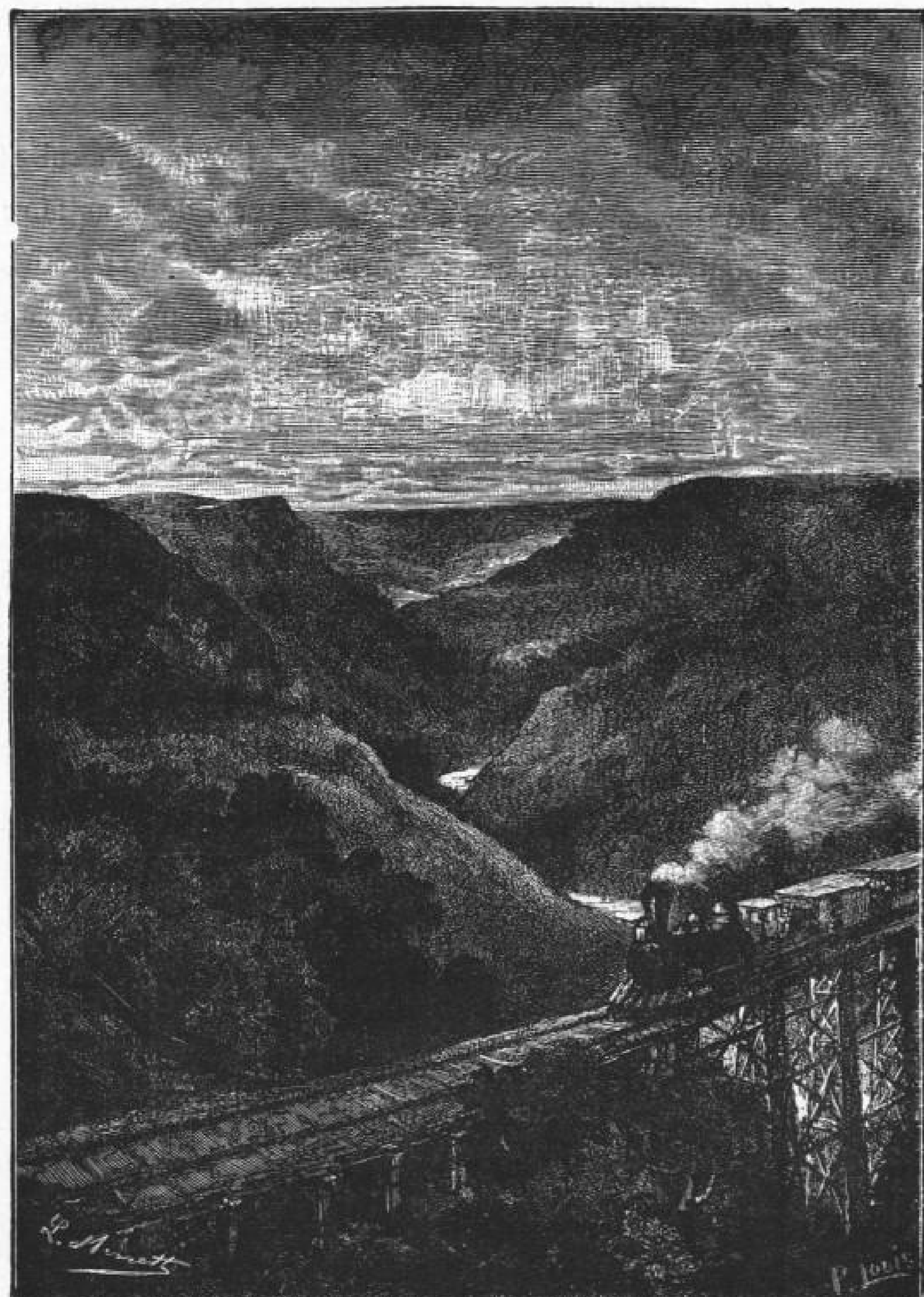
The train, on leaving Great-Salt-Lake and the Ogden station, rose for an hour toward the north, as far as Veber-river, having covered about nine hundred miles since San Francisco. From this point it resumed the direction of the east across the rugged massif of the Wahsatch mountains. It is in this part of the territory, comprised between these mountains and the Rocky Mountains properly so called, that the American engineers found themselves grappling with the most serious difficulties. Thus, over this stretch, the subsidy of the government of the Union rose to forty-eight thousand dollars per mile, whereas it was only sixteen thousand dollars on the plain; but the engineers, as has been said, did not force nature, they outwitted her, turning the difficulties, and to reach the great basin, a single tunnel, fourteen thousand feet long, was pierced in the whole course of the railroad.
It was at Salt Lake itself that the line had up to then reached its highest altitude. From this point, its profile described a very elongated curve, descending toward the valley of Bitter-creek, to rise again to the dividing point of the waters between the Atlantic and the Pacific. The rivers were numerous in
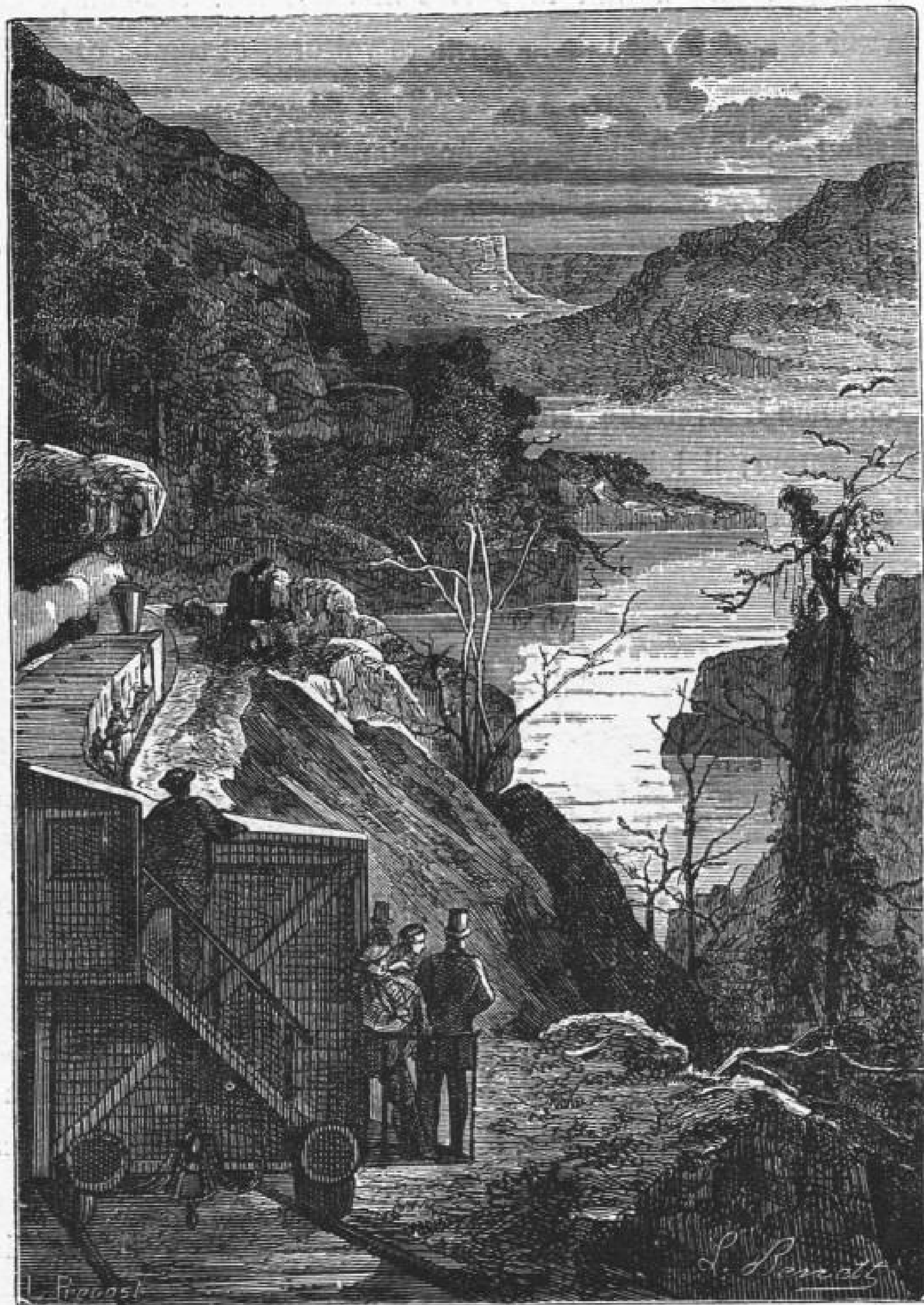
this mountainous region. It was necessary to cross on small bridges the Muddy, the Green, and others. Passepartout had become more impatient as he approached the goal. But Fix, in his turn, would have liked to be already out of this difficult country. He feared delays, he dreaded accidents, and was more in haste than Phileas Fogg himself to set foot on English soil!
At ten o'clock in the evening, the train stopped at the Fort-Bridger station, which it left almost immediately, and, twenty miles farther on, it entered the State of Wyoming,—the former Dakota,—following all the valley of Bitter-creek, from which flow a part of the waters that form the hydrographic system of the Colorado.
Green-river. The snow had fallen during the night rather abundantly, but, mingled with rain, half melted, it could not hinder the running of the train. However, this bad weather did not fail to worry Passepartout, for the accumulation of the snows, by miring the wheels of the cars, would certainly have compromised the journey.
"Besides, what an idea," he said to himself, "my master had to travel during the winter! Could he not wait for the fine season to increase his chances?"
But, at this moment, when the honest fellow was preoccupied only with the state of the sky and the lowering of the temperature, Mrs. Aouda was experiencing keener fears, which came from a wholly different cause.
Indeed, several travelers had got down from their car, and were walking on the platform of the Green-river station, waiting for the departure of the train. Now, through the window pane, the young woman recognized among them Colonel Stamp W. Proctor, that American who had behaved so grossly toward Phileas Fogg during the meeting at San Francisco. Mrs. Aouda, not wishing to be seen, threw herself backward.
This circumstance made a vivid impression on the young woman. She had become attached to the man who, however coldly, gave her each day the marks of the most absolute devotion. She doubtless did not understand all the depth of the feeling which her savior inspired in her, and to this feeling she still gave only the name of gratitude, but, unknown to herself, there was more than that. Thus her heart tightened when she recognized the coarse personage from whom Mr. Fogg meant sooner or later to demand satisfaction for his conduct. Evidently it was chance alone that had brought Colonel Proctor into this train, but there he was, and it was necessary at all costs to prevent Phileas Fogg from catching sight of his adversary.
Mrs. Aouda, when the train had started again, took advantage of a moment when Mr. Fogg was dozing to acquaint Fix and Passepartout with the situation.
"This Proctor is in the train!" cried Fix. "Well, reassure yourself, madam, before having to do with the said... with Mr. Fogg, he will have to do with me! It seems to me that, in all this, it is still I who have received the gravest insults!"
— And besides, added Passepartout, I will take charge of him myself, colonel though he is.
— Mr. Fix, resumed Mrs. Aouda, Mr. Fogg will not leave it to anyone else to avenge him. He is a man, he has said so, to return to America to find this insulter. If therefore he catches sight of Colonel Proctor, we shall not be able to prevent an encounter, which may lead to deplorable results. It is therefore necessary that he does not see him.
— You are right, madam, replied Fix, an encounter could ruin everything. Victor or vanquished, Mr. Fogg would be delayed, and...
— And, added Passepartout, that would play into the hands of the gentlemen of the Reform-Club. In four days we shall be in New York! Well then, if for four days my master does not leave his car, we may hope that chance will not bring him face to face with this accursed American, whom God confound! But we shall know well enough how to prevent it...
The conversation was interrupted. Mr. Fogg had awakened, and was looking at the countryside through the windowpane spotted with snow. But, later, and without being heard by his master or Mrs. Aouda, Passepartout said to the police inspector:
“Would you really fight for him?”
“I would do anything to bring him back to Europe alive!” Fix answered simply, in a tone that bespoke an implacable will.
Passepartout felt something like a shudder run through his body, but his convictions regarding his master did not waver.
And now, was there any way of keeping Mr. Fogg in this compartment in order to prevent any meeting between the colonel and him? That could not be difficult, the gentleman being of a somewhat unexcitable and incurious nature. In any case, the police inspector believed he had found the means, for a few moments later he was saying to Phileas Fogg:
“They are long and slow hours, sir, that one spends thus on a railway train.”
“Indeed,” replied the gentleman, “but they pass.”
“On board the steamers,” resumed the inspector, “you were in the habit of playing your whist?”
“Yes,” replied Phileas Fogg, “but here it would be difficult. I have neither cards nor partners.”
“Oh! cards, we will find some to buy. They sell everything in the American cars. As for partners, if, by chance, madame—”
“Certainly, sir,” answered the young woman quickly, “I know whist. It is part of an English education.”
“And I,” resumed Fix, “I have some pretensions to playing this game well. So, with the three of us and a dummy—”
“As you please, sir,” replied Phileas Fogg, delighted to take up his favorite game—even on a railway train.
Passepartout was dispatched in search of the steward, and he soon returned with two complete packs, counters, chips, and a tablet covered with cloth. Nothing was missing. The game began. Mrs. Aouda knew whist very sufficiently, and she even received some compliments from the severe Phileas Fogg. As for the inspector, he was simply first-rate, and worthy to stand up to the gentleman.
“Now,” Passepartout said to himself, “we have him. He will not move any more!”
At eleven o’clock in the morning, the train had reached the water-parting point of the two oceans. It was at Passé-Bridger, at a height of seven thousand five hundred and twenty-four English feet above sea level, one of the highest points touched by the profile of the route in this passage through the Rocky Mountains. After about two hundred miles, the travelers would at last find themselves on those longplains which extend to the Atlantic, and which nature made so favorable for the establishment of a railway line.
On the slope of the Atlantic basin, the first rios, tributaries or sub-tributaries of the North Platte River, were already unfolding. The whole horizon to the north and east was covered by that immense semicircular curtain which forms the northern portion of the Rocky Mountains, dominated by Laramie Peak. Between this curve and the railway line stretched vast plains, abundantly watered. To the right of the railroad rose in tiers the first slopes of the mountain mass which curves southward to the sources of the Arkansas River, one of the great tributaries of the Missouri.
At half past twelve, the travelers glimpsed for a moment Fort Halleck, which commands that region. A few more hours, and the crossing of the Rocky Mountains would be accomplished. One could therefore hope that no accident would mark the train’s passage through this difficult region. The snow had stopped falling. The weather was turning cold and dry. Great birds, frightened by the locomotive, fled into the distance. No wild beast, bear or wolf, showed itself on the plain. It was the desert in its immense bareness.
After a rather comfortable lunch, served in the car itself, Mr. Fogg and his partners had just resumed their interminable whist when violent blasts of the whistle were heard. The train stopped.
Passepartout put his head to the window and saw nothing that justified this stop. No station was in sight.
Mrs. Aouda and Fix could fear for a moment that Mr. Fogg might think of getting down onto the track. But the gentleman contented himself with saying to his servant:
“Go and see what it is.”
Passepartout rushed out of the car. Some forty travelers had already left their seats, and among them Colonel Stamp W. Proctor.
The train was stopped before a signal turned to red which closed the track. The engineer and the conductor, having climbed down, were arguing rather heatedly with a track guard, whom the stationmaster of Medicine Bow, the next station, had sent to meet the train. Some travelers had approached and were taking part in the discussion—among others the aforesaid Colonel Proctor, with his loud voice and imperious gestures.
Passepartout, having joined the group, heard the track guard saying:
“No! there is no way through! The Medicine Bow bridge is shaken and would not bear the weight of the train.”
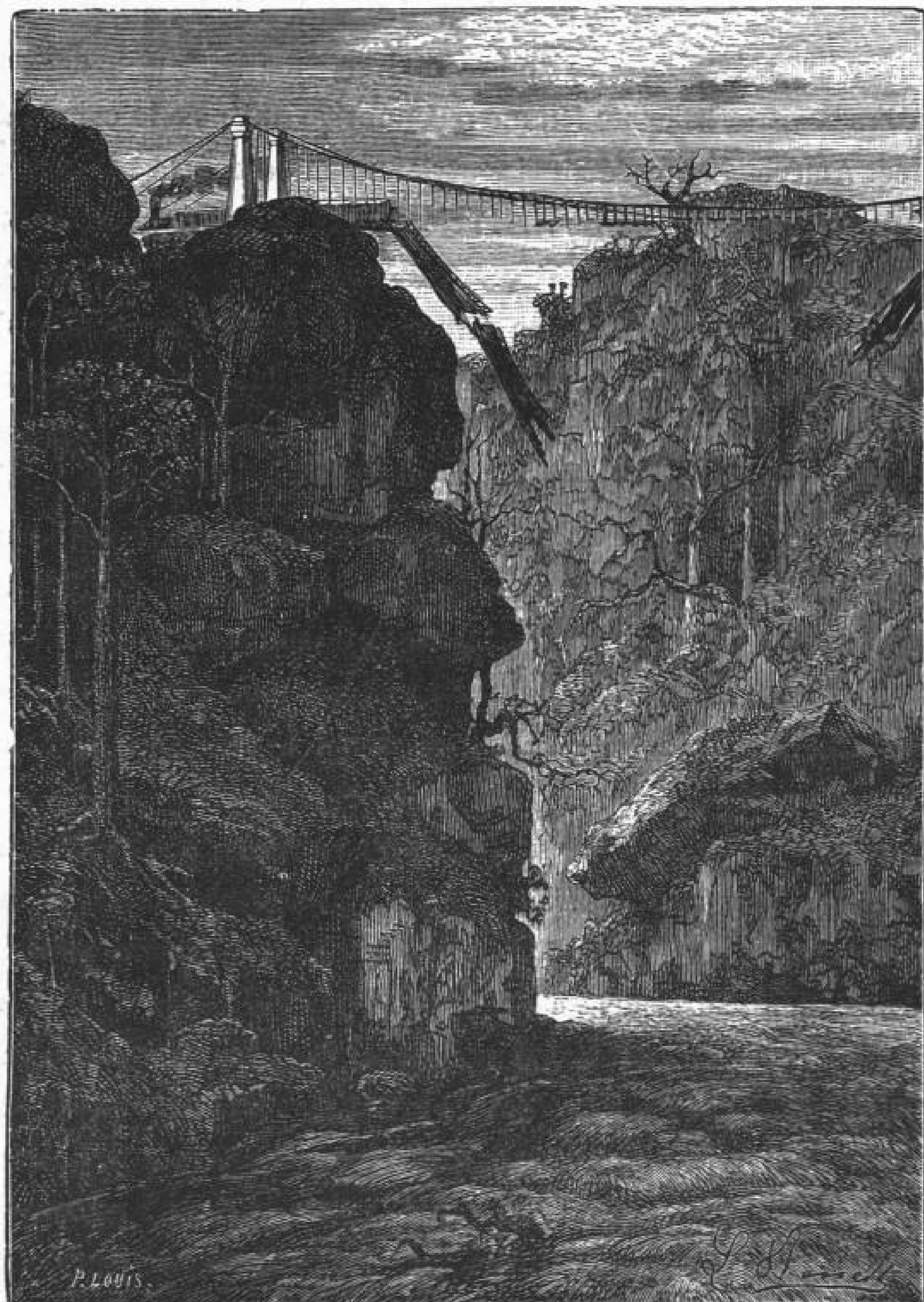
This bridge, which was in question, was a suspension bridge thrown over a rapids,a mile from the place where the convoy had stopped. According to the track guard, it threatened ruin, several of the wires were broken, and it was impossible to risk crossing it. The track guard was therefore in no way exaggerating when he affirmed that they could not pass. And besides, with the Americans’ habits of carelessness, one may say that when they set about being prudent, it would be madness not to be so.
Passepartout, not daring to go and warn his master, listened with clenched teeth, motionless as a statue.
“Well now!” cried Colonel Proctor, “we are not going to stay here, I imagine, taking root in the snow!”
“Colonel,” replied the conductor, “we have telegraphed to the Omaha station to ask for a train, but it is not likely to reach Medicine Bow before six hours.”
“Six hours!” cried Passepartout.
“No doubt,” replied the conductor. “Besides, we will need that time to reach the station on foot.”
“On foot!” cried all the travelers.
“But at what distance is this station, then?” one of them asked the conductor.
“Twelve miles, on the other side of the river.”
“Twelve miles in the snow!” cried Stamp W. Proctor.
The colonel let loose a volley of oaths, attacking the company, attacking the conductor, and Passepartout, furious, was not far from joining in chorus with him. There was a material obstacle against which, this time, all his master’s banknotes would founder.
Moreover, the disappointment was general among the travelers, who, not counting the delay, found themselves obliged to make some fifteen miles across the plain covered with snow. So it was a hubbub, exclamations, vociferations, which would certainly have attracted the attention of Phileas Fogg, had this gentleman not been absorbed in his game.
However, Passepartout found himself under the necessity of warning him, and, with his head down, he was making his way toward the car, when the train’s engineer—a true Yankee, named Forster—raising his voice, said:“Gentlemen, there might perhaps be a way to pass.”
“Over the bridge?” replied a traveler.
“Over the bridge.”
— With our train? asked the colonel.— With our train.
Passepartout had stopped and was drinking in the mechanic's words.
"But the bridge is threatening to collapse!" resumed the conductor.
"No matter," replied Forster. "I believe that by launching the train at its maximum speed, we would have some chance of getting across."
"The devil!" said Passepartout.
But a certain number of passengers had immediately been won over by the proposal. It particularly pleased Colonel Proctor. That hotheaded brain found the thing very feasible. He even recalled that engineers had had the idea of crossing rivers "without a bridge" with rigid trains launched at full speed, etc. And, in the end, all those interested in the question fell in with the mechanic's opinion.
"We have fifty chances of getting across," said one.
"Sixty," said another.
"Eighty!... ninety out of a hundred!"
Passepartout was dumbfounded, although he was ready to attempt anything to accomplish the crossing of Medicine Creek, but the attempt seemed to him a little too "American."
"Besides," he thought, "there is a much simpler thing to do, and these people do not even think of it!... Sir," he said to one of the passengers, "the means proposed by the mechanic seems to me a little hazardous, but—"
"Eighty chances!" replied the traveler, turning his back on him.
"I know well enough," replied Passepartout, addressing another gentleman, "but a simple reflection—"
"No reflection, it is useless!" replied the American thus addressed, shrugging his shoulders, "since the mechanic assures us that we shall get across!"
"No doubt," resumed Passepartout, "we shall get across, but it would perhaps be more prudent—"
"What! prudent!" cried Colonel Proctor, whom this word, heard by chance, made start. "At full speed, I tell you! Do you understand? At full speed!"
"I know... I understand..." repeated Passepartout, whom no one would let finish his sentence, "but it would be, if not more prudent, since the word shocks you, at least more natural..."
“Who? What? What’s the matter with that fellow and his ‘natural’?” people exclaimed on every side.
The poor boy no longer knew whom to make himself heard by.
“Are you afraid?” Colonel Proctor asked him.
“I, afraid!” cried Passepartout. “Well, so be it! I’ll show these people that a Frenchman can be as American as they are!”
“All aboard! All aboard!” shouted the conductor.
“Yes! all aboard!” repeated Passepartout, “all aboard! And right away! But no one will stop me from thinking that it would have been more natural to make us travelers cross that bridge on foot first, and then the train afterwards!”
But no one heard this wise reflection, and no one would have wished to acknowledge its soundness.
The travelers were back in their car. Passepartout took his seat again, saying nothing of what had happened. The players were wholly absorbed in their whist.
The locomotive whistled vigorously. The engineer, reversing the steam, brought his train back nearly a mile, backing up like a jumper who wants to take his run.
Then, at a second whistle, the forward motion began again; it accelerated; soon the speed became frightful; nothing could be heard but a single neighing sound issuing from the locomotive; the pistons beat twenty strokes a second; the wheel axles smoked in the grease boxes. One felt, so to speak, that the entire train, moving with a speed of a hundred miles an hour, no longer weighed upon the rails. Speed was devouring weight.
And they passed! And it was like a flash of lightning. Nothing of the bridge was seen. The convoy leaped, one might say, from one bank to the other, and the engineer did not manage to stop his runaway engine until five miles beyond the station.
But scarcely had the train crossed the river when the bridge, definitively ruined, collapsed with a crash into the rapids of Medicine Bow.