
About this book
Fogg bets his fortune he can circle the globe in eighty days. Verne's 1872 novel, French original, Hetzel edition, free to read online.
IN WHICH THE MASTER OF THE “TANKADÈRE” RUNS A GREAT RISK OF LOSING A TWO-HUNDRED-POUND BONUS.
This navigation of eight hundred miles, in a twenty-ton craft, and especially at that time of year, was an adventurous expedition. Those China seas are generally bad, exposed to terrible gales, principally during the equinoxes, and it was still the first days of November.
It would obviously have been to the pilot’s advantage to take his passengers all the way to Yokohama, since he was paid so much per day. But it would have been greatly imprudent of him to attempt such a passage under those conditions, and it was already an act of boldness, if not recklessness, to go up as far as Shanghai. But John Bunsby had confidence in his Tankadère, which rose over the waves like a mallow, and perhaps he was not wrong.
During the last hours of that day, the Tankadère sailed through the capricious channels of Hong Kong, and under all headings, close-hauled or before the wind, she behaved admirably.
“I do not need, pilot,” said Phileas Fogg at the moment when the schooner gained the open sea, “to urge upon you all possible diligence.
“Let Your Honor rely on me,” replied John Bunsby. “As for sails, we carry everything the wind permits. Our jibs would add nothing, and would only serve to overwhelm the boat by hindering her progress.”
“That is your trade, not mine, pilot, and I trust you.”
Phileas Fogg, his body erect, his legs apart, steady as a sailor, watched the swelling sea without flinching. The young woman, seated at the stern, felt moved as she contemplated this Ocean, already darkened by twilight, which she was braving in a frail boat. Above her head spread the white sails, carrying her through space like great wings. The schooner, lifted by the wind, seemed to fly through the air.
Night came. The moon was entering its first quarter, and its insufficient light would soon fade in the mists of the horizon. Clouds were driving in from the east and already invading part of the sky.
The pilot had set out his position lights—an indispensable precaution to take in these seas, which were very frequented near the landfalls. Encounters with ships were not rare there, and, with the speed that animated her, the schooner would have been shattered at the slightest collision.
Fix was brooding at the bow of the boat. He kept himself apart, knowing Fogg to be of a scarcely talkative nature. Besides, it repelled him to speak to this man, whose services he was accepting. He was also thinking of the future. It seemed certain to him that this Mr. Fogg would not stop at Yokohama, that he would immediately take the San Francisco packet in order to reach America, whose vast expanse would assure him impunity along with safety. Phileas Fogg’s plan seemed to him as simple as could be.
Instead of embarking in England for the United States, like a vulgar rogue, this Fogg had made the grand tour and crossed three quarters of the globe, in order to reach the American continent more surely, where he would quietly devour the million from the Bank, after having thrown the police off his track. But once on the soil of the Union, what would Fix do? Would he abandon this man? No, a hundred times no! and until he had obtained an act of extradition, he would not leave him by a single step. It was his duty, and he would carry it out to the end. In any case, a fortunate circumstance had occurred: Passepartout was no longer near his master, and above all, after Fix’s confidences, it was important that master and servant should never see each other again.
Phileas Fogg, for his part, was not without thoughts of his servant, so strangely disappeared. All things considered, it did not seem impossible to him that, as the result of a misunderstanding, the poor lad might have embarked on the Carnatic at the last moment. This was also Mrs. Aouda's opinion, and she deeply regretted that honest servant to whom she owed so much. It was therefore possible that he might be found again at Yokohama, and if the Carnatic had carried him there, it would be easy to know.
Towards ten o'clock the breeze began to freshen. Perhaps it would have been prudent to take a reef, but the pilot, after carefully observing the state of the sky, left the sails as they were set. Besides, the Tankadère carried her canvas admirably, having a great draught, and everything was ready to shorten sail rapidly in case of a squall.
At midnight Phileas Fogg and Mrs. Aouda went down into the cabin. Fix had preceded them, and had stretched himself out on one of the berths. As for the pilot and his men, they remained on deck all night.
The next day, November 8th, at sunrise, the schooner had made more than a hundred miles. The log, frequently heaved, indicated that her average speed was between eight and nine miles. The Tankadère had a free sheet, her sails all drawing, and under this trim she attained her maximum of speed. If the wind held in these conditions, the chances were in her favor.
The Tankadère, throughout that day, did not noticeably draw away from the coast, whose currents were favorable to her. She had it at five miles at most on her port beam, and this coast, irregularly outlined, appeared sometimes through a few clearings. The wind coming from the land, the sea was less heavy there for that very reason: a happy circumstance for the schooner, for vessels of small tonnage suffer especially from the swell, which breaks their speed, which "kills" them, to use the maritime expression.
Towards noon the breeze moderated a little and hauled to the southeast. The pilot had the flying jibs set; but at the end of two hours they had to be taken in, for the wind was freshening again.
Mr. Fogg and the young woman, fortunately proof against seasickness, ate with appetite the preserves and biscuit of the ship. Fix was invited to share their meal and had to accept, knowing well that it is as necessary to ballast stomachs as ships, but it vexed him! To travel at this man's expense, to feed on his own provisions—he found something disloyal in it. He ate, however—hurriedly, it is true—but at last he ate.
However, when the meal was over, he thought it his duty to take Mr. Fogg aside, and he said to him:
"Sir..."
That "sir" scraped his lips, and he restrained himself from seizing this "sir" by the collar!
"Sir, you have been very obliging in offering me passage on board your vessel. But, although my resources do not permit me to act as generously as you, I intend to pay my share..."
"Let us not speak of that, sir," replied Mr. Fogg.
"But I insist..."
"No, sir," repeated Fogg in a tone that admitted no reply. "That comes under general expenses!"
Fix bowed; he was suffocating, and, going to stretch himself out forward on the schooner, he said not another word all day.
Meanwhile they were speeding along rapidly. John Bunsby had good hope. Several times he told Mr. Fogg that they would arrive at Shanghai in good time. Mr. Fogg simply replied that he counted on it. Besides, the whole crew of the little schooner put zeal into it. The bonus spurred these brave fellows on. So not a sheet that was not conscientiously hauled taut! Not a sail that was not vigorously stretched! Not a yaw that could be reproached to the helmsman! They would not have maneuvered more severely in a regatta of the Royal Yacht Club.
In the evening the pilot had logged a run of two hundred and twenty miles since Hong Kong, and Phileas Fogg could hope that, on arriving at Yokohama, he would have no delay to record against his program. Thus the first serious setback he had experienced since his departure from London would probably cause him no harm.
During the night, towards the early morning hours, the Tankadère entered squarely into the Strait of Fo-Kien, which separates the great island of Formosa from the Chinese coast, and she crossed the Tropic of Cancer. The sea was very rough in that strait, full of eddies formed by the counter-currents. The schooner labored heavily. The short waves broke her progress. It became very difficult to stand upright on deck.
With the rising of the day, the wind freshened still more. There was in the sky the appearance of a squall. Besides, the barometer announced a coming change in the atmosphere; its diurnal march was irregular, and the mercury oscillated capriciously. The sea was also seen to rise towards the southeast in long swells "that smelt of the tempest." The day before, the sun had set in a red mist, amid the phosphorescent scintillations of the Ocean.
The pilot examined this bad aspect of the sky for a long time and murmured between his teeth things scarcely intelligible. At a certain moment, finding himself near his passenger:
"May I tell Your Honor everything?" he said in a low voice.
"Everything," replied Phileas Fogg.
"Well, we are going to have a squall."
"Will it come from the north or the south?" Mr. Fogg simply asked.
"From the south. Look. It is a typhoon that is brewing!"
"Let it be the typhoon from the south, since it will drive us the right way," replied Mr. Fogg.
"If you take it like that!" rejoined the pilot, "I have nothing more to say."
John Bunsby's forebodings did not deceive him. At a less advanced season of the year, the typhoon, to use a celebrated meteorologist's expression, would have flowed like a luminous cascade of electric flames, but, at the winter equinox, it was to be feared that it would unleash itself with violence. The pilot took his precautions in advance. He had all the schooner's sails furled and the yards lowered to the deck. The topgallant masts were struck. The bowsprit was run in. The hatches were carefully secured. Not a drop of water could thenceforth penetrate the hull of the vessel. A single triangular sail, a storm jib of strong canvas, was hoisted in the manner of a foresail, so as to keep the schooner running before the wind. And they waited.
John Bunsby had urged his passengers to go down into the cabin; but, in a narrow space almost deprived of air, and with the jolts of the swell, this imprisonment had nothing agreeable about it. Neither Mr. Fogg, nor Mrs. Aouda, nor Fix himself, consented to leave the deck.
Towards eight o'clock the squall of rain and gust struck the vessel. With nothing but her little piece of canvas, the Tankadère was carried away like a feather by that wind of which no exact idea can be given when it blows in tempest. To compare its speed to the quadruple speed of a locomotive launched at full steam would be to remain below the truth.
All day long the boat ran thus towards the north, carried along by the monstrous waves, fortunately preserving a speed equal to theirs. Twenty times she was on the point of being overwhelmed by one of those mountains of water which rose up astern; but a skilful turn of the helm, given by the pilot, warded off the catastrophe. The passengers were sometimes completely covered by the spray, which they received philosophically. Fix no doubt grumbled, but the intrepid Aouda, with her eyes fixed on her companion, whose coolness she could not but admire, showed herself worthy of him, and braved the storm at his side. As for Phileas Fogg, it seemed as though this typhoon formed part of his programme.
Until then the Tankadère had always held her course to the north; but towards evening, as was to be feared, the wind, shifting three points, hauled to the north-west. The schooner, presenting her flank to the sea, was then fearfully shaken. The waves struck her with a violence well calculated to inspire terror, when one does not know with what solidity all the parts of a vessel are bound together.
With the night the tempest increased still more. Seeing the darkness come on, and with the darkness the storm increase, John Bunsby felt lively uneasiness. He asked himself whether it would not be time to put in, and he consulted his crew.
His men consulted, John Bunsby approached Mr. Fogg and said to him:
"I think, your Honour, that we should do well to make for one of the ports on the coast."
"I think so too," replied Phileas Fogg.
"Ah!" said the pilot, "but which one?"
"I know only one," replied Mr. Fogg quietly.
"And that is—?"
"Shanghai."
This reply, the pilot was for some moments without understanding what it meant, what it contained of obstinacy and tenacity. Then he exclaimed:
"Well, yes! Your Honour is right. To Shanghai!"
And the course of the Tankadère was imperturbably maintained towards the north.
Truly terrible night! It was a miracle that the little schooner did not capsize. Twice she was nearly overwhelmed, and everything on board would have been swept away had the halyards given way. Mrs. Aouda was exhausted, but she did not utter a single complaint. More than once Mr. Fogg had to rush to her side to protect her from the violence of the waves.
Day broke again. The storm was still raging with extreme fury. However, the wind shifted back to the southeast. This was a favorable change, and the Tankadère once again set her course over that mountainous sea, whose waves now clashed against those raised by the new quarter of the wind. Hence a collision of cross-seas that would have crushed a boat less solidly built.
From time to time the coast could be glimpsed through the torn mists, but not a single ship was in sight. The Tankadère was alone on the sea.
At noon there were some signs of the storm abating, which became more pronounced as the sun lowered toward the horizon.
The short duration of the storm was due to its very violence. The passengers, utterly worn out, were able to eat a little and take some rest.
The night was relatively calm. The pilot had his sails set again at a single reef. The speed of the boat was considerable. The next day, the 11th, at daybreak, after reconnoitering the coast, John Bunsby was able to affirm that they were not a hundred miles from Shanghai.
A hundred miles, and only that one day left to cover them! Mr. Fogg was to arrive at Shanghai that very evening if he did not want to miss the departure of the Yokohama steamer. Without this storm, during which he had lost several hours, he would not at that moment have been thirty miles from the port.
The breeze was noticeably softening, but fortunately the sea was falling with it. The schooner was covered with canvas. Topsails, studding sails, jib, everything was set, and the sea foamed beneath her bows.
At noon the Tankadère was no more than forty-five miles from Shanghai.
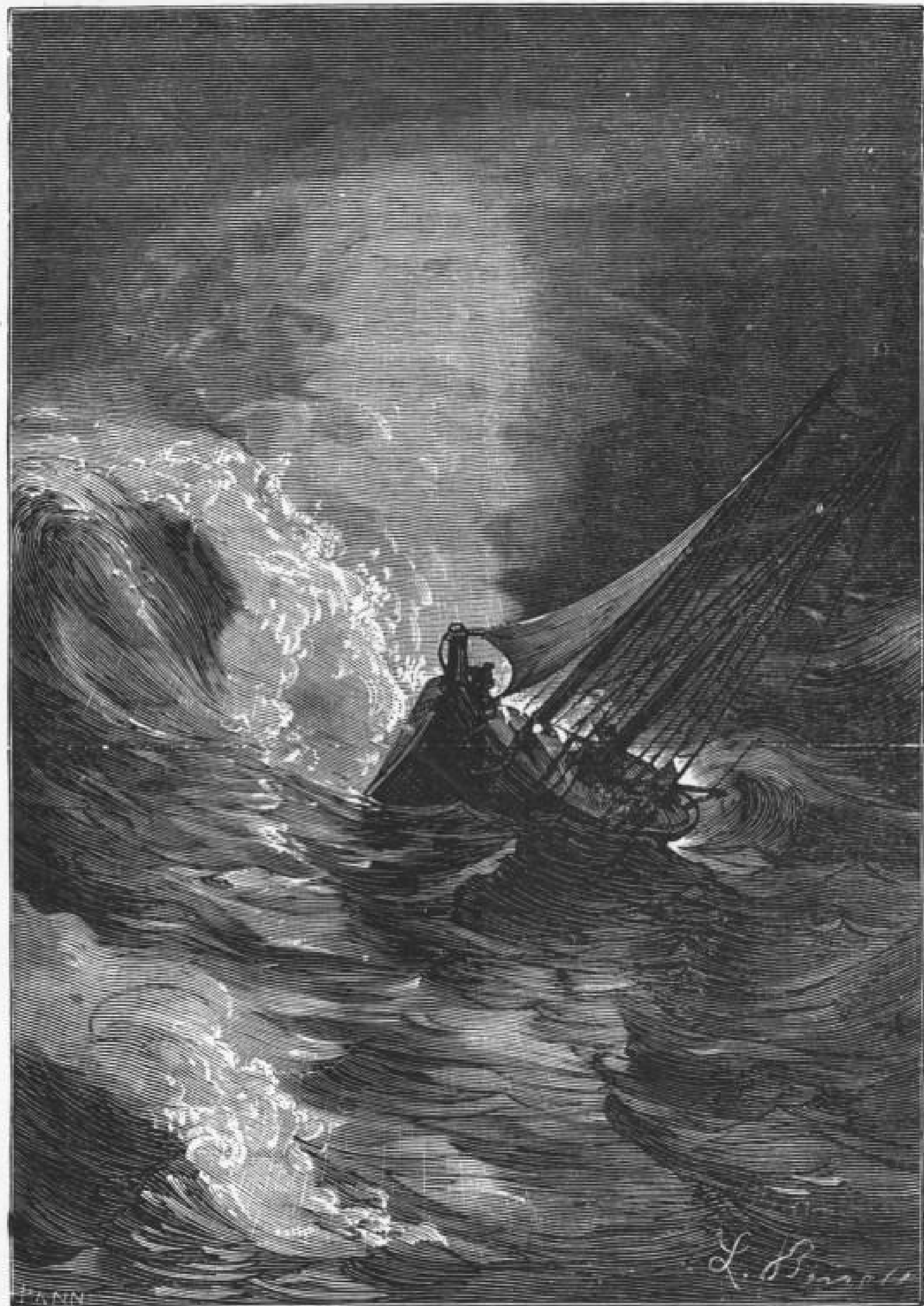
The Tankadère was carried along like a feather. (Page 118.)
She still had six hours left to reach that port before the departure of the Yokohama steamer.
Fears ran high on board. They wanted to arrive at any cost. Everyone—except Phileas Fogg, no doubt—felt their heart beat with impatience. The little schooner had to maintain an average of nine miles an hour, and the wind was still softening! It was an irregular breeze, capricious gusts coming from the coast. They passed, and the sea smoothed over immediately after their passage.
Yet the boat was so light, her tall sails of such fine cloth caught the fitful breezes so well that, with the current helping, by six o'clock John
Bunsby counted no more than ten miles to the Shanghai River, for the city itself lies at a distance of at least twelve miles above the mouth.
At seven o'clock they were still three miles from Shanghai. A formidable oath escaped the pilot's lips... The two-hundred-pound bonus was obviously about to slip from his grasp. He looked at Mr. Fogg. Mr. Fogg was impassive, and yet his entire fortune was at stake at that moment...
At that same moment, too, a long black spindle, crowned with a plume of smoke, appeared at the water's edge. It was the American steamer, leaving at the regulation hour. "Curse it!" cried John Bunsby, pushing the tiller away with a desperate arm. "Signals!" said Phileas Fogg simply.
...
A small bronze cannon lay extended at the bow of the Tankadère. It was used to make signals in foggy weather.
The cannon was loaded to the muzzle, but at the moment the pilot was about to apply a burning coal to the touchhole:
"The flag at half-mast," said Mr. Fogg.
The flag was lowered to mid-mast. It was a distress signal, and it was to be hoped that the American steamer, catching sight of it, would alter its course for an instant to come alongside the boat.
"Fire!" said Mr. Fogg.
And the detonation of the little bronze cannon burst through the air.