
About this book
Fogg bets his fortune he can circle the globe in eighty days. Verne's 1872 novel, French original, Hetzel edition, free to read online.
X X I X
IN WHICH WILL BE GIVEN AN ACCOUNT OF VARIOUS INCIDENTS WHICH ARE ENCOUNTERED ONLY ON THE RAILROADS OF THE UNION.
That very evening, the train continued on its way without obstacles, passed Fort Sauders, crossed the Cheyenne Pass, and arrived at Evans Pass. At this point, the railroad reached the highest point of the route, namely eight thousand
and ninety-one feet above the level of the Ocean. The travelers had only to descend to the Atlantic over those boundless plains, leveled by nature.
,
There was located on the “grand trunk” the junction of Denver City, the principal town of Colorado. This territory is rich in gold and silver mines, and more than fifty thousand inhabitants have already fixed their dwelling there.
At this moment, one thousand three hundred and eighty-two miles had been covered since San Francisco, in three days and three nights. Four nights and four days, according to all prediction, ought to suffice to reach New York. Phileas Fogg was therefore keeping within the regulation delays.
During the night, Camp Walbah was left on the left. Lodge-pole Creek ran parallel to the track, following the straight frontier common to the States of Wyoming and Colorado. At eleven o’clock, they were entering Nebraska, passing near Sedgwick, and touching at Julesburgh, situated on the south branch of Platte River.
It was at this point that the inauguration of the Union Pacific Railroad took place, on October 23, 1867, and whose chief engineer was General J.-M. Dodge. There the two powerful locomotives stopped, hauling the nine cars of the guests, among whom was the vice-president, Mr. Thomas C. Duran; there acclamations resounded; there the Sioux and the Pawnees gave the spectacle of a little Indian war; there fireworks burst forth; there, finally, was published, by means of a portable printing press, the first issue of the newspaper Railway-Pioneer. Thus was celebrated the inauguration of this great railway, instrument of progress and civilization, thrown across the desert and destined to link together towns and cities which did not yet exist. The whistle of the locomotive, more powerful than the lyre of Amphion, was soon to make them spring from American soil.
At eight o’clock in the morning, Fort Mac-Pherson was left behind. Three hundred and fifty-seven miles separate this point from Omaha. The railway followed, on its left bank, the capricious windings of the south branch of Platte River. At nine o’clock, they arrived at the important town of North Platte, built between those two arms of the great watercourse, which join around it to form only a single artery—a considerable tributary whose waters merge with those of the Missouri, a little above Omaha.
The one hundred and first meridian was crossed.
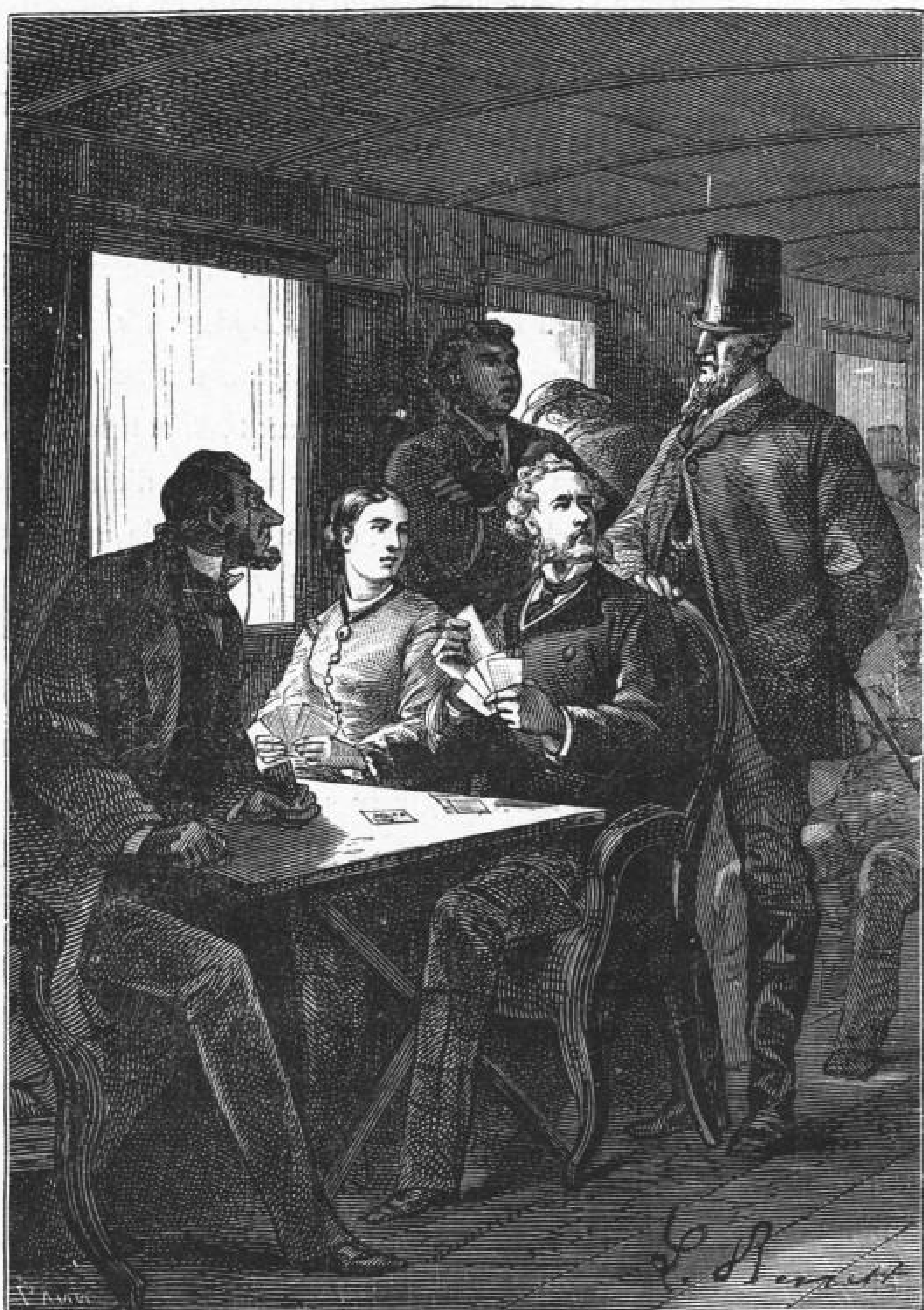
Mr. Fogg and his partners had resumed their game. None of them complained of the length of the route—not even the dead man. Fix had begun by winning a few guineas, which he was in the process of losing again, but he appeared no less passionate than Mr. Fogg. During that morning, chance singularly favored this gentleman. Trumps and honors rained into his hands. At a certain moment, after having combined a bold stroke, he was preparing to play spades, when, behind the seat, a voice made itself heard, saying:
“I would play diamonds…”
Mr. Fogg, Mrs. Aouda, and Fix raised their heads. Colonel Proctor was near them.
Stamp W. Proctor and Phileas Fogg recognized each other at once.
“Ah! it’s you, Mr. Englishman,” cried the colonel, “it’s you who want to play spades!”
“And who plays it,” replied Phileas Fogg coldly, laying down a ten of that suit.
“Well, it pleases me that it should be diamonds,” replied Colonel Proctor in an irritated voice. And he made a gesture to seize the card played, adding:
“You understand nothing of this game.”
“Perhaps I shall be more skillful at another,” said Phileas Fogg, who rose.
“It depends only on you to try, son of John Bull!” replied the coarse individual.
Mrs. Aouda had turned pale. All her blood rushed back to her heart. She had seized Phileas Fogg’s arm, who gently pushed her away. Passepartout was ready to throw himself upon the American, who was looking at his adversary with the most insulting air. But Fix had risen, and, going to Colonel Proctor, he said to him:
“You forget that it is I with whom you have to deal, sir, I whom you have not only insulted but struck!”
“Mr. Fix,” said Mr. Fogg, “I beg your pardon, but this concerns me alone. By claiming that I was wrong to play spades, the colonel has offered me a new insult, and he will give me satisfaction for it.”
“Whenever you like, and wherever you like,” replied the American, “and with whatever weapon you please!”
Mrs. Aouda tried in vain to hold Mr. Fogg back. The inspector attempted in vain to take the quarrel upon himself. Passepartout wanted to throw the colonel out the window, but a sign from his master stopped him. Phileas Fogg left the car, and the American followed him onto the platform.
“Sir,” said Mr. Fogg to his adversary, “I am in great haste to return to Europe, and any delay whatever would greatly prejudice
my interests.”
— Well! what does that matter to me? replied Colonel Proctor.
— Sir, very politely resumed Mr. Fogg, after our meeting at San Francisco, I had formed the project of coming to find you again in America, as soon as I should have finished the business which calls me to the old continent.
— Really!
— Will you give me an appointment in six months?
— Why not in six years?
— I say six months, replied Mr. Fogg, and I will be exact at the appointment.
— Defeats, all that! cried Stamp W. Proctor. Right away or not.
— So be it, replied Mr. Fogg. Are you going to New York?
— No.
— To Chicago?
— No.
— To Omaha?
— Little does it matter to you! Do you know Plum Creek?
— No, replied Mr. Fogg.
— It is the next station. The train will be there in an hour. It will stop there ten minutes. In ten minutes, one can exchange a few revolver shots.
— So be it, replied Mr. Fogg. I will stop at Plum Creek.
— And I even believe that you will stay there! added the American with unequaled insolence.
— Who knows, sir? replied Mr. Fogg, and he went back into his car, as cold as usual.
There, the gentleman began by reassuring Mrs. Aouda, telling her that braggarts were never to be feared. Then he begged Fix to serve him as witness in the encounter which was about to take place. Fix could not refuse, and Phileas Fogg tranquilly resumed his interrupted game, playing spades with perfect calm.
At eleven o'clock, the whistle of the locomotive announced the approach of Plum Creek station. Mr. Fogg rose, and, followed by Fix, he went out onto the platform. Passepartout accompanied him, carrying a pair of revolvers. Mrs. Aouda had remained in the car, pale as a corpse.
At that moment, the door of the other car opened, and Colonel Proctor appeared likewise on the platform, followed by his second, a Yankee of his own stamp. But at the instant when the two adversaries were about to step down onto the track, the conductor ran up and shouted to them:
"You don't get off, gentlemen.
"And why not?" asked the colonel.
"We are twenty minutes late, and the train does not stop.
"But I must fight with this gentleman.
"I am sorry," replied the employee, "but we are starting again immediately. There is the bell ringing!"
The bell was indeed ringing, and the train set off again.
"I am truly sorry, gentlemen," the conductor then said. "Under any other circumstances, I could have obliged you. But after all, since you have not had time to fight here, who is to prevent you from fighting on the way?"
"That may not suit the gentleman!" said Colonel Proctor, with a bantering air.
"It suits me perfectly," replied Phileas Fogg.
"Well now, decidedly, we are in America!" thought Passepartout. "And the train conductor is a gentleman of the very best society!"
And so saying, he followed his master.
The two adversaries, with their seconds, preceded by the conductor, made their way, passing from one car to another, to the rear of the train. The last car was occupied only by some ten travelers. The conductor asked them whether they would kindly, for a few moments, leave the place free for two gentlemen who had an affair of honor to settle.
Of course! But the travelers were only too glad to be able to oblige the two gentlemen, and they withdrew onto the platforms.
This car, some fifty feet long, lent itself very suitably to the occasion. The two adversaries could walk toward each other between the benches and shoot each other at their ease. Never was a duel easier to arrange. Mr. Fogg and Colonel Proctor, each provided with two six-shot revolvers, entered the car. Their seconds, remaining outside, shut them in. At the first whistle of the locomotive, they were to begin firing... Then, after the space of two minutes, they would remove from the car whatever remained of the two gentlemen.
Nothing could be simpler, in truth. It was even so simple that Fix and Passepartout felt their hearts beating as if they would break.
They were therefore waiting for the agreed whistle, when suddenly savage cries rang out. Detonations accompanied them, but these did not come from the car reserved for the duellists. These detonations, on the contrary, continued toward the front and along the whole line of the train. Cries of fright were heard inside the convoy.
Colonel Proctor and Mr. Fogg, revolver in hand, immediately left the car and rushed toward the front, where the detonations and cries were ringing out more loudly.
They had understood that the train was being attacked by a band of Sioux.
These bold Indians were not making their first attempt, and more than once already they had stopped convoys. Following their habit, without waiting for the train to stop, leaping onto the steps a hundred strong, they had climbed the cars as a clown mounts a galloping horse.
These Sioux were armed with rifles. Hence the detonations to which the travelers, almost all armed, replied with revolver shots. At first, the Indians had rushed upon the engine. The engineer and the stoker had been half stunned by blows from tomahawks. A Sioux chief, wishing to stop the train but not knowing how to work the regulator handle, had opened the steam intake wide instead of closing it, and the locomotive, carried away, was racing at a frightful speed.
At the same time, the Sioux had invaded the cars; they ran like furious monkeys along the roofs, they smashed in the doors and struggled hand to hand with the travelers. Outside the baggage car, forced open and pillaged, the parcels were hurled onto the track. Cries and gunshots did not cease.
Meanwhile the travelers defended themselves with courage. Certain cars, barricaded, withstood a siege like veritable traveling forts, carried along at a speed of a hundred miles an hour.
From the beginning of the attack, Mrs. Aouda had behaved courageously. Revolver in hand, she defended herself heroically, firing through the broken windows whenever some savage presented himself before her. Some twenty Sioux, struck dead, had fallen onto the track, and the wheels of the cars crushed like worms those among them who slid onto the rails from the platforms.
Several travelers, grievously struck by bullets or tomahawks, lay on the benches.
Yet it was necessary to put an end to it. This struggle had already lasted ten minutes, and could only end to the advantage of the Sioux if the train did not stop. Indeed, the station of Fort Kearney was not two miles away. There was an American post there, but once that post was passed, between Fort Kearney and the next station the Sioux would be masters of the train.
The conductor was fighting at Mr. Fogg's side when a bullet brought him down. As he fell, this man cried out:
"We are lost if the train does not stop within five minutes!"
"It will stop!" said Phileas Fogg, who wanted to rush out of the car.
"Stay, sir," Passepartout shouted to him. "That is my business!"
Phileas Fogg had not time to stop this courageous lad, who, opening a door without being seen by the Indians, managed to slip under the car. And then, while the struggle continued, while bullets crossed above his head, recovering his agility, his clown's suppleness, slipping under the cars, clinging to the chains, helping himself with the brake lever and the side beams of the frames, crawling from one carriage to another with marvelous skill, he thus reached the front of the train. He had not been seen, he could not have been.
There, hanging by one hand between the baggage car and the tender, with the other he unhooked the safety chains; but owing to the pull exerted, he could never have managed to unscrew the coupling bar, had not a jolt that the engine received made this bar spring loose, and the train, detached, gradually fell behind, while the locomotive fled with renewed speed.
Carried along by acquired momentum, the train rolled on for a few minutes more, but the brakes were applied inside the cars, and the convoy finally stopped less than a hundred paces from the station of Kearney.
There, the soldiers of the fort, drawn by the gunshots, came running in haste. The Sioux had not waited for them, and before the train had completely stopped, the whole band had decamped.
But when the travelers counted themselves on the station platform, they recognized that several were missing from the roll, and among others the courageous Frenchman whose devotion had just saved them.