
About this book
Fogg bets his fortune he can circle the globe in eighty days. Verne's 1872 novel, French original, Hetzel edition, free to read online.
IN WHICH INSPECTOR FIX TAKES THE INTERESTS
OF PHILEAS FOGG VERY SERIOUSLY.
Phileas Fogg found himself twenty hours behind. Passepartout, the involuntary cause of this delay, was in despair. He had decidedly ruined his master!
At that moment, the inspector approached Mr. Fogg, and, looking him straight in the face:
"Very seriously, sir," he asked him, "are you in a hurry?"
"Very seriously," replied Phileas Fogg.
"I insist," continued Fix. "You have a strong interest in being in New York on the 11th, before nine o'clock in the evening, the departure time of the Liverpool steamer?"
"A major interest."
"And if your journey had not been interrupted by this Indian attack, you would have arrived in New York on the 11th, as early as morning?"
"Yes, twelve hours ahead of the steamer."
"Good. You are therefore twenty hours behind. Between twenty and twelve, the gap is eight. That's eight hours to make up. Do you want to try to do it?"
"On foot?" asked Mr. Fogg.
"No, by sleigh," replied Fix, "by sail sleigh. A man proposed this means of transport to me."
It was the man who had spoken to the police inspector during the night, and whose offer Fix had refused.
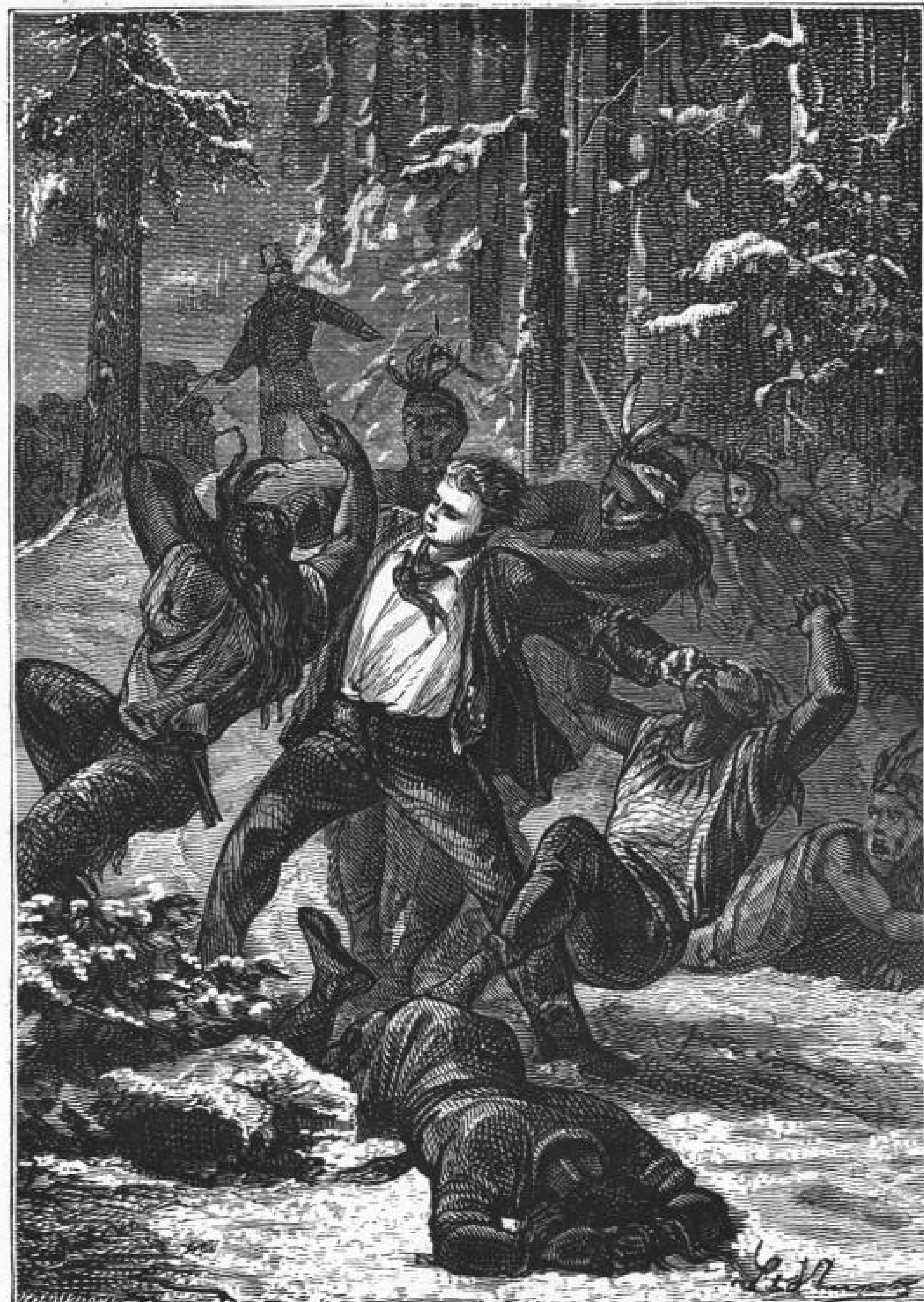
Phileas Fogg did not reply to Fix; but Fix having shown him the man in question who was walking in front of the station, the gentleman went to him. A moment later, Phileas Fogg and this American, named Mudge, entered a hut built at the foot of Fort Kearney.
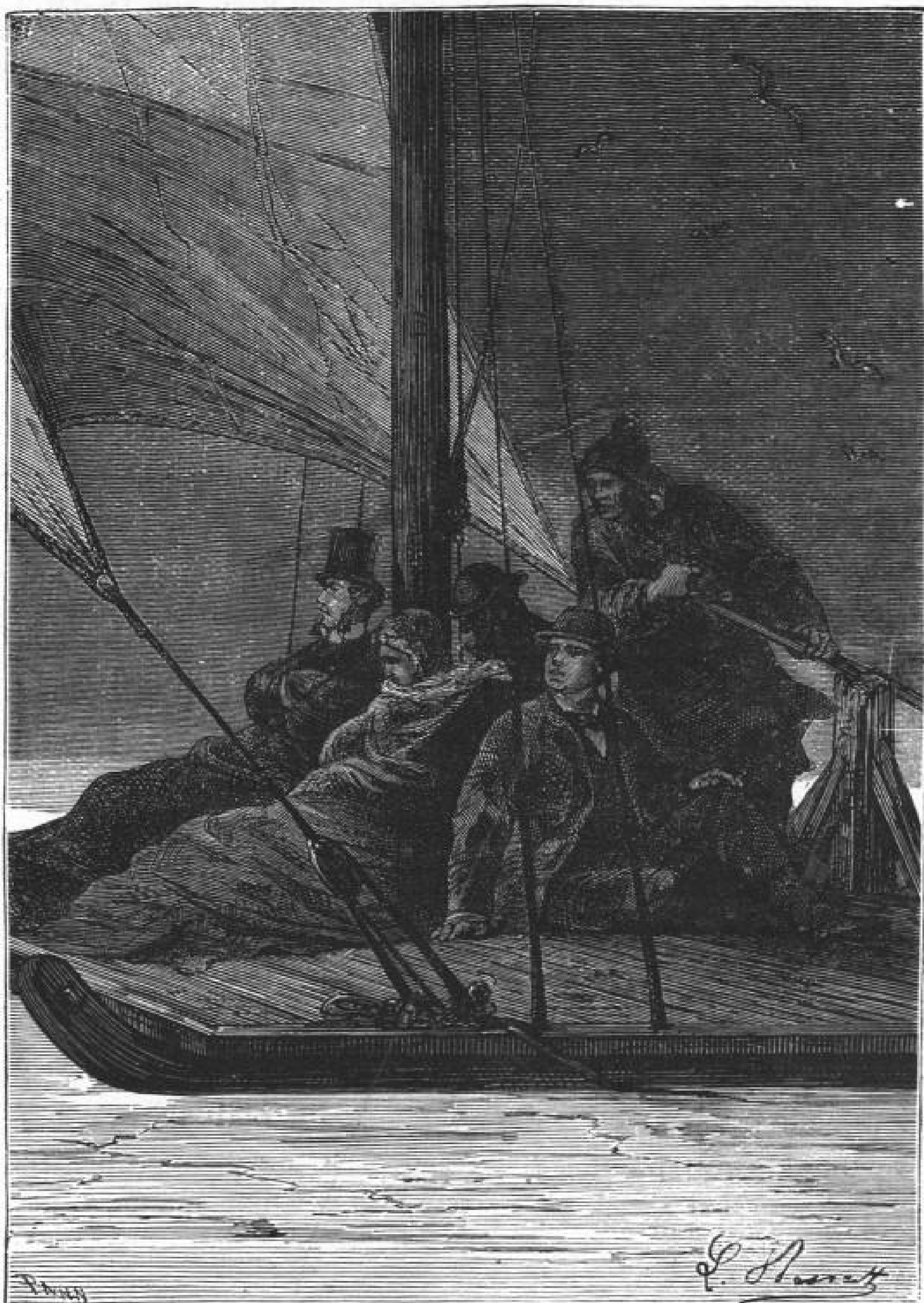
There, Mr. Fogg examined a rather singular vehicle, a sort of chassis, mounted on two long beams, slightly raised at the front like the runners of a sleigh, and on which five or six people could take their places. At a third of the chassis, toward the front, rose a very tall mast, on which was spread an immense brigantine. This mast, solidly held by metal shrouds, stretched an iron stay that served to hoist a large jib. At the rear, a sort of rudder-godille allowed the apparatus to be steered.
It was, as can be seen, a sleigh rigged as a sloop. During the winter, on the icy plain, when trains are stopped by the snows, these vehicles make extremely rapid crossings from one station to another. They are, moreover, prodigiously sailed—more sailed even than a racing cutter can be, exposed to capsizing—and, with the wind astern, they glide over the surface of the prairies with a speed equal, if not superior, to that of expresses.
In a few moments, a deal was concluded between Mr. Fogg and the master of this land craft. The wind was good. It was blowing from the west in a strong breeze. The snow was hardened, and Mudge undertook to drive Mr. Fogg in a few hours to the Omaha station. There, trains are frequent and the lines numerous, leading to Chicago and New York. It was not impossible
that the delay might be made up. There was therefore no hesitation in attempting the adventure.
Mr. Fogg, not wishing to expose Mrs. Aouda to the tortures of an open-air crossing, in this cold that speed would make even more unbearable, offered her to stay under the guard of Passepartout at the Kearney station. The honest lad would undertake to bring the young woman back to Europe by a better route and under more acceptable conditions.
Mrs. Aouda refused to separate from Mr. Fogg, and Passepartout felt very happy at this determination. Indeed, for nothing in the world would he have wanted to leave his master, since Fix was to accompany him.
As for what the police inspector was then thinking, it would be difficult to say. Had his conviction been shaken by the return of Phileas Fogg, or did he consider him an extremely clever rascal who, his journey around the world accomplished, must believe that he would be absolutely safe in England? Perhaps Fix's opinion concerning Phileas Fogg had indeed changed. But he was none the less determined to do his duty and, more impatient than all, to hasten the return to England with all his power.
At eight o'clock, the sleigh was ready to depart. The travelers—one would be tempted to say the passengers—took their places and wrapped themselves tightly in their traveling blankets. The two immense sails were hoisted, and, under the impulse of the wind, the vehicle sped over the hardened snow with a speed of forty miles an hour.
The distance separating Fort Kearney from Omaha is, in a straight line—"as the bee flies," as the Americans say—two hundred miles at most. If the wind held, that distance could be covered in five hours. If no incident occurred, by one o'clock in the afternoon the sledge ought to have reached Omaha.
What a crossing! The travelers, pressed one against another, could not speak. The cold, increased by the speed, would have cut off their speech. The sledge glided as lightly over the surface of the plain as a boat over the surface of the water—minus the swell. When the breeze came skimming along the ground, it seemed that the sledge was lifted from the earth by its sails, vast wings of immense span. Mudge, at the helm, held to the straight line, and, with a stroke of the sculling oar, corrected the lurches the apparatus tended to make. All the canvas was drawing. The jib had been furled and was no longer sheltered by the spanker. A topmast was hoisted, and a sky sail, spread to the wind, added its driving power to that of the other sails. It could not be estimated mathematically, but certainly the speed of the sledge must have been no less than forty miles an hour.
"If nothing breaks," said Mudge, "we shall arrive!"
And Mudge had an interest in arriving within the agreed time, for Mr. Fogg, faithful to his system, had enticed him with a large bonus.
The prairie, which the sledge cut across in a straight line, was as flat as a sea. It might have been taken for an immense frozen pond. The railroad serving that part of the territory ran up from southwest to northwest, through Grand Island, Columbus—an important town of Nebraska—Schuyler, Fremont, then Omaha. It followed the right bank of the Platte River throughout its course. The sledge, shortening this route, took the chord of the arc described by the railway. Mudge could not fear being stopped by the Platte River at that little bend it makes before Fremont, since its waters were frozen. The way was therefore entirely cleared of obstacles, and Phileas Fogg had only two circumstances to dread: a breakdown of the apparatus, a change or a falling-off of the wind.
But the breeze did not slacken. On the contrary. It blew hard enough to bend the mast, which the iron shrouds held firmly. These metal cables, like the strings of an instrument, resonated as if a bow had set them vibrating. The sledge rose amid a plaintive harmony of a very peculiar intensity.
"These strings give the fifth and the octave," said Mr. Fogg.
And these were the only words he spoke during that crossing. Mrs. Aouda, carefully wrapped in furs and traveling blankets, was, as far as possible, preserved from the attacks of the cold.
As for Passepartout, his face as red as the solar disk when it sets in the mists, he inhaled that pungent air. With the fund of imperturbable confidence he possessed, he had begun to hope again. Instead of arriving in the morning at New York, they would arrive there in the evening, but there were still some chances that it would be before the departure of the Liverpool steamer.
Passepartout had even felt a strong urge to shake his ally Fix's hand. He did not forget that it was the inspector himself who had procured the sail-sledge, and consequently the only means there was of reaching Omaha in time. But, by some presentiment or other, he kept to his customary reserve.
In any case, one thing Passepartout would never forget was the sacrifice Mr. Fogg had made, without hesitation, to tear him from the hands of the Sioux. For that, Mr. Fogg had risked his fortune and his life... No! his servant would not forget it!
While each of the travelers gave himself up to such diverse reflections, the sledge flew over the immense carpet of snow. If it passed a few creeks, tributaries or sub-tributaries of the Little Blue River, no one noticed. The fields and the watercourses disappeared beneath a uniform whiteness. The plain was absolutely deserted. Comprised between the Union Pacific Railroad and the branch line that is to connect Kearney with Saint Joseph, it formed, as it were, a great uninhabited island. Not a village, not a station, not even a fort. From time to time, one saw pass like a flash some grimacing tree, whose white skeleton twisted under the breeze. Sometimes, bands of wild birds rose in a single flight. Sometimes too, a few prairie wolves, in numerous packs, lean, famished, driven by a fierce need, raced against the sledge. Then Passepartout, revolver in hand, held himself ready to fire on the nearest. If some accident had then stopped the sledge, the travelers, attacked by these fierce carnivores, would have run the greatest risks. But the sledge held firm, it was not long in gaining ground, and soon the whole howling band was left behind.
At noon, Mudge recognized from certain signs that he was passing the frozen course of the Platte River. He said nothing, but he was already sure that, twenty miles farther on, he would have reached the station of Omaha.
And indeed, it was not yet one o'clock when this skillful guide, abandoning the tiller, rushed to the halyards of the sails and lowered them in a bunch, while the sledge, carried on by its irresistible momentum, still covered half a mile with bare canvas. At last it stopped, and Mudge, pointing to a cluster of roofs white with snow, said:
"We have arrived."
Arrived! Arrived, indeed, at that station which, by numerous trains, is daily in communication with the east of the United States!
Passepartout and Fix had leaped to the ground and were shaking their numbed limbs. They helped Mr. Fogg and the young woman down from the sledge. Phileas Fogg paid Mudge generously, and Passepartout shook his hand as he would a friend's, and all hurried toward the Omaha station.
It is at this important city of Nebraska that the railroad of the Pacific proper stops, the one that puts the Mississippi basin in communication with the great Ocean. To go from Omaha to Chicago, the railroad, under the name of the "Chicago-Rock Island Road," runs directly east, serving fifty stations.
A direct train was ready to leave. Phileas Fogg and his companions had only time to rush into a car. They had seen nothing of Omaha, but Passepartout admitted to himself that there was no occasion to regret it, and that seeing was not the point.
With extreme rapidity, this train passed through the State of Iowa, by Council Bluffs, Des Moines, Iowa City. During the night, it crossed the Mississippi at Davenport, and by Rock Island it entered Illinois. The next day, the 10th, at four o'clock in the evening, it arrived at Chicago, already risen from its ruins, and more proudly seated than ever on the shores of its beautiful Lake Michigan.
Nine hundred miles separate Chicago from New York. Trains were not lacking at Chicago. Mr. Fogg passed immediately from one to the other. The dashing locomotive of the "Pittsburgh-Fort Wayne-Chicago Railroad" started off at full speed, as if it had understood that the honorable gentleman had no time to lose. It crossed like a flash Indiana, Ohio, Pennsylvania, New Jersey, passing through towns with antique names, some of which had streets and streetcars, but no houses yet. At last the Hudson appeared, and, on December 11, at a quarter past eleven at night, the train stopped in the station, on the right bank of the river, before the very pier of the steamers of the Cunard line, otherwise called the "British and North American Royal Mail Steam Packet Co."
The China, bound for Liverpool, had left forty-five minutes earlier!