
About this book
Fogg bets his fortune he can circle the globe in eighty days. Verne's 1872 novel, French original, Hetzel edition, free to read online.
XXIII
IN WHICH PASSEPARTOUT'S NOSE GROWS IMMEASURABLY LONG.
The next day, Passepartout, exhausted and famished, told himself that he must eat at any cost, and the sooner the better. He still had the resource of selling his watch, but he would sooner have died of hunger. It was now the case, if ever, for this brave fellow to make use of the powerful, if not melodious, voice with which nature had endowed him.
He knew a few refrains from France and England, and he resolved to try them out. The Japanese must certainly be lovers of music, since everything among them is done to the sound of cymbals, tam-tams, and drums, and they could not fail to appreciate the talents of a European virtuoso.
But perhaps it was a little early to organize a concert, and the dilettanti, suddenly awakened, would perhaps not have paid the singer in coin bearing the effigy of the mikado.
Passepartout therefore decided to wait a few hours; but, while walking along, he reflected that he would look too well dressed for a traveling artist, and the idea then came to him to exchange his clothes for a more ragged outfit in harmony with his position. This exchange would, moreover, produce a balance in his favor, which he could immediately apply to satisfying his appetite.
This resolution taken, it remained to execute it. It was only after lengthy searches that Passepartout discovered a native secondhand dealer, to whom he explained his request. The European suit pleased the dealer, and soon Passepartout came out decked in an old Japanese robe and wearing a sort of ribbed turban, discolored by the action of time. But in return, a few small silver coins jingled in his pocket.
"Good," he thought, "I'll imagine that we are at carnival!"
Passepartout's first concern, thus "Japanized," was to enter a modest-looking "tea-house," and there, with the remains of some poultry and a few
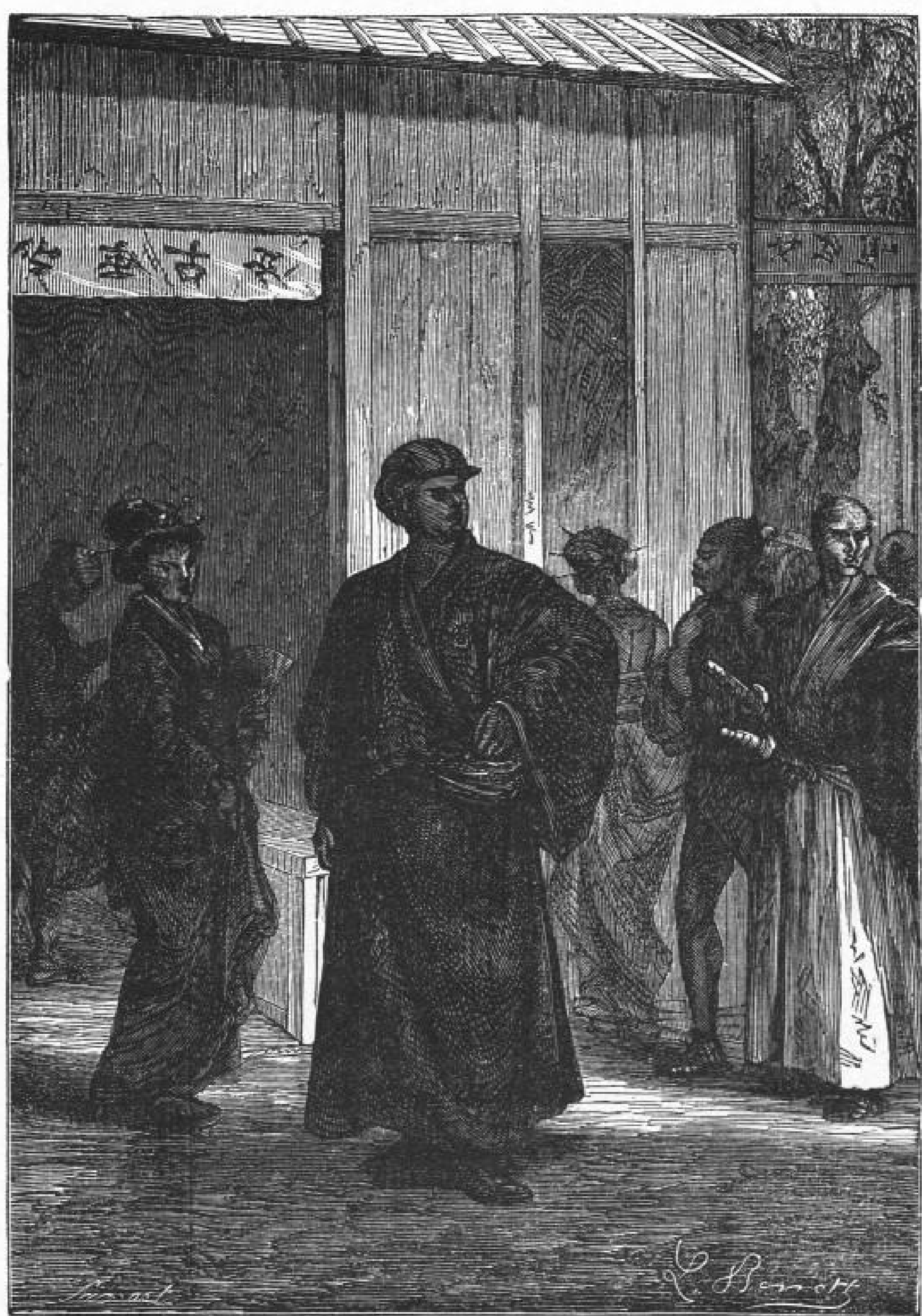
handfuls of rice, he lunched like a man for whom dinner would still be a problem to solve.
"Now," he said to himself when he was copiously restored,
"the thing is not to lose my head. I no longer have the resource of selling this outfit for another even more Japanese one. I must therefore consider the means of leaving as promptly as possible this Land of the Sun, of which I shall keep only a lamentable memory!"
Passepartout then thought of visiting the steamships bound for America. He counted on offering himself as cook or servant, asking as his only wages passage and food. Once in San Francisco, he would see about getting by. The important thing was to cross those four thousand seven hundred miles of the Pacific that stretch between Japan and the New World.
Passepartout, not being a man to let an idea languish, headed for the port of Yokohama. But as he approached the docks, his plan, which had seemed so simple to him at the moment he had conceived it, seemed to him more and more impracticable. Why would a cook or servant be needed aboard an American steamship, and what confidence would he inspire, decked out in this way? What recommendations could he put forward? What references could he give?
As he was reflecting thus, his gaze fell upon an immense poster that a sort of clown was carrying through the streets of Yokohama. This poster was worded thus in English:
JAPANESE ACROBATIC TROUPE
OF
THE HONORABLE WILLIAM BATULCAR
LAST PERFORMANCES
Before their departure for the United States of America
OF THE
LONG-NOSES-LONG-NOSES
UNDER THE DIRECT INVOCATION OF THE GOD TINGOU
Grand Attraction!
"The United States of America!" cried Passepartout, "that is precisely my business!..."
He followed the sandwich-board man, and, in his wake, he soon re-entered the Japanese town. A quarter of an hour later, he stopped before a vast shed, crowned with several clusters of banners, and whose outer walls depicted, without perspective, but in violent colors, a whole troop of jugglers.
It was the establishment of the honorable Batulcar, a sort of American Barnum, director of a troupe of mountebanks, jugglers, clowns, acrobats, balancers, gymnasts, who, according to the poster, were giving their last performances before leaving the empire of the Sun for the States of the Union.
Passepartout entered beneath a peristyle that preceded the shed, and asked for Mr. Batulcar. Mr. Batulcar appeared in person.
"What do you want?" he said to Passepartout, whom he took at first for a native.
"Do you need a servant?" asked Passepartout.
"A servant," cried the Barnum, stroking the thick gray goatee that flourished beneath his chin, "I have two, obedient, faithful, who have never left me, and who serve me for nothing, on condition that I feed them.... And here they are," he added, showing his two robust arms, furrowed with veins as big as double-bass strings.
"So I cannot be of any use to you?"
"Of none."
"The devil! Yet it would have suited me very well to leave with you."
"Come now," said the honorable Batulcar, "you are Japanese as I am a chair! Why then are you dressed in this way?"
"One dresses as one can!"
"True, that. You are a Frenchman, you?"
"Yes, a Parisian from Paris."
"Then you must know how to make faces?"
"Faith," replied Passepartout, vexed to see his nationality provoke this question, "we French, we know how to make faces, it is true, but no better than the Americans!"
"Right. Well, if I do not take you as a servant, I can take you as a clown. You understand, my good fellow. In France, they exhibit foreign buffoons, and abroad, French buffoons!"
"Ah!"
"You are vigorous, besides?"
"Especially when I leave the table."
"And you know how to sing?"
"Yes," replied Passepartout, who had once taken part in some street concerts.
"But do you know how to sing head down, with a spinning top on the sole of your left foot, and a saber balanced on the sole of your right foot?"
"By Jove!" replied Passepartout, who remembered the first exercises of his youth.
"You see, that is the whole thing!" replied the honorable Batulcar.
The engagement was concluded hic et nunc.
At last, Passepartout had found a position. He was hired to do everything in the famous Japanese troupe. It was not very flattering, but within eight days he would be on his way to San Francisco.
The performance, announced with great fanfare by the honorable Batulcar, was to begin at three o'clock, and soon the formidable instruments of a Japanese orchestra, drums and tam-tams, were thundering at the door. It is easy to understand that Passepartout had not been able to study a role, but he was to lend the support of his sturdy shoulders in the great exercise of the "human cluster" performed by the Long-Noses of the god Tingou. This "great attraction" of the performance was to close the series of exercises.
Before three o'clock, the spectators had invaded the vast shed. Europeans and natives, Chinese and Japanese, men, women and children, rushed onto the narrow benches and into the boxes facing the stage. The musicians had gone back inside, and the full orchestra, gongs, tam-tams, clappers, flutes, tambourines and bass drums, were performing with fury.
This performance was like all those acrobatic exhibitions. But it must be admitted that the Japanese are the foremost tightrope walkers in the world. One of them, armed with his fan and small pieces of paper, performed the very graceful exercise of the butterflies and flowers. Another, with the fragrant smoke of his pipe, rapidly traced in the air a series of bluish words that formed a compliment addressed to the assembly. This one juggled with lighted candles, which he extinguished one after another as they passed before his lips, and relit from one another without interrupting for a single moment his marvelous juggling. That one reproduced, by means of spinning tops, the most improbable combinations; beneath his hand, these humming machines seemed to be animated with a life of their own in their interminable gyration; they ran along pipe stems, along sword edges, along iron wires, veritable hairs stretched taut from one side of the stage to the other; they went around large crystal vases, they climbed bamboo ladders, they scattered into every corner, producing harmonic effects of a strange character by combining their diverse tonalities. The jugglers juggled with them, and they spun in the air; they tossed them like shuttlecocks, with wooden rackets, and they still spun; they stuffed them into their pockets, and when they pulled them out, they were still spinning—until the moment when a released spring made them burst open into fireworks!
It is useless to describe here the prodigious exercises of the acrobats and gymnasts of the troupe. The feats of the ladder, the pole, the ball, the barrels, etc., were performed with remarkable precision. But the principal attraction of the performance was the exhibition of those "Long-Noses," astonishing equilibrists whom Europe does not yet know.
These Long-Noses form a particular corporation placed under the direct invocation of the god Tingou. Dressed like heroes of the Middle Ages, they wore a splendid pair of wings on their shoulders. But what distinguished them more especially was that long nose with which their faces were adorned, and above all the use they made of it. These noses were nothing less than bamboos, five, six, ten feet long, some straight, others curved, these smooth, those warty. Now, it was upon these appendages, fixed in a solid manner, that all their balancing exercises were performed. A dozen of these worshippers of the god Tingou lay down on their backs, and their comrades came to frolic upon their noses, raised like lightning rods, leaping, flitting from one to another, and executing the most improbable tricks.
To conclude, the human pyramid had been specially announced to the public, in which about fifty Long-Noses were to represent the "Chariot of Juggernaut." But instead of forming this pyramid by taking their shoulders as a point of support, the artists of the honorable Batulcar were to fit themselves together only by their noses. Now, one of those who formed the base of the chariot had left the troupe, and as it was enough to be vigorous and skillful, Passepartout had been chosen to replace him.
!
!
!
Certainly, the worthy fellow felt quite pitiful when—sad memory of his youth—he had put on his medieval costume, adorned with multicolored wings, and a six-foot nose had been applied to his face! But after all, this nose was his livelihood, and he made the best of it.
Passepartout entered the stage, and came to range himself with those of his colleagues who were to form the base of the Chariot of Juggernaut. All stretched out on the ground, nose raised toward the sky. A second section of equilibrists came to place themselves on these long appendages, a third was tiered above, then a fourth, and on these noses, which touched only at their tips, a human monument soon rose up to the friezes of the theater.
!
!
Now, the applause redoubled, and the instruments of the orchestra burst forth like so many thunderclaps, when the pyramid swayed, the balance broke, one of the noses at the base gave way, and the monument collapsed like a house of cards...
It was Passepartout's fault, who, abandoning his post, crossing the footlights without the help of his wings, and climbing to the right-hand gallery, fell at the feet of a spectator, crying out:
"Ah! my master! my master!"
"You?"
"Me!"
"Well! in that case, to the steamer, my boy!.."
Mr. Fogg, Mrs. Aouda, who accompanied him, and Passepartout had rushed through the corridors outside the shed. But there they found the honorable Batulcar, furious, demanding damages for "the breakage." Phileas Fogg calmed his fury by throwing him a handful of banknotes. And, at half past six, at the moment when he was about to leave, Mr. Fogg and Mrs. Aouda set foot on the American steamer, followed by Passepartout, wings on his back, and on his face that six-foot nose which he had not yet been able to tear from his visage!