
About this book
Fogg bets his fortune he can circle the globe in eighty days. Verne's 1872 novel, French original, Hetzel edition, free to read online.
IN WHICH PASSEPARTOUT PROVES ONCE MORE THAT FORTUNE SMILES UPON THE BOLD.
The plan was bold, bristling with difficulties, perhaps impracticable. Mr. Fogg was about to risk his life, or at the very least his liberty, and consequently the success of his projects, but he did not hesitate. Moreover, he found in Sir Francis Cromarty a determined ally.
As for Passepartout, he was ready; he could be counted on. The idea of his master exalted him. He sensed a heart, a soul beneath that icy exterior. He found himself growing fond of Phileas Fogg.
There remained the guide. What course would he take in the affair? Would he not be inclined toward the Indians? Failing his cooperation, they must at least secure his neutrality.
Sir Francis Cromarty put the question to him frankly.
"My officer," replied the guide, "I am a Parsi, and this woman is a Parsi. Dispose of me."
"Good, guide," replied Mr. Fogg.
"However, know this well," resumed the Parsi, "not only do we risk our lives, but horrible tortures, if we are caught. So, consider."
"That is considered," replied Mr. Fogg. "I think we shall have to wait for night to act?"
"I think so too," replied the guide.
This worthy Indian then gave some details about the victim. She was an Indian woman of celebrated beauty, of Parsi race, daughter of wealthy merchants of Bombay. She had received an absolutely English education in that city, and from her manners and her accomplishments one would have taken her for a European. Her name was Aouda.
Orphaned, she had been married against her will to that old rajah of Bundelkund. Three months later, she became a widow. Knowing the fate that awaited her, she escaped, was immediately recaptured, and the rajah's relatives, who had an interest in her death, condemned her to that torture from which it did not seem she could escape.
This account could only root Mr. Fogg and his companions more firmly in their generous resolve. It was decided that the guide would direct the elephant toward the pagoda of Pillaji, approaching it as closely as possible.
Half an hour later, a halt was made under a thicket, five hundred paces from the pagoda, which could not be seen; but the howls of the fanatics could be heard distinctly.
The means of reaching the victim were then discussed. The guide knew this pagoda of Pillaji, in which he affirmed that the young woman was imprisoned. Could they enter it through one of the doors, when the whole band would be plunged in the sleep of drunkenness, or would they have to make a hole in a wall? This could not be decided until the moment and the place itself. But what was beyond doubt was that the abduction must be carried out that very night, and not when, at daybreak, the victim would be led to the torture. At that moment, no human intervention could have saved her.
Mr. Fogg and his companions waited for night. As soon as darkness fell, around six o'clock in the evening, they resolved to carry out a reconnaissance around the pagoda. The last cries of the fakirs were then dying away. Following their custom, these Indians must be plunged in the deep drunkenness of "hang," — liquid opium mixed with an infusion of hemp, — and it might be possible to slip in among them as far as the temple.
The Parsi, guiding Mr. Fogg, Sir Francis Cromarty, and Passepartout, advanced
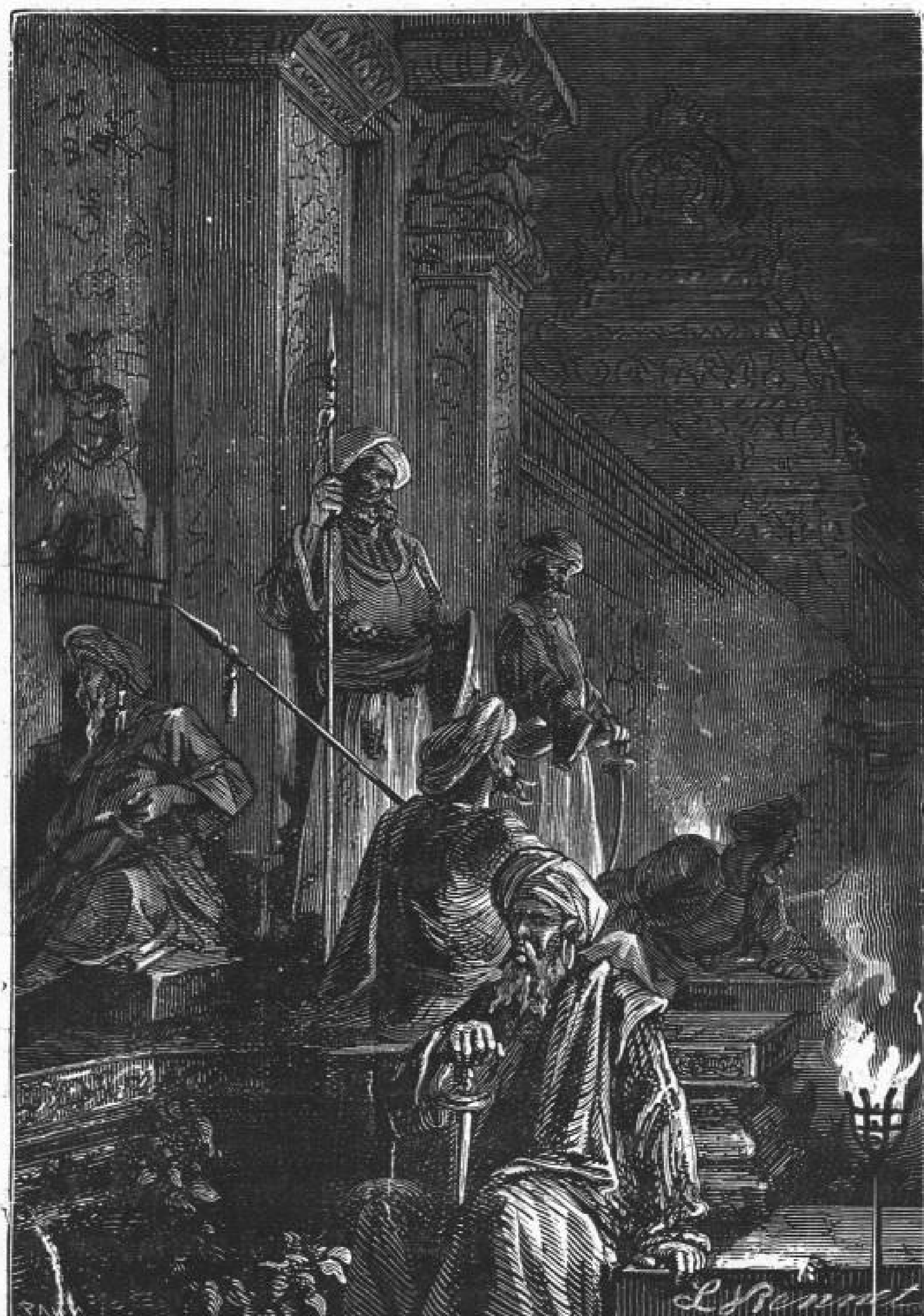
noiselessly through the forest. After ten minutes of crawling under the branches, they reached the edge of a small river, and there, by the light of iron torches tipped with burning resins, they saw a pile of stacked wood. It was the pyre, made of precious sandalwood and already soaked with perfumed oil. On its upper part rested the embalmed body of the rajah, which was to be burned at the same time as his widow. A hundred paces from this pyre rose the pagoda, whose minarets pierced the treetops in the shadows.
"Come!" said the guide in a low voice.
And, redoubling his caution, followed by his companions, he slipped silently through the tall grass.
The silence was now broken only by the murmur of the wind in the branches.
Soon the guide stopped at the edge of a clearing. A few resins illuminated the place. The ground was strewn with groups of sleepers, weighed down by drunkenness. It was like a battlefield covered with the dead. Men, women, children, all were mingled together. A few drunkards were still groaning here and there.
In the background, between the mass of trees, the temple of Pillaji loomed indistinctly. But to the guide's great disappointment, the rajah's guards, lit by smoky torches, were watching at the doors and pacing with drawn sabers. It could be supposed that inside the priests were keeping watch as well.
The Parsi went no farther. He had recognized the impossibility of forcing the entrance to the temple, and he led his companions back.
Phileas Fogg and Sir Francis Cromarty had understood, as he had, that they could attempt nothing on that side.
They stopped and conferred in low voices.
"Let us wait," said the brigadier general, "it is only eight o'clock still, and it is possible that these guards will also succumb to sleep."
"That is possible, indeed," replied the Parsi.
Phileas Fogg and his companions therefore lay down at the foot of a tree and waited.
The time seemed long to them! The guide sometimes left them and went to observe the edge of the woods. The rajah's guards were still watching by the light of the torches, and a vague light filtered through the windows of the pagoda.
They waited thus until midnight. The situation did not change. The same surveillance outside. It was evident that they could not count on the guards dozing off. The drunkenness of the "hang" had probably been spared them. They must therefore act otherwise and penetrate through an opening made in the walls of the pagoda. There remained the question of knowing whether the priests were watching beside their victim with as much care as the soldiers at the temple door.
After a final conversation, the guide said he was ready to set out. Mr. Fogg, Sir Francis, and Passepartout followed him. They made a fairly long detour in order to reach the pagoda from its rear.
Around half past midnight, they arrived at the foot of the walls without having met anyone. No surveillance had been established on that side, but it is true to say that windows and doors were absolutely lacking.
The night was dark. The moon, then in its last quarter, was barely leaving the horizon, encumbered with thick clouds. The height of the trees further increased the darkness.
But it was not enough to have reached the foot of the walls; they still had to make an opening there. For this operation, Phileas Fogg and his companions had absolutely nothing but their pocketknives. Very fortunately, the walls of the temple consisted of a mixture of brick and wood that could not be difficult to pierce. Once the first brick was removed, the others would come easily.
They set to work, making as little noise as possible. The Parsi on one side, Passepartout on the other, worked to loosen the bricks so as to obtain an opening two feet wide. The work was progressing when a cry was heard inside the temple, and almost immediately other cries answered it from outside.
7 8 9 1
Passepartout and the guide interrupted their work. Had they been surprised? Was the alarm being given? The most ordinary prudence commanded them to move away, — which they did at the same time as Phileas Fogg and Sir Francis Cromarty. They crouched again under the cover of the woods, waiting for the alert, if alert it was, to die down, and ready, in that case, to resume their operation.
But — a fatal setback — guards appeared at the rear of the pagoda and settled there in such a way as to prevent any approach.
It would be difficult to describe the disappointment of these four men, halted in their work. Now that they could no longer reach the victim, how would they save her? Sir Francis Cromarty was gnawing his fists. Passepartout was beside himself, and the guide had some difficulty restraining him. The impassive Fogg waited without showing his feelings.
"Have we nothing left to do but leave?" asked the brigadier general in a low voice.
"We have nothing left to do but leave," replied the guide.
"Wait," said Fogg. "It is enough that I be at Allahabad tomorrow before noon."
"But what do you hope for?" replied Sir Francis Cromarty. "In a few hours daylight will come, and..."
"The chance that escapes us may present itself again at the supreme moment."
The brigadier general would have liked to be able to read Phileas Fogg's eyes.
What, then, was this cold Englishman counting on? Did he intend, at the moment of the torture, to rush toward the young woman and openly snatch her from her executioners?
That would have been madness, and how could one admit that this man was mad to such a degree? Nevertheless, Sir Francis Cromarty consented to wait until the denouement of this terrible scene. However, the guide did not leave his companions at the spot where they had taken refuge, and he led them back toward the front part of the clearing. There, sheltered by a clump of trees, they could observe the sleeping groups.
Meanwhile Passepartout, perched on the first branches of a tree, was mulling over an idea that had at first crossed his mind like a flash of lightning, and which finally became embedded in his brain.
He had begun by saying to himself: "What madness!" and now he was repeating: "Why not, after all? It's a chance, perhaps the only one, and with such brutes!..."
In any case, Passepartout did not formulate his thought any further, but he soon began to slip with the suppleness of a serpent onto the lower branches of the tree whose tip curved toward the ground.
The hours passed, and soon some less somber hues announced the approach of day. However, the darkness was still deep.
It was the moment. There was something like a resurrection in that drowsy crowd. The groups stirred to life. Beats of tom-toms rang out. Songs and cries burst forth again. The hour had come at which the unfortunate woman was to die.
Indeed, the doors of the pagoda opened. A brighter light escaped from within. Mr. Fogg and Sir Francis Cromarty could perceive the victim, vividly illuminated, whom two priests were dragging outside. It even seemed to them that, shaking off the torpor of intoxication by a supreme instinct of self-preservation, the unfortunate woman was attempting to escape from her executioners. Sir Francis Cromarty's heart leaped, and by a convulsive movement, seizing Phileas Fogg's hand, he felt that this hand held an open knife.
At that moment the crowd began to move. The young woman had fallen back into the torpor produced by the fumes of hemp. She passed through the fakirs, who escorted her with their religious vociferations.
Phileas Fogg and his companions, mingling with the last ranks of the crowd, followed her.
Two minutes later, they arrived at the edge of the river and stopped less than fifty paces from the pyre, on which the body of the rajah was lying. In the semi-darkness, they saw the victim absolutely inert, stretched beside the corpse of her husband.
Then a torch was brought near, and the wood, soaked in oil, immediately caught fire.
At that moment, Sir Francis Cromarty and the guide held back Phileas Fogg, who, in a moment of generous folly, was rushing toward the pyre...
But Phileas Fogg had already pushed them aside, when the scene suddenly changed. A cry of terror rose. The whole crowd threw itself to the ground, terrified.
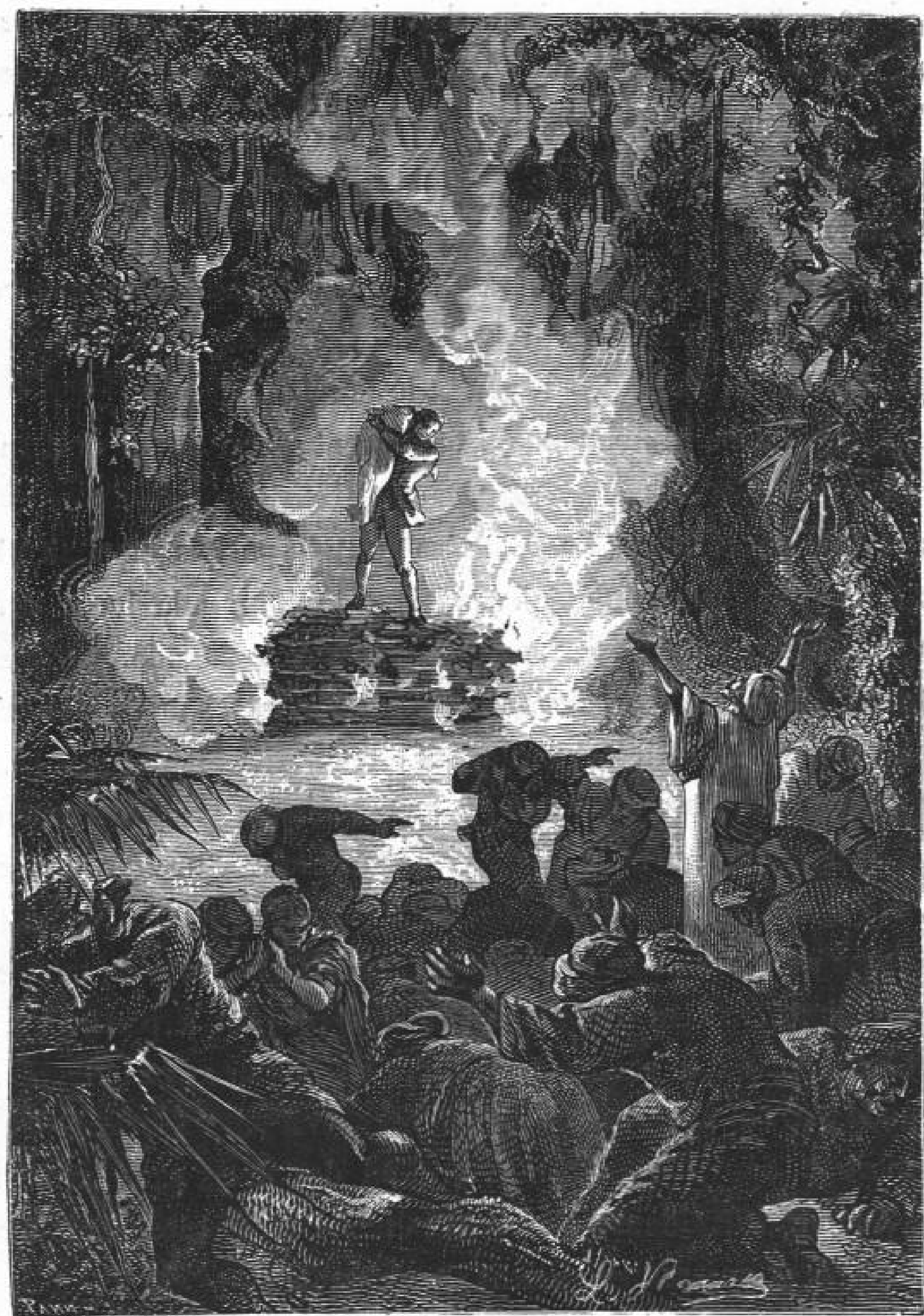
So the old rajah was not dead, since he was seen to straighten up all at once, like a ghost, lift the young woman in his arms, and descend from the pyre amid swirling vapors that gave him a spectral appearance?
The fakirs, the guards, the priests, seized by sudden terror, were there, face down, not daring to raise their eyes and look upon such a prodigy!
The inanimate victim passed between the vigorous arms that carried her, and without seeming to weigh them down. Mr. Fogg and Sir Francis Cromarty had remained standing. The Parsi had bowed his head, and Passepartout, no doubt, was no less stupefied!... This resurrected man thus arrived near the place where Mr. Fogg and Sir Francis Cromarty were standing, and there, in a curt voice:
"Let's clear out!..." he said.
It was Passepartout himself who had slipped toward the pyre amid the thick smoke! It was Passepartout who, taking advantage of the still deep darkness, had snatched the young woman from death! It was Passepartout who, playing his role with audacious good fortune, was passing through the midst of the general terror!
An instant later, all four disappeared into the wood, and the elephant carried them off at a rapid trot. But cries, clamors, and even a bullet, piercing Phileas Fogg's hat, told them that the trick had been discovered.
Indeed, on the blazing pyre the body of the old rajah could then be made out. The priests, recovered from their fright, had understood that an abduction had just been carried out.
Immediately they had rushed into the forest. The guards had followed them. A volley had been fired, but the abductors were fleeing rapidly, and in a few moments they were out of range of bullets and arrows.