About this book
The Cyclops, the Sirens and ten years of detours before Ithaca. Homer's Odyssey in Butcher and Lang's 1883 prose translation, free to read online.
NOTE 8, PAGE 36; BOOK III. 162. ἀμφιλείωσαι = recurvatae. a picture of a sea fight between the Egyptians under Ramses III. (1200- 1166 B.C.) and those maritime peoples of the Mediterranean, among whom it has been usual to recognize the ancestors of the Achæans, Etruscans, and Sicilians.
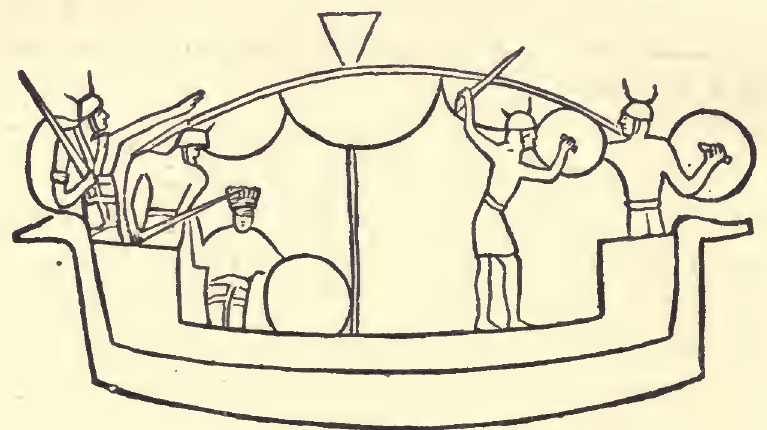
The ships of these pre- homeric sea- kings might be called ἀμφιλέυσσαι; they are lofty in prow and stern, and either extremity is finished off with a curved bird's beak, which rises high out of the water. The vessels of the Egyptians are low at prow and stern, and have not that raised and fenced half- deck on which the warrior stands in our engraving. This is the place where Odysseus posted himself when he meant to offer battle to Scylla of the rock. (Od. xii. 220, 230):—eis 'upia vnbs Eβaivov npoμns.
If this be the correct explanation of ἀμφιλέυσσαι, it must be remembered that the term would no longer apply to Greek vessels of the sixth century, as represented in the vases of that period. The prow was by that time constructed for ramming purposes, for which the high birds' beaks of the early Mediterranean vessels were not at all adapted. An example of the Homeric ship, or something like it, is painted on a very old vase in the Cesnola collection. (Cesnola's Cyprus, pl. xlv.) Like the vessels in the Egyptian reliefs, this galley has its prow and stern recurvatae, built high out of the water and protected by lofty bulwarks. On the whole subject consult M. Chabas, Études sur l'Antiquité Historique, pp. 309- 313 (Paris 1873), from which our sketch is borrowed. We may recognize the vessels of early Mediterranean sea- rovers in the Egyptian reliefs, without committing ourselves to the ethnological theories either of De Rouge or Brugsch. Avon. It seems not improbable that the white races of Libya, the Tahennu, may have been akin by stock and language to the early Greeks. Thus, when the post-Homeric Greeks made the acquaintance of the Libyans, they found their own local names in Africa.
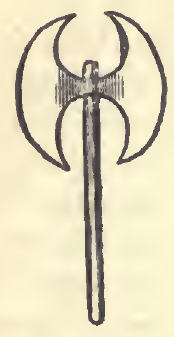
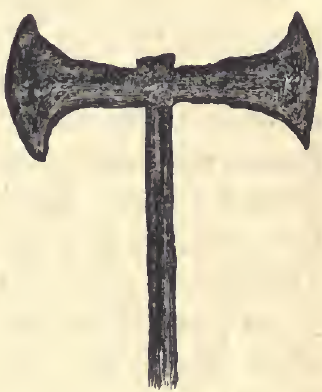
The genitive will then be an ablative genitive, not unoonmon in Homer. (8) That we are not acquainted with any examples of ancient Greek axes like that drawn by Goebel. The double-headed axe which is represented in miniature on some ornaments from the Mycenaean graves (Schliemann's Mycenae und Tiryns, pp. 218, 253, 362) and in a heraldic design on a ring, found near Mycenae, is hammer-headed, as in figure 2. There would be no difficulty in merely shooting over the tops of the handles of axes like these.
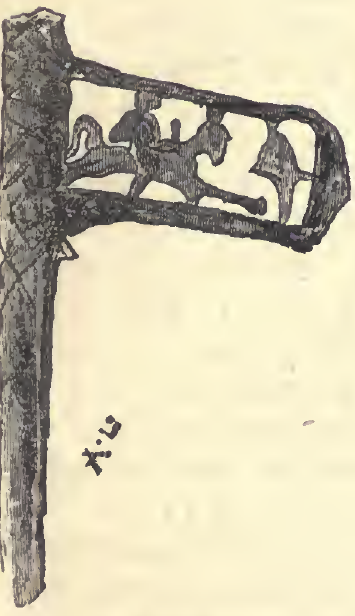
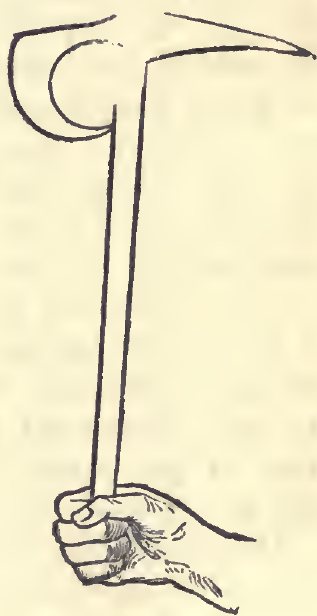
Many commentators have supposed that the axe- heads were stuck in the ground by their edges, without the handles, and that Odysseus shot through the handle- hole. But even if axes, in Homer's time, were attached to the handle by the method familiar to us, and to later Greece, the holes could not have been raised more than a few inches above the earth. Thus an arrow could scarcely have been sent through them, whether by a standing (xix. 575), or by a seated archer (xxi. 420). The difficulty is to find an ancient axe through a hole in the metal of which it was possible to shoot. Probably if we could see the weapon with which Homer was familiar the puzzle would instantly disappear. We engrave (figures 3 and 4) two Egyptian axes (now in the British Museum) merely to show that axes with open- work blades were not unknown in antiquity, that they are not, as Mr. Merry says, 'a pure invention.' If the grotesque figure were removed from within the blade of figure 3, it would be easy to shoot through the opening, and the same would be the case if the openings in figure 4 were enlarged, as they might be in another example. Despite the intercourse between Egypt and pre- historical Greece, it would be the height of rashness to allege that the Achaeans were familiar with axes shaped like these. Probably the axes of Odysseus were like that which we engrave (fig. 5). This weapon is used by an Amazon in a conflict with Heracles on a metope of a temple in Selinus. The probable date is about 500 B.C. It is easy to see how the feat of Odysseus might have been performed with axes of this pattern. For this illustration we are indebted to Mr. A. S. Murray. (Benndorf's Metopen von Selinunt, pl. 7.)
If we would combine this view as to the shape of the axes with the explanation of given above, we must suppose that the comparison with is not intended to be carried out into every detail. The general point of resemblance consists in the arrangement in a straight line, at regular intervals;— \(\iota \sigma \tau \alpha \chi^{\prime} \xi \epsilon \iota \eta \delta \rho \nu \sigma \nu \sigma \nu \delta there is some correspondence suggested between the openings in the axe- blades and the notches in the δρύσχοι; but it would be rash to conclude that the shape of the axe- blades conforms exactly to that of the δρύσχοι.