TextGrad: Automatic "Differentiation" via TextMert Yuksekgonul et al.

F.4 Initialization

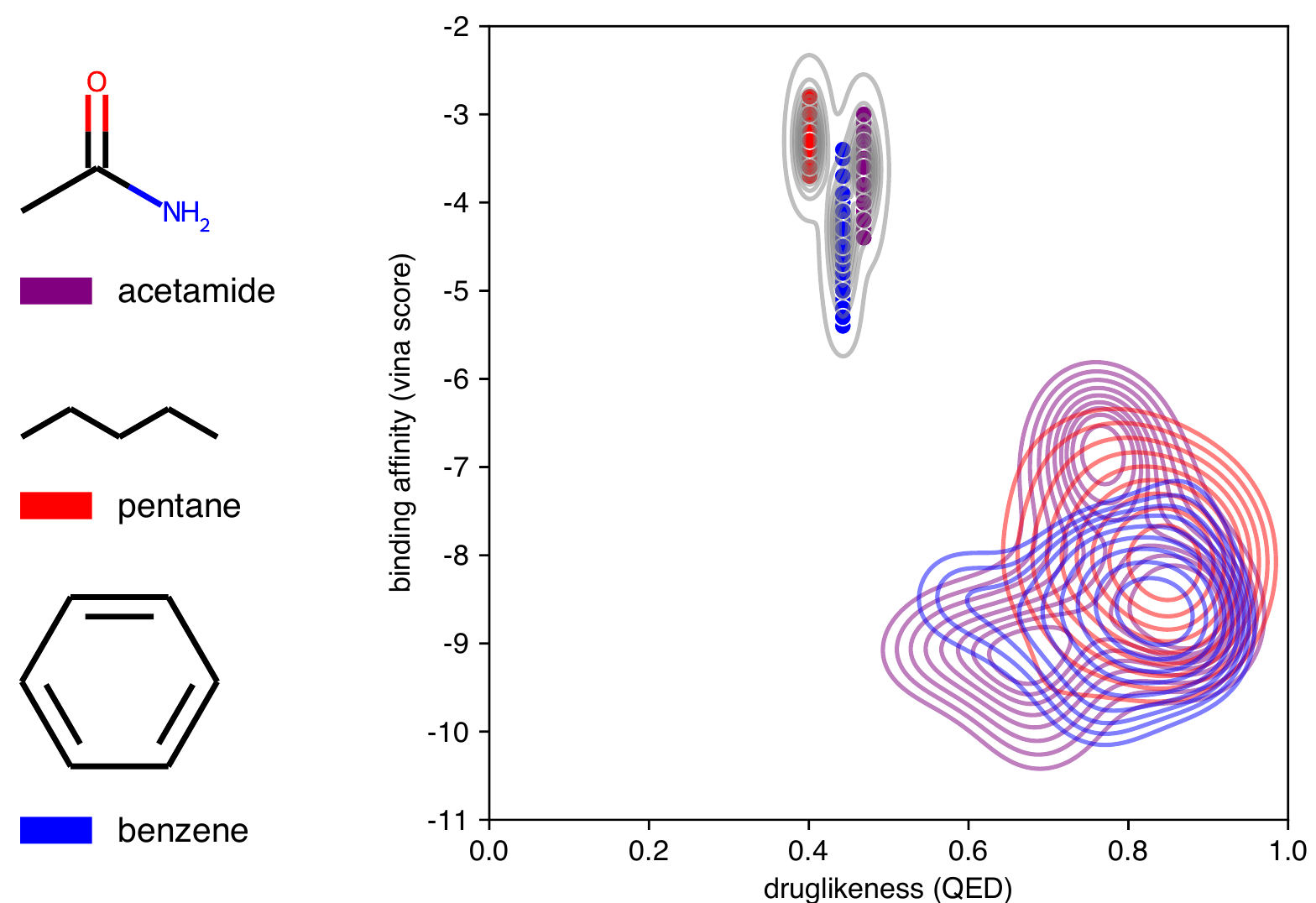
Supplementary Figure 1: Molecule Initialization. We initialize TEXTGRAD with fragment molecules from three, diverse functional groups and optimize each initial molecule for 10 iterations for all 58 targets in the DOCKSTRING benchmark suite. For each fragment and each protein, we perform post selection on the generated molecules using the summary score outlined in equation 25 and visualize the resulting distribution. We observe that while the initial QED and Vina score distributions of the starting fragments varies greatly, the distribution of the optimized molecules is highly overlapping.

In practice, molecular optimization is typically accelerated by large scale pre- optimization screening, where libraries of millions or even billions of existing chemical structures are scored and ranked by docking, druglikeness, and other metrics. Only the most promising structures, termed "leads", are further refined by medicinal chemists [104]. While TEXTGRAD is capable of optimizing any initial molecule, in this work, to more accurately characterize it's performance and avoid biasing its designs towards existing drugs, we instead select our three initial molecules from simple fragments of common functional groups, shown in Figure 1. These fragments are highly diverse, and belong to different functional groups. Although these initial fragments have differing druglikness and binding affinity characteristics, the impact of the starting fragment on TEXTGRAD's performance is minimal, and TEXTGRAD is capable of generating molecules with high druglikeness and binding affinity from all three fragments.