
3.5 Radiotherapy treatment plan optimization
Radiation therapy, also known as radiotherapy, is a cancer treatment that uses beams of intense energy, such as X- rays, to kill cancer cells. Before treatment begins, a radiotherapy team, including radiation oncologists and planners, collaborates to design an effective treatment plan. This involves determining the necessary dose of radiotherapy and pinpointing the exact locations that need treatment.
Radiotherapy treatment planning can be formulated as a two- loop optimization problem. The inner loop, known as inverse planning, includes processes such as influence map optimization and direct aperture optimization [62]. This optimization problem is typically a constrained one, solved by a numerical optimizer, aiming to minimize a weighted cost function balancing multiple conflicting objectives [63]. These objectives include delivering the prescribed dose to the planning target volume (PTV), which encompasses the tumor and an additional margin to account for uncertainties in planning or treatment delivery, while protecting critical normal tissues, known as organs at risk (OARs), from receiving unsafe doses.
The main challenge in treatment planning is translating overall clinical goals into weighted objective functions and dose constraints that yield an acceptable plan [62]. Human planners often use a trial- and- error approach, iteratively adjusting optimization hyperparameters based on the results of the optimization process until the plans meet clinical requirements [62]. These hyperparameters include the weights assigned to PTVs, organs, and other tissues in the objective function. This process can be subjective, influenced by the planner's experience and the available time, and involves repeatedly using computationally expensive optimization algorithms over many iterations. This makes the process inefficient, time- consuming, and costly [64].
Method. We apply TEXTGRAD to perform the outer loop optimization, i.e. hyperparameter optimization for the inner loop numerical optimizer. Instance optimization is performed with gpt- 4o over the hyperparameters represented as a string: "weight for PTV: [PTV WEIGHT], weight for bladder: [BLADDER WEIGHT], weight for rectum: [RECTUM WEIGHT], weight for femoral heads: [FH WEIGHT], weight for body: [BODY WEIGHT]". When hyperparameters are provided, we obtain the treatment plan by adopting a numerical optimizer and constructing a loss as the mismatch between the current plan and the clinical objectives. Specifically, to compute the gradient, we first solve the inner optimization loop using a numerical optimizer matRad[65] to obtain the corresponding treatment plan . The loss is computed on the treatment plan and the clinical goals using an LLM with prompts provided in Section G.1.
and the new hyperparameters are obtained by a TextGrad descent step
To further improve LLM's capability to understand the relationship between hyperparameters and the resulting plan from matRad, a set of paired plans and their corresponding hyperparameters is provided as context for LLMs during the TGD_step. Therefore,
Evaluation metrics. To evaluate a treatment plan, we adopt several commonly used dose metrics as a plan cannot be evaluated using a single metric. We consider the mean dose delivered to the target/organ volume, as well as , which denotes the minimum dose received by of the target/organ volume.
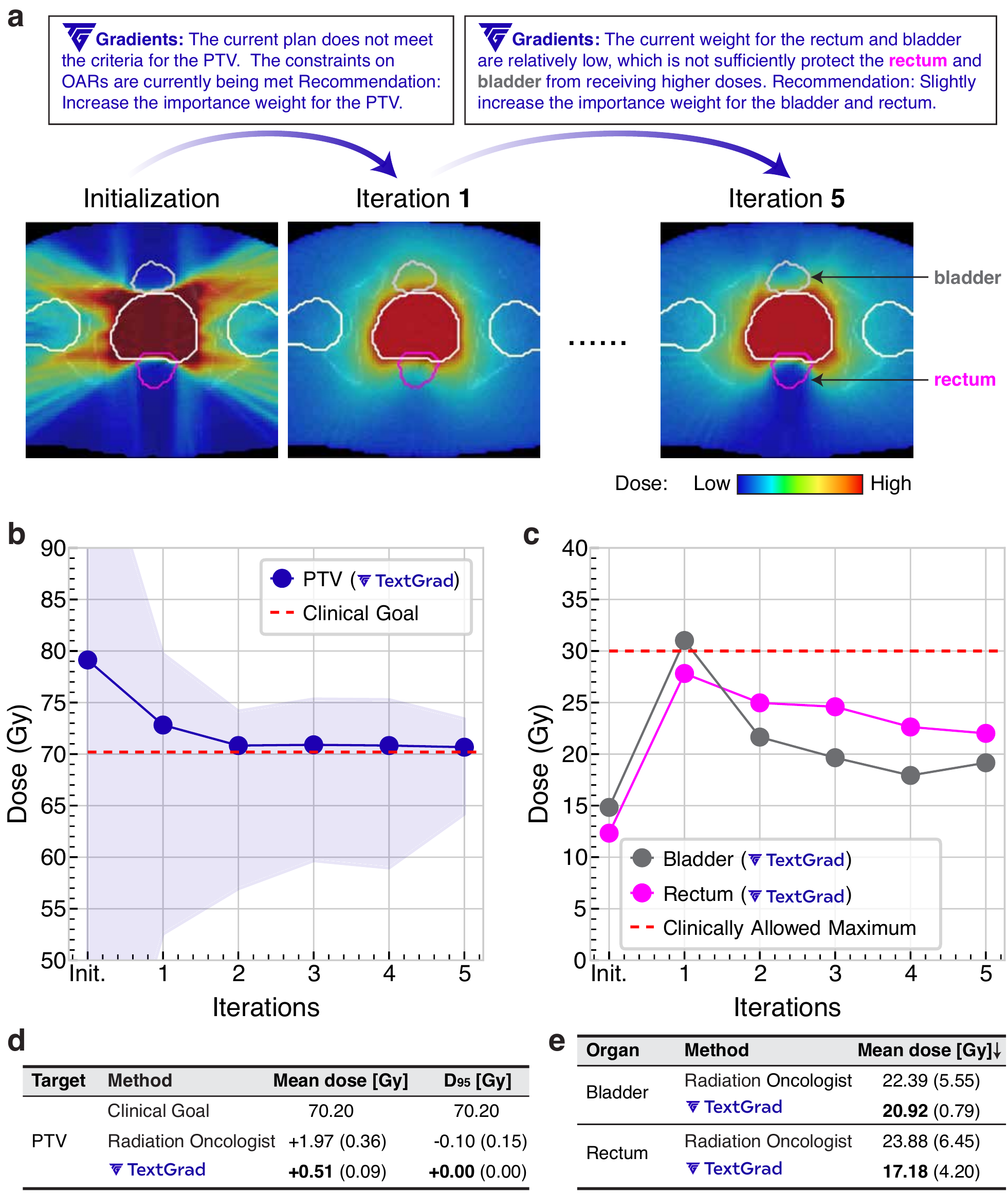
Results. The gradients generated by TExTGRAD provide meaningful guidance to improve the hyperparameters. As illustrated in Figure 3, when there is dose spillage outside the Planning Target Volume (PTV), the gradient suggests an increase in the importance weight for the PTV. This adjustment results in a more uniform and confined dose for the PTV. However, this can lead to insufficient protection of the bladder and rectum as their relative weights are reduced. Therefore, in the following step, the gradients suggest slightly increasing the weights for the bladder and rectum, resulting in better protection for these organs. We compared TExTGRAD optimized plans with the clinical plans used to treat five prostate cancer patients. In Figure 3 (c), we assess TextGrad's capabilities in achieving clinical goals for the PTV region. TextGrad outperforms the clinical plans across all metrics, achieving a higher mean dose, and a that exactly matches the prescribed dose. In Figure 3 (d), we focus on the sparing of healthy organs. TextGrad- optimized plans achieve lower mean doses for these healthy organs, suggesting better organ sparing than the human- optimized plans. We report the averages across five plans and with standard deviation included in the bracket.