
About this book
Anna's love for Count Vronsky breaks against society, while Levin searches for meaning. Garnett's 1919 illustrated translation, free to read online.
CHAPTER XXIX
ONE of Anna's objects in coming back to Russia had been to see her son. From the day she left Italy the thought of it ha never ceased to agitate her. And as she got nearer to Peters burg, the delight and importance of this meeting grew eve greater in her imagination. She did not even put to hersel the question how to arrange it. It seemed to her natural an simple to see her son when she should be in the same tow with him. But on her arrival in Petersburg she was sudden made distinctly aware of her present position in society, an she grasped the fact that to arrange this meeting was no eas matter.
She had now been two days in Petersburg. The thoug of her son never left her for a single instant, but she had n yet seen him. To go straight to the house, where she mig meet Alexey Alexandrovitch, that she felt she had no right do. She might be refused admittance and insulted. To wri and so enter into relations with her husband—that it ma her miserable to think of doing; she could only be at pea when she did not think of her husband. To get a glimpse ner son out walking, finding out where and when he went out, was not enough for her; she had so looked forward to this meeting, she had so much she must say to him, she so longed to embrace him, to kiss him. Seryozha's old nurse might be a help to her and show her what to do. But the nurse was not now living in Alexey Alexandrovitch's house. In this uncertainty, and in efforts to find the nurse, two days had lipped by.
Hearing of the close intimacy between Alexey Alexandroitch and Countess Lidia Ivanovna, Anna decided on the third day to write to her a letter, which cost her great pains, and in which she intentionally said that permission to see her son must depend on her husband's generosity. She knew that if he letter were shown to her husband, he would keep up his character of magnanimity, and would not refuse her request.
The commissionaire who took the letter had brought her ack the most cruel and unexpected answer, that there was no nswer. She had never felt so humiliated as at the moment then, sending for the commissionaire, she heard from him the xact account of how he had waited, and how afterwards he ad been told there was no answer. Anna felt humiliated, nsulted, but she saw that from her point of view Countess idia Ivanovna was right. Her suffering was the more poign- nt that she had to bear it in solitude. She could not and would not share it with Vronsky. She knew that to him, al- nough he was the primary cause of her distress, the question f her seeing her son would seem a matter of very little conse- uence. She knew that he would never be capable of under- anding all the depth of her suffering, that for his cool tone at ny allusion to it she would begin to hate him. And she readed that more than anything in the world, and so she hid rom him everything that related to her son. Spending the hole day at home she considered ways of seeing her son, and ad reached a decision to write to her husband. She was just omposing this letter when she was handed the letter from idia Ivanovna. The countess's silence had subdued and de- ressed her, but the letter, all that she read between the lines in it, so exasperated her, this malice was so revolting beside her passionate, legitimate tenderness for her son, that she turned against other people and left off blaming herself.
“This coldness—this pretense of feeling!” she said to herself. “They must needs insult me and torture the child, and I am to submit to it! Not on any consideration! She is worse than I am. I don’t lie, anyway.” And she decided on the spot that next day, Seryozha’s birthday, she would go straight to her husband’s house, bribe or deceive the servants, but at any cost see her son and overturn the hideous deception with which they were encompassing the unhappy child.
She went to a toy-shop, bought toys and thought over a plan of action. She would go early in the morning at eight o’clock, when Alexey Alexandrovitch would be certain not to be up. She would have money in her hand to give the hall-porter and the footman, so that they should let her in, and not raising her veil, she would say that she had come from Seryozha’s godfather to congratulate him, and that she had been charged to leave the toys at his bedside. She had prepared everything but the words she should say to her son. Often as she had dreamed of it, she could never think of anything.
The next day, at eight o’clock in the morning, Anna got out of a hired sledge and rang at the front entrance of her former home.
“Run and see what’s wanted. Some lady,” said Kapiton- itch, who, not yet dressed, in his overcoat and goloshes, had peeped out of the window and seen a lady in a veil standing close up to the door. His assistant, a lad Anna did not know, had no sooner opened the door to her than she came in, and pulling a three-rouble note out of her muff put it hurriedly into his hand.
“Seryozha—Sergey Alexeitch,” she said, and was going on. Scrutinizing the note, the porter’s assistant stopped her at the second glass-door.
. . “Whom do you want?” he asked.
She did not hear his words and made no answer.
Noticing the embarrassment of the unknown lady, Kapitonch went out to her, opened the second door for her, and sked her what she was pleased to want.
“From Prince Skorodumov for Sergey Alexeitch,” she said. “His honor’s not up yet,” said the porter, looking at her tentively.
Anna had not anticipated that the absolutely unchanged all of the house where she had lived for nine years would so reatly affect her. Memories sweet and painful rose one after mother in her heart, and for a moment she forgot what she as here for.
“Would you kindly wait?” said Kapitonitch, taking off her ur cloak.
As he took off the cloak, Kapitonitch glanced at her face, recognized her, and made her a low bow in silence.
“Please walk in, your excellency,” he said to her.
She tried to say something, but her voice refused to utter ny sound; with a guilty and imploring glance at the old man he went with light, swift steps up the stairs. Bent double, nd his goloshes catching in the steps, Kapitonitch ran after er, trying to overtake her.
“The tutor’s there; maybe he’s not dressed. I’ll let him now.”
Anna still mounted the familiar staircase, not understanding hat the old man was saying.
“This way, to the left, if you please. Excuse its not being dy. His honor’s in the old parlor now,” the hall-porter id, panting. “Excuse me, wait a little, your excellency; I’ll st see,” he said, and overtaking her, he opened the high door nd disappeared behind it. Anna stood still waiting. “He’s nly just awake,” said the hall-porter, coming out. And at he very instant the porter said this, Anna caught the sound f a childish yawn. From the sound of this yawn alone he knew her son and seemed to see him living before her yes.
“Let me in; go away!” she said, and went in through the igh doorway. On the right of the door stood a bed, and sit- ng up in the bed was the boy. His little body bent forward with his night-shirt unbuttoned, he was stretching and still yawning. The instant his lips came together they curved into a blissfully sleepy smile, and with that smile he slowly and deliciously rolled back again.
"Seryozha!" she whispered, going noiselessly up to him.
When she was parted from him, and all this latter time when she had been feeling a fresh rush of love for him, she had pictured him as he was at four years old, when she had loved him most of all. Now he was not even the same as when she had left him; he was still further from the four-year-old baby, more grown and thinner. How thin his face was, how short his hair was! What long hands! How he had changed since she left him! But it was he with his head, his lips, his soft neck and broad little shoulders.
"Seryozha!" she repeated just in the child's ear.
He raised himself again on his elbow, turned his tangled head from side to side as though looking for something, and opened his eyes. Slowly and inquiringly he looked for several seconds at his mother standing motionless before him, then all at once he smiled a blissful smile, and shutting his eyes, rolled not backwards but towards her into her arms.
"Seryozha! my darling boy!" she said, breathing hard and putting her arms round his plump little body. "Mother!" he said, wriggling about in her arms so as to touch her hands with different parts of him.
Smiling sleepily still with closed eyes, he flung his fat little arms round her shoulders, rolled towards her, with the delicious sleepy warmth and fragrance that is only found in children, and began rubbing his face against her neck and shoulders.
"I know," he said, opening his eyes; "it's my birthday to day. I knew you'd come. I'll get up directly."
And saying that he dropped asleep.
Anna looked at him hungrily; she saw how he had grown and changed in her absence. She knew, and did not know the bare legs so long now, that were thrust out below the quilt those short-eropped curls on his neck in which she had so ofter
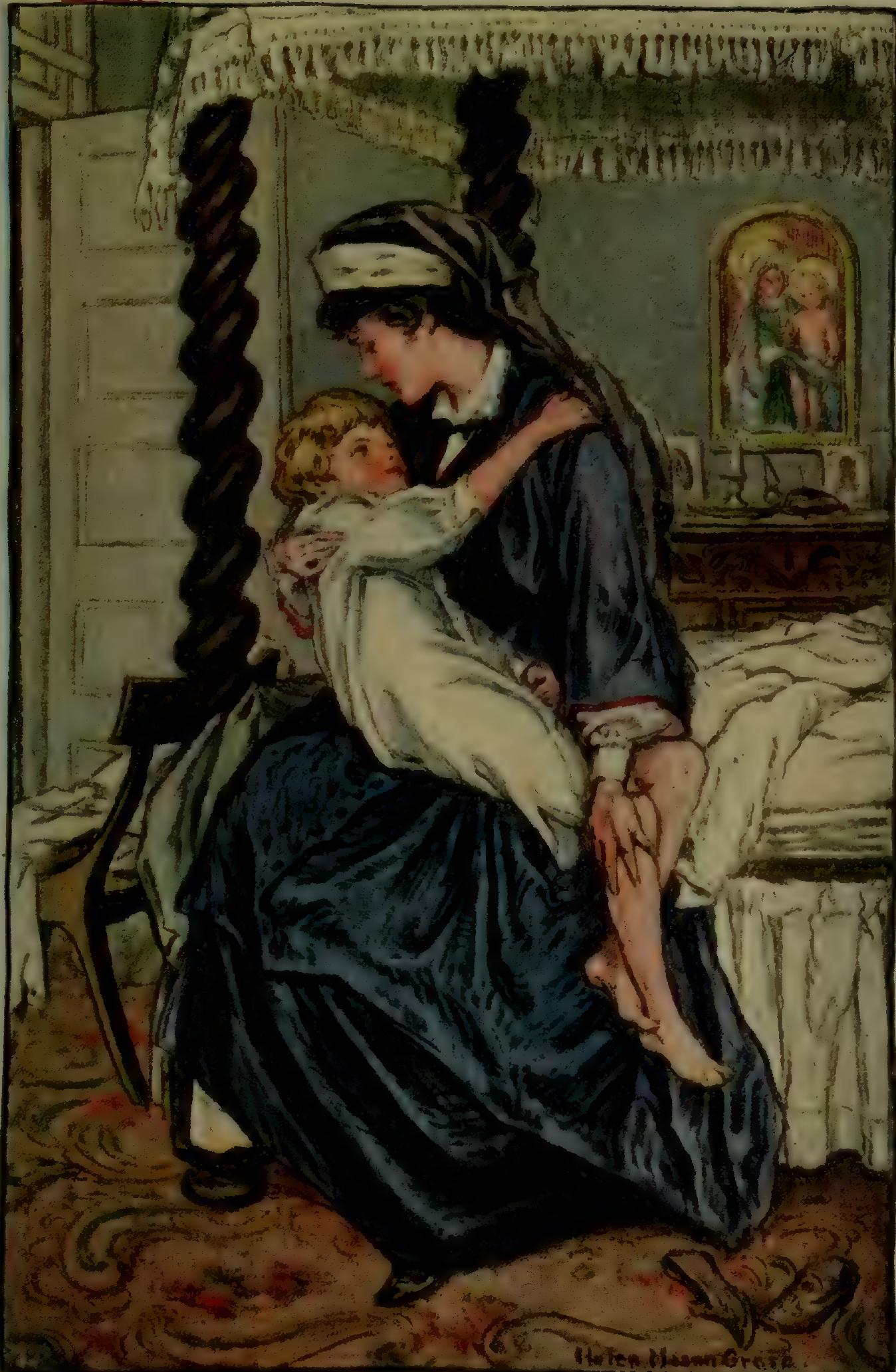
Mother, what are you crying for?

kissed him. She touched all this and could say nothing; tears choked her.
"What are you crying for, mother?" he said, waking completely up. "Mother, what are you crying for?" he cried in a tearful voice.
"I won't cry . . . I'm crying for joy. It's so long since I've seen you. I won't, I won't," she said, gulping down her tears and turning away. "Come, it's time for you to dress now," she added, after a pause, and, never letting go his hands, she sat down by his bedside on the chair, where his clothes were put ready for him.
"How do you dress without me? How . . ." she tried to begin talking simply and cheerfully, but she could not, and again she turned away.
"I don't have a cold bath, papa didn't order it. And you've not seen Vassily Lukitch? He'll come in soon. Why, you're sitting on my clothes!"
And Seryozha went off into a peal of laughter. She looked at him and smiled.
"Mother, darling, sweet one!" he shouted, flinging himself on her again and hugging her. It was as though only now, on seeing her smile, he fully grasped what had happened.
"I don't want that on," he said, taking off her hat. And as it were, seeing her afresh without her hat, he fell to kissing her again.
"But what did you think about me? You didn't think I was dead?"
"I never believed it."
"You didn't believe it, my sweet?"
"I knew, I knew!" he repeated his favorite phrase, and snatching the hand that was stroking his hair, he pressed the open palm to his mouth and kissed it.