
About this book
Anna's love for Count Vronsky breaks against society, while Levin searches for meaning. Garnett's 1919 illustrated translation, free to read online.
CHAPTER VII
Vronsky and Anna had been traveling for three months gether in Europe. They had visited Venice, Rome, and ules, and had just arrived at a small Italian town where they eant to stay some time. .A handsome head waiter, with thick maded hair parted from the neck upwards, an evening coat, broad white cambric shirt-front, and a bunch of trinkets nging above his rounded stomach, stood with his hands in a full curve of his pockets, looking contemptuously from der his eyelids while he gave some frigid reply to a gentle- un who had stopped him. Catching the sound of footsteps ning from the other side of the entry towards the stair- se, the head waiter turned round, and seeing the Russian ent, who had taken their best rooms, he took his hands out his pockets deferentially, and with a bow informed him that a courier had been, and that the business about the palazzo had been arranged. The steward was prepared to sign the agreement.
“Ah! I’m glad to hear it,” said Vronsky. “Is madame at home or not?”
“Madame has been out for a walk but has returned now,” answered the waiter.
Vronsky took off his soft wide-brimmed hat and passed his handkerchief over his heated brow and hair, which had grown half over his ears, and was brushed back covering the bald patch on his head. And glancing casually at the gentleman, who still stood there gazing intently at him, he would have gone on.
“This gentleman is a Russian, and was inquiring after you,” said the head waiter.
With mingled feelings of annoyance at never being able to get away from acquaintances anywhere, and longing to find some sort of diversion from the monotony of his life, Vronsky looked once more at the gentleman, who had retreated and stood still again, and at the same moment a light came into the eyes of both.
“Golenishtchev!”
“Vronsky!”
It really was Golenishtchev, a comrade of Vronsky’s in the Corps of Pages. In the corps Golenishtchev had belonged to the liberal party; he left the corps without entering the army, and had never taken office under the government. Vronsky and he had gone completely different ways on leaving the corps, and had only met once since.
At that meeting Vronsky perceived that Golenishtchev had taken up a sort of lofty intellectually liberal line, and was consequently disposed to look down upon Vronsky’s interests and calling in life. Hence Vronsky had met him with the chilling and haughty manner he so well knew how to assume, the meaning of which was: “You may like or dislike my way of life, that’s a matter of the most perfect indifference to me; you will have to treat me with respect, if you want to know me.”
Golenishtchev had been contemptuously indifferent to the tone taken by Vronsky. This second meeting might have been expected, one would have supposed, to estrange them still more. But now they beamed and exclaimed with delight on recognizing one another. Vronsky would never have expected to be so pleased to see Golenishtchev, but probably he was not himself aware how bored he was. He forgot the disagreeable impression of their last meeting, and with a face of frank delight held out his hand to his old comrade. The same expression of delight replaced the look of uneasiness on Golenishtchev's face.
"How glad I am to meet you!" said Vronsky, showing his strong white teeth in a friendly smile.
"I heard the name Vronsky, but I didn't know which one. I'm very, very glad!"
"Let's go in. Come, tell me what you're doing."
"I've been living here for two years. I'm working."
"Ah!" said Vronsky with sympathy; "let's go in." And with the habit common with Russians, instead of saying in Russian what he wanted to keep from the servants, he began to speak in French.
"Do you know Madame Karenina? We are traveling together. I am going to see her now," he said in French, carefully scrutinizing Golenishtchev's face.
"Ah! I did not know" (though he did know), Golenishtchev answered carelessly. "Have you been here long?" he added.
"Four days," Vronsky answered once more, scrutinizing his friend's face intently.
"Yes, he's a decent fellow, and will look at the thing properly," Vronsky said to himself, catching the significance Golenishtchev's face and the change of subject. "I can produce him to Anna, he looks at it properly."
During those three months that Vronsky had spent abroad with Anna, he had always on meeting new people asked himself how the new person would look at his relations with Anna, and for the most part, in men, he had met with the "proper" way of looking at it. But if he had been asked, and those who looked at it "properly" had been asked, exactly how they did look at it, both he and they would have been greatly puzzled to answer.
In reality, those who in Vronsky's opinion had the "proper" view had no sort of view at all, but behaved in general as well-bred persons do behave in regard to all the complex and insoluble problems with which life is encompassed on all sides; they behaved with propriety, avoiding allusions and unpleasant questions. They assumed an air of fully comprehending the import and force of the situation, of accepting and ever approving of it, but of considering it superfluous and uncalled for to put all this into words.
Vronsky at once divined that Golenishtchev was of this class and therefore was doubly pleased to see him. And in fact Golenishtchev's manner to Madame Karenina, when he was taken to call on her, was all that Vronsky could have desired. Obviously without the slightest effort he steered clear of all subjects which might lead to embarrassment.
He had never met Anna before, and was struck by her beauty, and still more by the frankness with which she accepted her position. She blushed when Vronsky brought in Golenishtchev, and he was extremely charmed by this childish blush overspreading her candid and handsome face. But what he liked particularly was the way in which at once, as though on purpose that there might be no misunderstanding with an outsider, she called Vronsky simply Alexey, and said they were moving into a house they had just taken, what was her called a palazzo. Golenishtchev liked this direct and simple attitude to her own position. Looking at Anna's manner o simple-hearted, spirited gaiety, and knowing Alexey Alexan drovitch and Vronsky, Golenishtchev fancied that he under stood her perfectly. He fancied that he understood what sh was utterly unable to understand: how it was that, having made her husband wretched, having abandoned him and he son and lost her good name, she yet felt full of spirits, gaiety and happiness.
"It's in the guide-book," said Golenishtchev, referring to the palazzo Vronsky had taken. "There's a first-rate Tinto- etto there. One of his latest period."
"I tell you what: it's a lovely day, let's go and have another look at it," said Vronsky, addressing Anna.
"I shall be very glad to; I'll go and put on my hat. Would you say it's hot?" she said, stopping short in the door- ray and looking inquiringly at Vronsky. And again a vivid ush overspread her face.
Vronsky saw from her eyes that she did not know on what terms he cared to be with Golenishtchev, and so was afraid of ot behaving as he would wish.
He looked a long, tender look at her.
"No, not very," he said.
And it seemed to her that she understood everything, most f all, that he was pleased with her; and smiling to him, she talked with her rapid step out at the door.
The friends glanced at one another, and a look of hesitation ume into both faces, as though Golenishtchev, unmistakably imiring her, would have liked to say something about her, nd could not find the right thing to say, while Vronsky de- red and dreaded his doing so.
"Well then," Vronsky began to start a conversation of some rt; "so you're settled here? You're still at the same work, en?" he went on, recalling that he had been told Golenish- hev was writing something.
"Yes, I'm writing the second part of the Two Elements," id Golenishtchev, coloring with pleasure at the question- that is, to be exact, I am not writing it yet; I am preparing, llecting materials. It will be of far wider scope, and will uch on almost all questions. We in Russia refuse to see that are the heirs of Byzantium," and he launched into a long nd heated explanation of his views.
Vronsky at the first moment felt embarrassed at not even howing of the first part of the Two Elements, of which the tthor spoke as something well known. But as Golenishtchev gan to lay down his opinions and Vronsky was able to follow them even without knowing the Two Elements, he listened to him with some interest, for Golenishtchev spoke well. But Vronsky was startled and annoyed by the nervous irascibility with which Golenishtchev talked of the subject that engrossed him. As he went on talking, his eyes glittered more and more angrily; he was more and more hurried in his replies to imaginary opponents, and his face grew more and more excited and worried. Remembering Golenishtchev, a thin, lively, good- natured and well- bred boy, always at the head of the class, Vronsky could not make out the reason of his irritability, and he did not like it. What he particularly disliked was that Golenishtchev, a man belonging to a good set, should put himself on a level with some scribbling fellows, with whom he was irritated and angry. Was it worth it? Vronsky disliked it, yet he felt that Golenishtchev was unhappy, and was sorry for him. Unhappiness, almost mental derangement, was visible on his mobile, rather handsome face, while without even noticing Anna's coming in, he went on hurriedly and hotly expressing his views.
When Anna came in in her hat and cape, and her lovely hand rapidly swinging her parasol, and stood beside him, it was with a feeling of relief that Vronsky broke away from the plaintive eyes of Golenishtchev which fastened persistently upon him, and with a fresh rush of love looked at his charming companion, full of life and happiness. Golenishtchev recovered himself with an effort, and at first was dejected and gloomy, but Anna, disposed to feel friendly with every one as she was at that time, soon revived his spirits by her direct and lively manner. After trying various subjects of conversation, she got him upon painting, of which he talked very well, and she listened to him attentively. They walked to the house they had taken, and looked over it.
"I am very glad of one thing," said Anna to Golenishtchev when they were on their way back, "Alexey will have a capital atelier. You must certainly take that room," she said to Vronsky in Russian, using the affectionately familiar form as though she saw that Golenishtchev would become intimate with
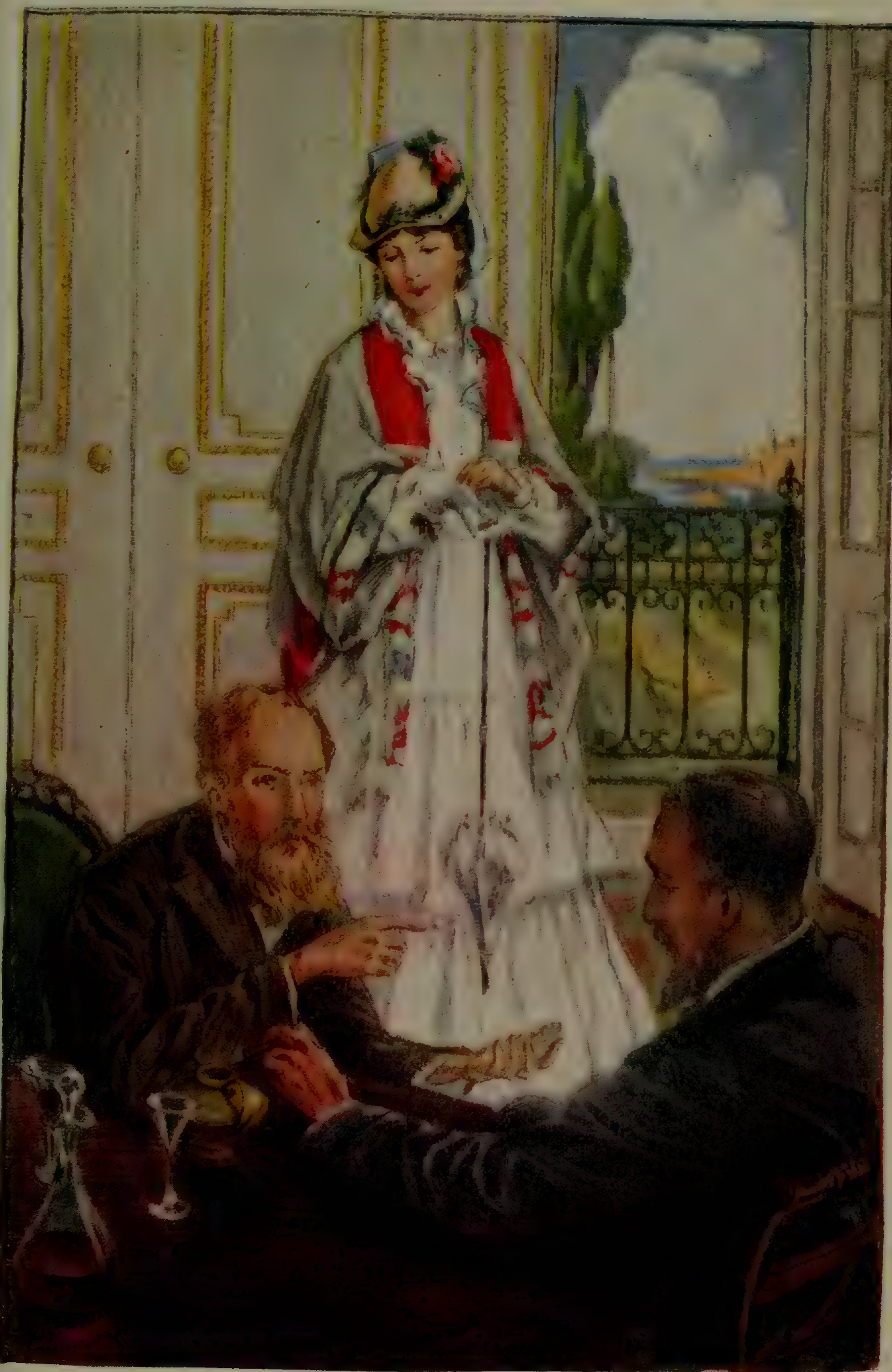

them in their isolation, and that there was no need of reserve before him.
"Do you paint?" said Golenishtchev, turning round quickly to Vronsky.
"Yes, I used to study long ago, and now I have begun to do a little," said Vronsky, reddening.
"He has great talent," said Anna with a delighted smile. "I'm no judge, of course. But good judges have said the same."