Informazioni sul libro
Il Ciclope, le Sirene e dieci anni di deviazioni prima di Itaca. L'Odissea di Omero nella versione in prosa di Butcher e Lang del 1883, online gratis.
NOTES.
NOTE 1, PAGE 1; BOOK 1, 2.
lepos.
It is difficult to determine whether lepos in Homer does not sometimes retain its primitive meaning of strong (see Curtius, Etym. No. 614): in certain phrases this may perhaps be accepted, as an archaism. It is not obvious how else to explain, e.g. Il. xvii. 464 lepo dippov, Il. x. 56 fvAakaw lepov teAos, Od. xxiv. 81 lepo optatos. Combinations however such as lepo nTovAeopov in the text, and lepo nTapod. x. 56, easily admit the ordinary sense. So too in lepo uevos, lepo is, phrases which are applied to princes, one may, as in the epithet oeiovs, trace the idea of sacredness which attached to the kingly office. On the whole we have not felt so sure of the archaic usage as to adopt it in our translation.
NOTE 2, PAGE 1; BOOK 1, 14.
8ia oedav.
The original meaning of oios was bright (see Curtius, Etym. No. 269), and survivals of this are found in the phrases 0o oav, ai0epa oav. The word is commonly taken to denote noble birth, but this interpretation often fails, e.g. when the term is used as an epithet of Philoetius the neatherd (Od. xxi. 240), and as an epithet of places. The great majority of instances where it is used, whether of persons or places, seem best satisfied by understanding it of the external quality, beauty. It has very rarely, perhaps never, a moral reference; sometimes the context directly excludes any such meaning. The difficulty of translating oios lies in this, that it was probably more vague and fluctuating than any corresponding adjective in English. Special kinds of excellence were less sharply separated off from one another in the early period of the Greek language than they were later. The uses of aupuav illustrate this. Similarly Froissart and Brantome apply respectful terms of moral excellence to knights and ladies whom they describe as anything but moral.
In cases of involuntary or unpremeditated homicide, φόνος ἀκοσύσιος. the manslayer goes into exile until he has appeased the kindred of the dead, or until the stated term of such exile (a year, as we learn from other sources,) has elapsed. The act of reconciliation is denoted by αἰδεῖσθαι, Aristoc. § 77, cp. § 72, Nausim. § 22, Macart. § 57 (similarly αἰδεῖσις, Midas, § 43). It may be added that in Attic law the price of blood is τὰ ὑποφόνια.
NOTE 5, PAGE 10; BOOK i. 277-8.
The ἐξόνα or bride-price.
The ἐξόνα in Homer are invariably gifts made by the wooers to the father or kinsmen of the bride, that is, the bride-price, the kalym of the dwellers on the Volga. The Greeks of the Homeric age virtually bought their wives; cp. Aristotle, Pol. ii. 8, § 19, speaking of the barbaric customs of ancient Greece, τὰς γυναῖκας ἐνοῦντο παρ' ἀλλήλων. The father of the bride was thus said ἐξονοῦσθαι θύγατρα (Od. ii. 53), to accept certain ἐξόνα as the price for his daughter,—what is called 'coming to terms about the marriage' in Iliad xiii. 381 (ὄφρα...συνάμεθα...ἀμφὶ γάμῳ). As a rule the woman would go to the highest bidder, but in the case of a favoured wooer it seems to have been not unusual either to remit the price and give the bride ἀνάξιον (cp. Agamemnon's offer to Achilles, II. ix. 141), or to return a portion of the ἐξόνα after marriage (Od. i. 278, ii. 196), as is still the custom in similar circumstances among the Kanekas in New Caledonia.
In Pindar ἔδνα is already used in its later sense of φέβην or dowry (Pind. Pyth. iii. 94; Ol. ix. 10).
In Homer ἐξόνα, gifts from the wooers to the father of the bride, are distinguished on the one hand from δῶρα, gifts from the wooers to the bride, and on the other from μεθία, gifts from the father of the bride to his daughter.
NOTE 6, PAGE 12; BOOK i. 349.
ἀλφιστής.
The etymology and meaning of this word are not yet placed beyond doubt. Two derivations are offered.
1. From root ἀρθ- which appears in Gr. ἀλφ-άνειν, Lat. lab- or, Germ. Arb- eit. This derivation gives rise to two explanations of the word, which are not generally distinguished:—are thus distinguished from beasts and from savages, who are ɞɦɝ
(a) 'Gain-getting,' 'enterprising;' a very appropriate sense if ἀφησται is a special epithet of sea-faring men or traders. And so some commentators take it (e.g. Nitzsch on Odyss. i. 349, Paley on Aesch. Theb. 770). But two out of the three passages where it occurs in Homer lead rather to the conclusion that, whatever be the exact meaning of the word, it is an epithet descriptive of mankind at large, not of merchantmen only. Such is the context of Od. i. 349, 'it is not minstrels who are in fault, but Zeus, methinks, is in fault:'-ὅς τε εἶδωσιν ἀνδράσιν ἀλφηστήσιν, ὅπως ἐλέησαν, ἐκάστρῳ.
Again, Od. xiii. 261, 'Orsilochus who in wide Crete' ἀνέπας ἀλφηστὰς νίκα ταχέεισι ποδέσαν.
The context of the third passage, Od. vi. 8, hardly helps us to determine whether the word has the wider or the narrower application: 'Nausithous planted them (the Phæacians) in Scheria' ἐκὰς ἀνδρῶν ἀλφηστάων.
Assuming, then, that it is a generic epithet of mankind, we seem to require some more obvious and primitive description than 'gain-getting,' 'enterprising.'
(b) The second explanation supplies us with such a description. Those who adopt it find in the root ἀλφ- the notion of winning by effort: thus ἀλφησται would mean 'toilsome,' 'living by the sweat of their brow.' This interpretation is open to a different objection from the last. The sense thus given is excellent, but it is very questionable whether the proposed etymology will yield it. The root ἀλφ- in Greek shows no trace of the idea of activity or labour, which appears in the cognate words in other languages. In Greek, ἀλφάνω means 'to bring in, to fetch, a price,' and other derivatives of the root ἀλφ- must be interpreted mainly by the usage of this verb, and not by the primary meaning of the root as it is revealed by comparative philology, a meaning which, while it is found elsewhere, is purely hypothetical in Greek.
2. The other derivation, to which on the whole we incline, is from ἀλφι (Hom. Hym. Cer. 208), in the sense of ἀλφιρον, and ἔδω, 'barley-meal eating.' Thus we should have a vivid Homeric epithet, which seizes on a striking and differentiating mark of men. Its proper place would be alongside of ἀνδρί γε σιτοφάγῳ (Od. ix. 191), of 'the description of men as ἐπὶ χθονὶ σῖτον ἔδοντες (Od. viii. 222, ix. 89, x. 101), and as ἀρούρης καπνὸν ἔδοντες (Il. xxi. 465). Civilized men as ἀλφησται
it may be worth mentioning that the traditional interpretation of ἀλφανταί, now however discarded, is 'inventive.' Eustathius, the scholiasts on the Odyssey, and the grammarians agree in paraphrasing it by εὔρετικοί, ἐφευρετικοί, ἐπινοητικοί, adding that εὔρισκεν is synonymous with ἀλφεῖν (see, for instance, Schol. B and E on Od. i. 340, and Etym. Magn). This at first sight is unintelligible, for beyond all doubt ἀλφεῖν never meant to 'invent.' But there was one idiomatic use of ἀλφάνειν in which it was equivalent to εὔρισκεν. τί ἀλφάνει; 'what does it fetch?' at a public auction, was the older expression for the later Attic τί εὔρισκει; see Bekk. Anecd. p. 382, 8, Lexic. Seq. and the quotations there from Aristophanes and Eupolis. Similarly τιμὴν ἀλφεῖν, 'to fetch a price' (cf. τιμαλφής), is the same as τιμὴν εὔρεῖν. Is it possible that the equivalency of εὔρείν and ἀλέείν in these technical expressions misled the grammarians into explaining ἀλήστραλ by εὔρετικοί?
For an interesting discussion of this word see an article by Mr. F. F. Fletcher in Hermathena, No. 1, 1873, where the view which is maintained above, and which seems to have originated with K. F. Hermann, is enforced at length. We have adopted some of the arguments put forward in that article.
NOTE 7, PAGE 24; BOOK II. 244-5.
NOTE 8, PAGE 36; BOOK III. 162. ἀμφιλείωσαι = recurvatae. a picture of a sea fight between the Egyptians under Ramses III. (1200- 1166 B.C.) and those maritime peoples of the Mediterranean, among whom it has been usual to recognize the ancestors of the Achæans, Etruscans, and Sicilians.
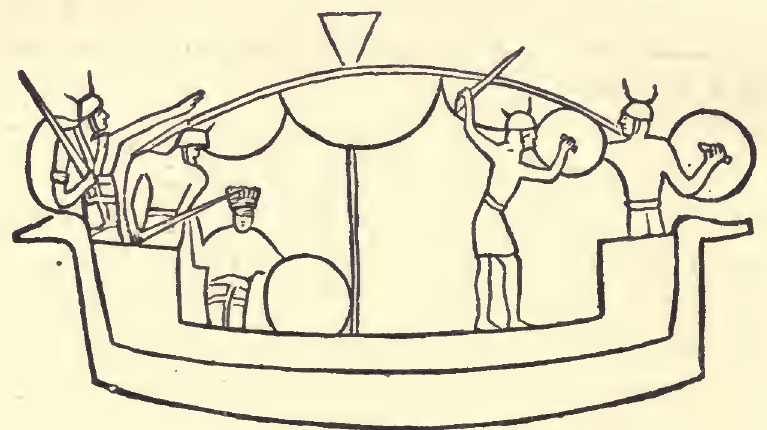
The ships of these pre- homeric sea- kings might be called ἀμφιλέυσσαι; they are lofty in prow and stern, and either extremity is finished off with a curved bird's beak, which rises high out of the water. The vessels of the Egyptians are low at prow and stern, and have not that raised and fenced half- deck on which the warrior stands in our engraving. This is the place where Odysseus posted himself when he meant to offer battle to Scylla of the rock. (Od. xii. 220, 230):—eis 'upia vnbs Eβaivov npoμns.
If this be the correct explanation of ἀμφιλέυσσαι, it must be remembered that the term would no longer apply to Greek vessels of the sixth century, as represented in the vases of that period. The prow was by that time constructed for ramming purposes, for which the high birds' beaks of the early Mediterranean vessels were not at all adapted. An example of the Homeric ship, or something like it, is painted on a very old vase in the Cesnola collection. (Cesnola's Cyprus, pl. xlv.) Like the vessels in the Egyptian reliefs, this galley has its prow and stern recurvatae, built high out of the water and protected by lofty bulwarks. On the whole subject consult M. Chabas, Études sur l'Antiquité Historique, pp. 309- 313 (Paris 1873), from which our sketch is borrowed. We may recognize the vessels of early Mediterranean sea- rovers in the Egyptian reliefs, without committing ourselves to the ethnological theories either of De Rouge or Brugsch. Avon. It seems not improbable that the white races of Libya, the Tahennu, may have been akin by stock and language to the early Greeks. Thus, when the post-Homeric Greeks made the acquaintance of the Libyans, they found their own local names in Africa.
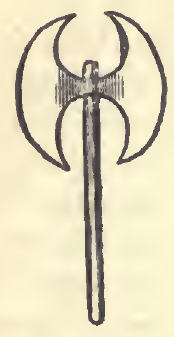
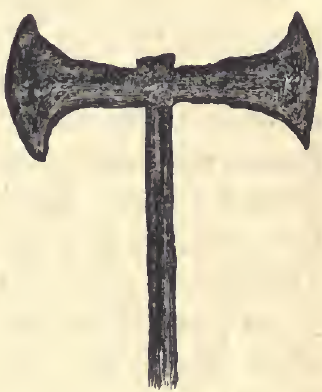
The genitive will then be an ablative genitive, not unoonmon in Homer. (8) That we are not acquainted with any examples of ancient Greek axes like that drawn by Goebel. The double-headed axe which is represented in miniature on some ornaments from the Mycenaean graves (Schliemann's Mycenae und Tiryns, pp. 218, 253, 362) and in a heraldic design on a ring, found near Mycenae, is hammer-headed, as in figure 2. There would be no difficulty in merely shooting over the tops of the handles of axes like these.
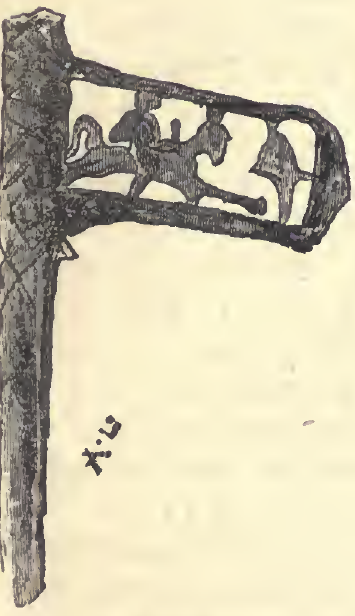
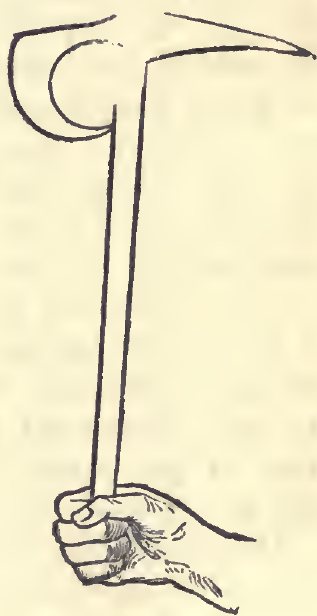
Many commentators have supposed that the axe- heads were stuck in the ground by their edges, without the handles, and that Odysseus shot through the handle- hole. But even if axes, in Homer's time, were attached to the handle by the method familiar to us, and to later Greece, the holes could not have been raised more than a few inches above the earth. Thus an arrow could scarcely have been sent through them, whether by a standing (xix. 575), or by a seated archer (xxi. 420). The difficulty is to find an ancient axe through a hole in the metal of which it was possible to shoot. Probably if we could see the weapon with which Homer was familiar the puzzle would instantly disappear. We engrave (figures 3 and 4) two Egyptian axes (now in the British Museum) merely to show that axes with open- work blades were not unknown in antiquity, that they are not, as Mr. Merry says, 'a pure invention.' If the grotesque figure were removed from within the blade of figure 3, it would be easy to shoot through the opening, and the same would be the case if the openings in figure 4 were enlarged, as they might be in another example. Despite the intercourse between Egypt and pre- historical Greece, it would be the height of rashness to allege that the Achaeans were familiar with axes shaped like these. Probably the axes of Odysseus were like that which we engrave (fig. 5). This weapon is used by an Amazon in a conflict with Heracles on a metope of a temple in Selinus. The probable date is about 500 B.C. It is easy to see how the feat of Odysseus might have been performed with axes of this pattern. For this illustration we are indebted to Mr. A. S. Murray. (Benndorf's Metopen von Selinunt, pl. 7.)
If we would combine this view as to the shape of the axes with the explanation of given above, we must suppose that the comparison with is not intended to be carried out into every detail. The general point of resemblance consists in the arrangement in a straight line, at regular intervals;— \(\iota \sigma \tau \alpha \chi^{\prime} \xi \epsilon \iota \eta \delta \rho \nu \sigma \nu \sigma \nu \delta there is some correspondence suggested between the openings in the axe- blades and the notches in the δρύσχοι; but it would be rash to conclude that the shape of the axe- blades conforms exactly to that of the δρύσχοι.
NoTE 18, PAGE 359; Book xxii. 2.
The House of Odysseus.
It is a most difficult thing to understand the arrangements of the hall of Odysseus in which the woors were slaughtered. Let us leave on one side the questions which do not immediately concern us, and follow the movements of Odysseus himself. In Book xvii. 297, he stands by Argos, the dog, which lies nponapoe oupav, 'before the doors;' either the doors which open from the outer court into the public way, or from the house into the outer court. The swineherd then enters the house, and Odysseus soon follows, humbly enough, i'ce 8' eni meAivov ovdov evrooe oupav, 'he sat down on the ashen threshold within the doors.' There Telemachus spied him, and sent him a mess. My impression is, that he was sitting just within the doors of the hall. Probably he looked, from his lowly seat, all the way up to the high table at the upper end, where Telemachus would sit. Now behind Telemachus, behind the high table, were the doors opening on the passages which led to the women's rooms, and to the oaxAuros, or store- chamber where Telemachus had hidden the weapons. We can easily conceive such doors in the wall behind a high table in the hall of a college. The same arrangement of high table, of women's rooms, and of store- chamber may be seen in the plans of the skali, or chief's hall, in Sir G. W. Dasent's Story of Burnt Njal (vol. i. p. c.). These plans should not be neglected by students interested in the architecture of the Homeric age, as the correspondence between the skali and the heroic house is singularly close. Whether in the house of Odysseus a passage ran outside the wall of the hall to the store- chambers, so that a man might go thither from the chief door, without walking through the hall, is not quite certain.
We left Odysseus just within his own door, on the ashen threshold. There he did not remain. On the morning of the day when the wooers were slain, Telemachus purposely (kepoea vavav, xx. 257) called him to another place. Telemachus would sit at the high table, at the upper end of the room. He would face the entrance, and just behind him would be the doors leading to the women's chambers. Here he placed Odysseus, evros evotaeos yeyapov, napd 7divov ovdov, and there Odysseus remained, and thence he shot the wooers. But was this Aavos ovos really at the upper end of the room, where the dais of a college hall is raised? Many things may be taken to point the other way. Let it be observed, however, that λάνος οὐδός was, not improbably, a pretty high dais, faced with stone, above the level of the hall, and on a level with the doors leading to the women's rooms. That it was near the women's rooms, not at the other extremity of the hall, may perhaps be inferred from xxi. 234:—ἀλλὰ σύ, δέΈὔμαιε, φέρον ἀνὰ δώματα τόξον ἐν χείρεσον ἐμοὶ θέμεναι, εἶπεῖν τε γυναιξὶν κληίσαι μεγάροιο θύρας, that is, Odysseus tells Eumaeus to bring the bow to him up to his end of the hall, by the threshold of stone, and then to tell the women (who are close by, inside the door) to make their doors fast. Again, (xxi. 380,) when Odysseus gets the bow, Eumaeus calls Eurycleia out, and bids her shut the door, and to take no heed if she hears a noise of groaning in the halls. Now to tell Eurycleia as much as this, he must have been near her quarters; he could not have shouted from the further end of the hall. The strongest proof, however, that the stone threshold was between the inner chamber and the hall is to be found in xxiii. 88. Penelope comes into the hall, from the inner chambers, ἡ δ' ἐπεὶ εἰσῆλθεν καὶ ὑπέρβη λάινον οὐδόν.
The λάινος οὐδός is also known as that which Agamemnon crossed, when he inquired of the oracle at Pytho, or Delphi; and again, is spoken of in the Iliad as having behind it the countless treasures of Delphi. In both places it may mean the threshold between the nave of the God's house, or hall, and the θαλάμος, or inner chamber of the Pythoness, where she prophesied, and where the treasures were kept, just as in a man's house the women and treasues lay behind the hall. It is certain, at all events, that Odysseus shot from near the stone threshold. His settle was placed near it (xx. 258), from this settle he shot through the iron, and then (xxii. 2), ἀπὸ δ' ἐπὶ μέγαν οὐδόν, 'he leaped on to the great threshold,' and began to slay the wooers. I conceive that the height of the threshold made it a place of strength, and that he had the command of the armoury where the weapons lay, because the door of it was close behind him. Plainly the wooers had not the command of the door giving on the passage to the store chamber or armoury, otherwise they would not have sent Melanthius through the clerestory openings. Now we are never told that this door had been fastened by Eurycleia from within, as the doors leading to the women's chambers had been. Odysseus then showered his arrows from above the high table towards the entrance of the hall. If this is a mistaken view, there must have been more than one 'threshold of stone,' and Telemachus must have reached the armoury by means of a passage running the whole length of the house, from the outer door. In Book xxii. line 76 certainly reads as if Odysseus were guarding the outer door. If he really stood above the high table, then in line 123, ἀκρότατον δὲ παρ' οὖδον, οὖδός (unless, as in the text, we take it to be the threshold of the δροσούρην itself) would be the broad raised place where I have supposed Odysseus to stand. At the edge of it, next the wall, was a postern, guarded by the swineherd, who would indeed have been an 'unenviable swineherd,' as Mr. Buckley calls him, if he had been obliged to guard the postern as it is placed in some plans, that is, at the upper end of the hall among the enemies, while Odysseus is supposed to be at the lower end. There was a shut door behind Odysseus, for (xxii. 258, 275) the spears thrown at him struck it. On the whole, the balance seems somewhat to lean to the theory that Odysseus shot from the οὖδός above the high table, with his back to the store-chamber (with which he could communicate) and to the women's rooms (of which the door was locked), and with his face to the entrance of the hall. On the other hand, the speech of Melanthius (xxii. 136) ἀγχι γὰρ αἰνὶς αὐλῆς καλὰ θύρετρα, is unintelligible on this theory.
The theory of Mr. Watkiss Lloyd (Architect Aug. 4 and 11, 1877) is the same as mine up to the moment when Odysseus ἀλτο ἐπὶ μέγαν οὖδον, where Mr. Watkiss Lloyd supposes that the hero has traversed the whole length of the hall. But it is not in the Homeric manner to leave this important movement unmentioned. as the horses and hounds of Patroclus, and the captive Trojan youths. This last act seems to have been reprobated by the general feeling of Homeric Greece. When the flame had consumed the corpse, the ashes were stored in a golden vase, and that was deposited in a receptacle dug in the floor of the barrow. Last a rounded barrow of stones and earth was built above the dust of the dead, and finally 'a pillar was dragged up thereupon.' (Od. xii. 14.) The στήλη is particularly mentioned in Iliad xvii. 434, 'as a pillar firmly abides that is set on the barrow of woman or man,' and again (Iliad xvi. 457, 675) it is called 'the due of the dead.' These facts suggest two conclusions. First, the famous tombs of the Mycenaean acropolis cannot be of the Homeric age, for they do not conform to Homer's repeated descriptions. Secondly, no antiquarian discovery could be more valuable than that of a real Homeric στήλη. It is most probable that they were not plain stones, but that, as in later Greece, they were engraved with some hieratic and conventional design. The earliest known Greek stelae (leaving those of Mycenae out of the question) were excavated at Sparta. On these are represented two crowned figures, male and female, seated on the same throne, and approached by the much smaller figure of the dead, who bears in his hands a cock, the victim commonly sacrificed after a death by all races from Siberia to Ceylon,—the cock that Socrates 'owed to Asclepius.' The seated figures are doubtless intended for Hades and Persephone. Interesting as these stelae are, they cannot, from the character of the art, be much earlier than the sixth century. If the Mycenaean graves are pre-Homeric, we may suppose that the rude design on the stela, the king fighting from his chariot, is a faint memory of Egyptian art. The discovery of a genuine Homeric tumulus will clear up many archaeological problems. The absence of writing on an ancient memorial pillar would be far from proving that writing was unknown. Uninscribed monoliths have been raised in memory of great events by Scotch Highlanders in the present century. On the subject of the stelae, see Mittelungen der deutschen Archäologischen Institutes in Athen, vol. ii, pp. 20-24.