Turn Scanned PDF Into EPUB

Take a scanned PDF and turn it into EPUB with OCR, desktop review, and a workflow aimed at producing something readable afterward.

Drop a PDF or EPUB here

Upload one document, then choose the result you want to create.

PDF or EPUB · one file at a time

A book on paper. Ready for any screen.

Select, search and resize the text in your scans, with illustrations and equations kept in place. Leave constant zooming and sideways scrolling behind, and read comfortably on your phone or e-reader.

Scanned page · English
On floating bodies · p. 274
Converted · European Spanish

Las obras de Arquímedes

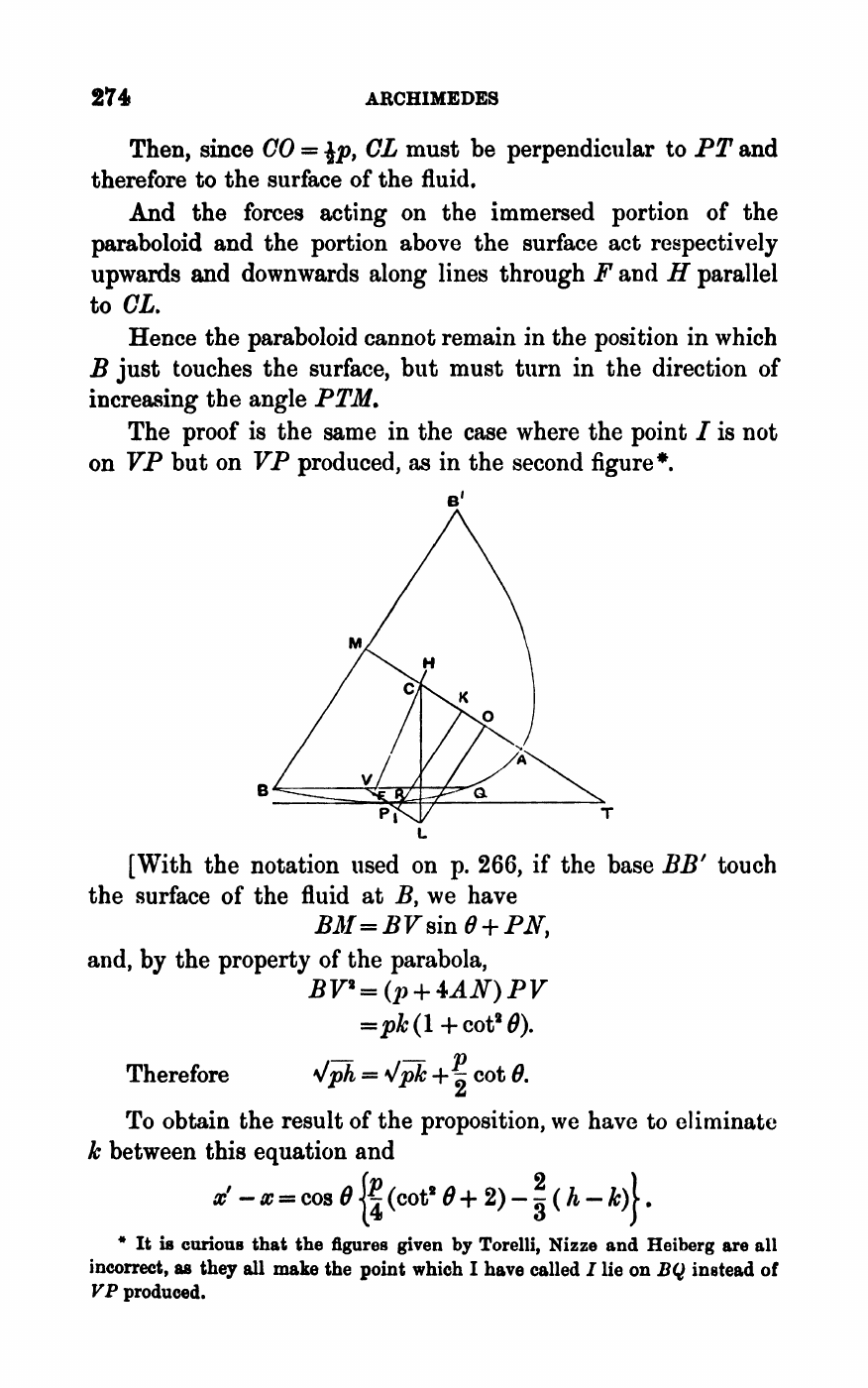
Entonces, puesto que CO = ½p, CL debe ser perpendicular a PT y, por tanto, a la superficie del fluido.

Y las fuerzas que actúan sobre la parte sumergida del paraboloide y sobre la parte situada por encima de la superficie actúan, respectivamente, hacia arriba y hacia abajo, a lo largo de rectas que pasan por F y H y son paralelas a CL.

Por tanto, el paraboloide no puede permanecer en la posición en que B apenas toca la superficie, sino que debe girar en el sentido de aumentar el ángulo PTM.

La demostración es la misma cuando el punto I no está en VP, sino en su prolongación, como en la segunda figura*.
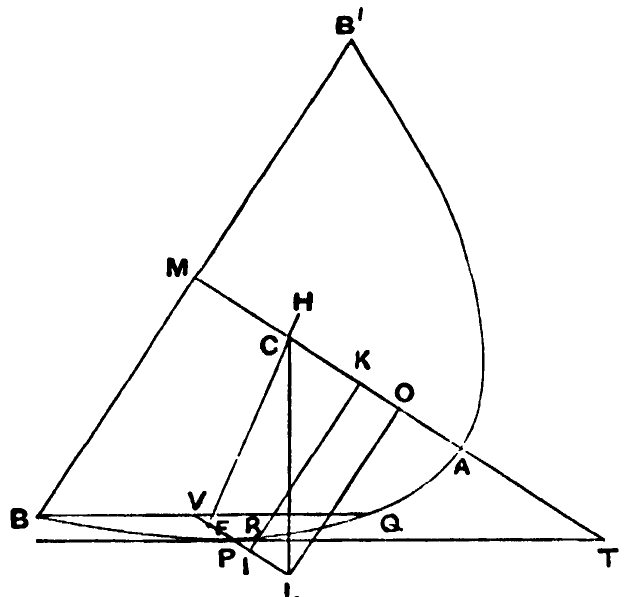
Diagrama geométrico del original

[Con la notación de la p. 266, si la base BB′ toca la superficie del fluido en B, tenemos

BM=BVsinθ+PN

y, por la propiedad de la parábola,

BV2=(p+4AN)PV=pk(1+cot2θ)

Por tanto

ph=pk+p2cotθ

Para obtener el resultado de la proposición, debemos eliminar k entre esta ecuación y

x′−x=cosθ{p4(cot2θ+2)−23(h−k)}.

* Es curioso que las figuras de Torelli, Nizze y Heiberg sean todas incorrectas, pues sitúan el punto que he llamado I en BQ en vez de en la prolongación de VP.

274
  • Text recognition
  • Illustrations & equations
  • Adjustable text
  • Reflowable pages

Turn scanned pages into an ebook with adjustable text that flows to fit your screen. Keep the words, illustrations and equations together, and enjoy old books on your phone or e-reader.

Desktop + iOS client

Download the desktop app to turn a scanned PDF into something you can read

The desktop app gives you room to inspect OCR output, review the converted EPUB on a larger screen, and keep the source file local while you work. That helps when your real question is not whether conversion can happen, but whether the result becomes useful.

EPUB PDF ZIP M4B
See client apps

Built for turning scanned PDFs into readable EPUB files

This phrasing leans toward outcome rather than pure tool comparison. The user usually wants a scanned file to become something they can meaningfully keep reading.

  1. Best for outcome-focused scanned PDF tasks

    Useful when your real concern is whether the scanned PDF can become an EPUB worth reading, not just whether a converter exists.

  2. The output should feel usable, not merely converted

    A strong outcome is a file that reads more naturally and is easier to keep using than the original scanned PDF.

  3. Desktop inspection helps confirm the outcome

    Users often still need to verify recognition quality and reading flow before deciding the EPUB is good enough.

  4. Focused on the reading outcome

    It stays centered on OCR review, EPUB readability, and whether the converted file is good enough to keep using.