When translating a foreign-language ebook, you often face a choice: should you generate a target-only edition, or a bilingual edition that keeps the original text?
Choosing target-only leaves you wondering how you will check the source text when encountering rare or unfamiliar terms. Choosing bilingual makes you wonder whether the extra text will lead to too many page turns. These two output modes differ significantly in layout and reading rhythm. Understanding how each structures paragraphs before you submit your file will help you pick the best setup for your book.
Paragraph Layout and Reading Differences Between the Two Modes
Each mode organizes page content in a distinct way:
Target-Only: Continuous Single-Language Reading
In target-only mode, the output replaces each source paragraph with its translation:
Translated paragraph 1
Translated paragraph 2
Translated paragraph 3
Reading experience: The page unfolds in a single language, letting you follow the narrative without interruption. For novels, memoirs, popular essays, or any reading where you simply want to absorb the storyline at a natural pace, this mode keeps your momentum going. You can always keep the original EPUB handy in a separate file if you ever need to inspect an occasional sentence.
Bilingual Mode: Original Paragraph Followed by Translation
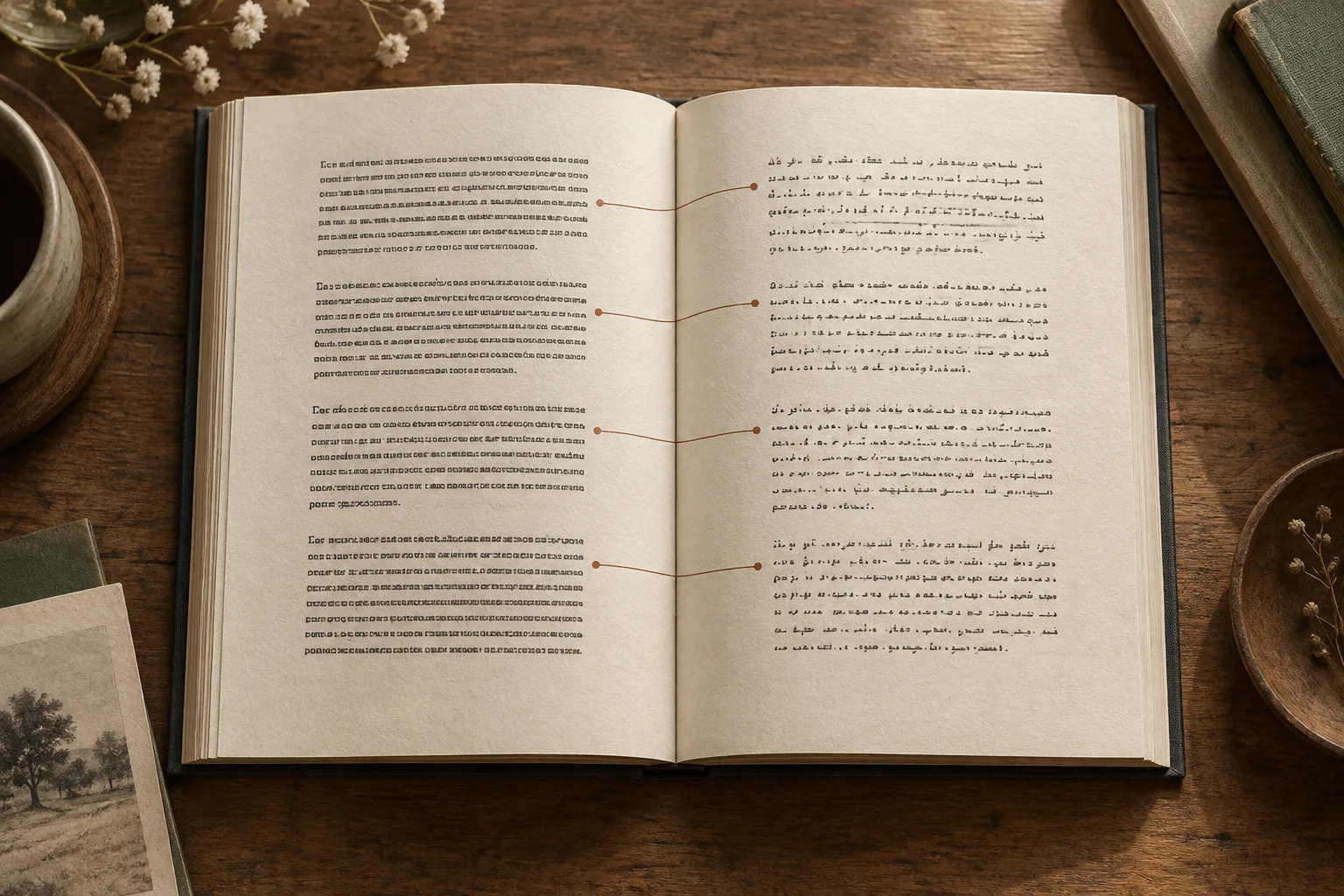
In bilingual mode, the system preserves the source text and inserts the corresponding translation directly after each original paragraph. The bilingual output stacks paragraphs sequentially rather than placing them in side-by-side columns:
Original paragraph 1
Translated paragraph 1
Original paragraph 2
Translated paragraph 2
Reading experience: Because the file retains both languages, there is more text to scroll through. Instead of reading straight ahead, your eyes naturally shift back and forth between the two languages. When you encounter specialized terminology, dense conceptual phrasing, or deliberate wordplay, the original wording sits right there above the translation—no switching back and forth between separate files.
If the source paragraphs are lengthy, a single source paragraph plus its translation might span across page turns, meaning you might not see both completely on a single screen. Shifting between languages during long reading stretches also takes some getting used to. If you are still deciding which approach fits your personal habits, check out Bilingual EPUB or Pure Translation.
Upload Settings and Writing Translation Instructions
Here is the workflow in the EPUB Translator:
- Upload your local EPUB file, making sure it opens normally in standard e-readers.
- Select your target language (for example, English or Chinese).
- In the output options, select either Target-only or Bilingual.
- Add custom translation instructions if needed, confirm your settings, check Rates to estimate usage, and start the task.
Concrete Examples of Translation Instructions
Translation instructions let you communicate your stylistic preferences to the translation model. Being specific about terminology and desired tone works far better than vague requests like "translate accurately and naturally." Common examples include:
- Proper nouns and character names:
Keep character names in their original English form without transliteration; use conventional target-language renderings for geographic names. - Technical domain terminology:
This is a book on low-level computer systems. When specialized terms (such as Thread Pool or Deadlock) first appear, include the original English term in parentheses; use standard domain translations thereafter. - Tone and register preferences:
This is an accessible social science essay. Maintain a plain, fluent tone and avoid overly formal or archaic idioms.
For more prompt combinations and ideas, take a look at our guide on book translation instructions.
File Organization and What to Do If You Pick the Wrong Mode
After your task finishes, you can store the original and translated files in the same folder. It helps to add clear suffixes upon downloading: for instance, name the original title-original.epub, the target-only edition title-en.epub, and the bilingual edition title-bilingual.epub. When syncing across multiple devices, distinct file names prevent opening the wrong edition from your library.
When opening the file, do not just verify that chapter one has the expected structure (single-language flow or alternating bilingual paragraphs). Jump ahead to a longer chapter later in the book to check that footnote links in extended paragraphs are intact, and click two or three subheadings in the table of contents to verify they navigate to the right sections.
What If You Selected the Wrong Mode?
If you open the finished file only to realize you created a target-only file for a monograph you needed to study closely, or generated a bilingual file for a novel you just wanted to read casually, you will need to reselect the desired mode and submit a new task.
A new task incurs fresh processing charges. Double-checking your output mode and target language before submitting saves you the hassle of running the book twice. If you run into issues where a book will not open or styles render improperly, consult troubleshooting translated EPUBs for format diagnostics.